Working in any field of public policy is a bit like living in a haunted house: You spend most of your day dodging bogeymen, ghosts, phantasms, phantoms and specters of imagined harms, frauds, invasions and various conspiracies supposedly perpetrated by evil companies against helpless consumers, justice, God, Gaia, small woodland creatures and every sort of underserved, disadvantaged and/or underprivileged group of man, animal, vegetable and mineral imaginable.
But Internet policy—particularly online privacy—tends to be haunted by such groundless imaginings far more than most other areas of policy, largely because it manifests itself in ways that are far more real and immediate to ordinary users. For example, as outraged as any of us might feel about the Gulf oil spill, how many of us have the slightest clue what’s really involved (beyond what we’ve learned watching TV anchors stumble through a vocabulary they don’t understand)?
By contrast, huge numbers of Americans have daily interaction with web services like those provided by Google, Microsoft, Yahoo, Twitter and Facebook. That doesn’t mean we necessarily
understand how these technologies work. Indeed, quite the contrary! As Arthur C. Clark said, “Any sufficiently advanced technology is indistinguishable from magic.” But we often think we know how these technological marvels work, and certainly sound much more informed when we spout off (pun intended) about these things than, say, “top kills” on the bottom of the ocean floor. In short, we know just enough web services to be dangerous when we ground strong policy positions in our unsophisticated understanding of how things really work online.
There are few better examples of this than the constantly repeated bugaboo that “Facebook sells your data to advertisers!” Or “Facebook only wants you to share more information with more people for advertising purposes!” These myths bear no relation to how advertising on social networking sites actually works, as Facebook CEO Sheryl Sandberg explains beautifully in a short tutorial video. Here’s the key portion: Continue reading →
So, I’m sitting here at today’s Federal Trade Commission (FTC) workshop, “Will Journalism Survive the Internet Age?” and several panelists have argued that private “professional” media is toast, not just because of the rise of the Net and digital media, but also because the inherent cross-subsidy that advertising has traditionally provided is drying up. It very well could be the case that both statements are true and that private media operators are in some trouble because of it. But what nobody seems to be acknowledging is that our government is currently on the regulatory warpath against advertising and that this could have profound impact on the outcome of this debate.
As Berin Szoka and I noted in a recent paper, “The Hidden Benefactor: How Advertising Informs, Educates & Benefits Consumers,” the FTC, the FCC, the FDA, and Congress are all considering, or already imposing, a host of new rules that will seriously affect advertising markets. This article in
AdAge today confirms this:
The advertising industry is heading for a “tsunami” of regulation and is at a “tipping point” of greatly increased scrutiny, warned a panel on social media and privacy at the American Advertising Federation conference here [in Orlando].
The reason this is so important for the ongoing debate about the future of media and journalism is because, as Berin and I argued in our paper: Continue reading →
Yesterday, the Federal Trade Commission (FTC) hosted an all-day workshop on “Protecting Kids’ Privacy Online,” which looked into the Children’s Online Privacy Protection Act of 1998 (COPPA) and challenges posed to its enforcement by new technological developments. The FTC staff did a nice job bringing together and moderating 5 panels worth of participants, all of whom had plenty of interesting things to say about the future of COPPA. But I was more struck by what was not said yesterday. Namely, there was:
- ZERO explanation of the supposed harms of advertising, marketing, and data collection. Advertising-bashing is an old sport here in Washington, so I guess I should not have been surprised to hear several panelists yesterday engaging in teeth-gnashing and hand-wringing about advertising, marketing, and the data collection methods that make it possible. But this grousing just went on and on without any explanation by the critics of the supposed harms that would result from it.
- ZERO appreciation of the benefits of advertising, marketing, and data collection. Not once yesterday — NOT ONCE — did anyone pause to ask what it is that makes all these wonderful online sites, services and content free (or dirt cheap) to consumers. Everyone at this show was guilty of the “manna fallacy” (that all this stuff just falls magically to Earth from the Net Gods above). Well, back here in the real world, something has to pay for all those goodies, and that something is advertising and marketing, which are facilitated by data collection! Or would you like to pay $19.95 a month for each of those currently free sites and services? Yeah, I didn’t think so.
Continue reading →
By Adam Thierer & Berin Szoka
Opt-in mandates may soon be coming to an Internet near you! Rick Boucher, House Energy & Commerce Committee Chairman, is expected to soon introduce the privacy bill he’s been working on behind closed doors for many months. At the heart of the bill is supposed to be a mandate that websites and services obtain opt-in consent prior to collecting information with users—at least if they plan on sharing that information with any third party or doing with it beyond what a narrow safe harbor would allow.
Boucher is apparently trying to strike the right balance between “protecting privacy” and the benefits to users of advertising and data collection. But there may be significant costs to an opt-in regime that are little appreciated by privacy advocates, who tend to think of opt-out as meaningless and opt-in as the ideal of user empowerment. In their new paper “
Opt-in Dystopias,” Google’s Senior Policy Counsel Nicklas Lundblad and Policy Manager Betsy Masiello provide a sophisticated analysis of the dark side of opt-in. They argue that “mandatory opt-in applied across contexts of information collection is poised to have several unintended consequences on social welfare and individual privacy,” specifically:
• Dual cost structure: Opt-in is necessarily a partially informed decision because users lack experience with the service and value it provides until after optingin. Potential costs of the opt-in decision loom larger than potential benefits,
whereas potential benefits of the opt-out decision loom larger than potential costs.
•
Excessive scope: Under an opt-in regime, the provider has an incentive to exaggerate the scope of what he asks for, while under the opt-out regime the provider has an incentive to allow for feature-by-feature opt-out.
•
Desensitisation: If everyone requires opt-in to use services, users will be desensitised to the choice, resulting in automatic opt-in.
•
Balkanisation: The increase in switching costs presented by opt-in decisions is likely to lead to proliferation of walled gardens.
Lundblad and Masiello discuss each of those concerns in great detail, so read the paper for further elaboration. They do a particularly good good walking the reader through the complexity of even defining what we mean by “opt-in,” which is far trickier than most people imagine.
Continue reading →
 As the Wall Street Journal is already reporting, today eBay sustained an important win in its long-running dispute with Tiffany over counterfeit goods sold through its marketplace. (The full opinion is available here.)
I wrote about this case as my leading example of the legal problems that appear at the border between physical life and digital life, both in “
The Laws of Disruption” and a 2008 article for CIO Insight.
To avoid burying the lede, here’s the key point: for an online marketplace to operate, the burden has to be on manufacturers to police their brands, not the market operator. Any other decision, regardless of what the law says or does not say, would effectively mean the end of eBay and sites like it.
Continue reading →
That’s basically what FTC Chairman Jon Leibowitz told the Association of National Advertisers when he spoke to their “Advertising Law & Public Policy” conference last Thursday. As I noted last week, there’s intense pressure in Congress to pass a financial regulatory overhaul and, unfortunately, the version passed by the House in December—Rep. Barney Frank’s “Wall Street Reform and Consumer Protection Act of 2009” (H.R. 4173)—would also grant the Federal Trade Commission vast new powers for all its regulations, not just those relating to the non-bank financial institutions it currently regulates. In particular, HR 4173 would:
- Make it far easier (and not just faster) for the FTC to issue all kinds of new regulations on its own, without a specific Congressional mandate to do so and instead of relying on case-by-case enforcement to punish “unfair” or “deceptive” acts and practices;
- Reduce public input into those regulations;
- Impose heavy civil penalties on companies before notifying them that a practice might be “unfair” or “deceptive”;
- Prosecute those who merely provided “substantial assistance” to someone engaged in “unfair” or “deceptive” acts or practices; and
- Sue on its own authority, instead of through DOJ (as now).
I summarized my concerns about this bill in this short interview with PFF’s new communications director, Mike Wendy, last week:
[display_podcast]
Leibowitz has lobbied hard to have his agency put on steroids (as former FTC Chairman Jim Miller put it), asking for all these things, as well as more funding, at the first Senate hearing on Hr 4173 back in February. (Conveniently, he was the only witness!) He repeated his calls for these powers on Thursday but tried to allay fears about how they’d be used. Continue reading →
 He climbed cathedral mountains, he saw silver clouds below
He saw everything as far as you can see
And they say that he got crazy once and he tried to touch the sun
And he lost a friend but kept his memory
-John Denver,
Rocky Mountain High
He climbed cathedral mountains, he saw silver clouds below
He saw everything as far as you can see
And they say that he got crazy once and he tried to touch the sun
And he lost a friend but kept his memory
-John Denver,
Rocky Mountain High
We know that states are increasingly looking to tax anything and everything, including on the Internet. As Declan McCullagh reported earlier this week, Colorado and “fifteen other states have considered or are considering enacting laws targeting Amazon and other e-commerce companies that typically do not charge sales tax for shipments sent outside their home state.” These nexus taxes are #2 on the NetChoice iAWFUL list of bad legislation.
But Colorado’s recent “track and tax” law marks the most privacy-egregious Internet-related tax law we’ve seen.
Here’s the rub: The Colorado state tax department will now have a listing of all purchases its citizens make from out-of-state companies. Why? So it can enforce its tax on purchases by way of the use tax that each of us owes to our government when sales tax isn’t collected.
HB 1193 was enacted last month as part of a package of revenue raising legislation. It originally started as an advertising nexus bill, but turned into a reporting bill when a lot of in-state companies that rely on affiliate advertising revenue complained that they would be harmed. Now it is consumer privacy that is harmed.
HB 1193 forces out-of-state retailers to track and report the purchases of Coloradans: Continue reading →
By Berin Szoka & Adam Thierer
This morning, The Progress & Freedom Foundation (PFF) and the Electronic Frontier Foundation (EFF) filed joint comments with the Federal Communications Commission (FCC) in the inquiry “Empowering Parents and Protecting Children in an Evolving Media Landscape.” (MB Docket No. 09-194) As Adam summarized here before, the stated purpose of this FCC Notice of Inquiry is to:
seek information on the extent to which children are using electronic media today, the benefits and risks these technologies bring for children, and the ways in which parents, teachers, and children can help reap the benefits while minimizing the risks [and] to gather data and recommendations from experts, industry, and parents that will enable us to identify actions that all stakeholders can take to enable parents and children to navigate this promising electronic media landscape safely and successfully.
In our joint comments with Lee Tien and Seth David Schoen of EFF, we warned that the FCC should tread carefully when considering taking action on areas described in their inquiry. The agency simply has no authority to act on many of the topics discussed throughout the NOI, and it should not attempt to preempt successful private sector solutions. Congress never authorized the Commission to regulate Internet media, nor asked the agency to consider doing so. In fact, Congress plainly declared that the Internet should be kept “unfettered by Federal or State regulation.” Continue reading →
By Adam Thierer & Berin Szoka
Progress & Freedom Foundation Progress Snapshot No. 6.5, Feb 2010 [.pdf]
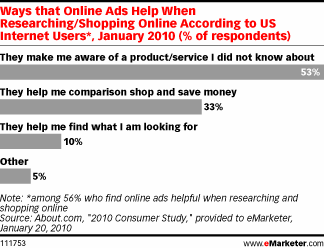 Advertising is increasingly under attack in Washington. In fact, we’re busy finishing up a paper with the working title: “The New Assault on Advertising: What it Means for the Future of Media & Culture.” Among other things, the paper inventories the many ways in which policymakers in Washington and elsewhere are stepping up regulation of commercial advertising and marketing efforts-and highlights the common themes that unite them. Unfortunately, the report is already over 50 pages long and we keep finding new threats to discuss!
This regulatory tsunami could not come at a worse time, of course, since an attack on advertising is tantamount to an attack on media itself, and media is at a critical point of technological change. As we have pointed out repeatedly, the vast majority of media and content in this country is supported by commercial advertising in one way or another-particularly in the era of “free” content and services.[1]
An Attack on Advertising Will Hurt Consumers
But there’s a more important reason to fear Washington’s new war on advertising:
It will hurt consumer welfare. That’s because advertising provides important information and signals to consumers about goods and services that are competing for their attention and business—and that scarcest of all things in the modern world, consumers’ attention. Continue reading →
by Adam Thierer & Berin Szoka, Progress Snaphot 6.1
Stephanie Clifford of the
New York Times posted a very interesting article this week summarizing a recent “on-the-record chat” the Times staff had with Federal Trade Commission (FTC) chairman Jon Leibowitz and FTC Bureau of Consumer Protection chief David Vladeck. The interview [discussed by Braden here] is profoundly important in that it reveals an alarming disconnect regarding the relationship between “privacy” regulation and the future of media, which were the subjects of their discussion with Times staff. Namely, Leibowitz and Vladeck apparently fail to appreciate how the delicate balance between commercial advertising and journalism is at risk precisely because of the sort of regulations they apparently are ready to adopt. Because the value of online advertising depends on data about its effectiveness and consumers’ likely interests, and because advertising is indispensable to funding media, what’s ultimately at stake here is nothing short of the future of press freedom.
The “Day of Reckoning” Is Upon Us
Leibowitz and Vladeck spend the first half of
The Times interview wringing their hands about “privacy policies,” the declarations made by websites and advertising networks about their data collection and use practices (for which the FTC can and must hold them accountable). But the two feel that privacy policies don’t adequately inform consumers. Chairman Leibowitz claims that online companies “haven’t given consumers effective notice, so they can make effective choices.” And Mr. Vladeck states that advise-and-consent models “depended on the fiction that people were meaningfully giving consent.” But he and the FTC seem ready to abandon the notice and choice model because the “literature is clear” that few people read privacy policies, Vladeck told the Times. He and Leibowitz continue:
“Philosophically, we wonder if we’re moving to a post-disclosure era and what that would look like,” Mr. Vladeck said. “What’s the substitute for it?” He said the commission was still looking into the issue, but it hoped to have an answer by June or July, when it plans to publish a report on the subject. Mr. Leibowitz gave a hint as to what might be included: “I have a sense, and it’s still amorphous, that we might head toward opt-in,” Mr. Leibowitz said.
This clearly foreshadows the regulatory endgame we have long suspected was coming. When the FTC released its “Self-Regulatory Principles for Online Behavioral Advertising” eleven months ago, we asked: “What’s the Harm & Where Are We Heading?” Their answers to both questions have become clearer with each new calculated comment—all apparently intended to slowly “turn up the heat” on the advertising industry so that the proverbial frog will stay in the pot until the water finally boils. Leibowitz’s FTC has simply dodged the “harm” question with a four-part strategy: Continue reading →

 The Technology Liberation Front is the tech policy blog dedicated to keeping politicians' hands off the 'net and everything else related to technology.
PFF & EFF File Joint Comments in FCC’s “Empowering Parents & Protecting Children” NOI
by Adam Thierer on February 24, 2010 · 3 comments
By Berin Szoka & Adam Thierer
This morning, The Progress & Freedom Foundation (PFF) and the Electronic Frontier Foundation (EFF) filed joint comments with the Federal Communications Commission (FCC) in the inquiry “Empowering Parents and Protecting Children in an Evolving Media Landscape.” (MB Docket No. 09-194) As Adam summarized here before, the stated purpose of this FCC Notice of Inquiry is to:
In our joint comments with Lee Tien and Seth David Schoen of EFF, we warned that the FCC should tread carefully when considering taking action on areas described in their inquiry. The agency simply has no authority to act on many of the topics discussed throughout the NOI, and it should not attempt to preempt successful private sector solutions. Congress never authorized the Commission to regulate Internet media, nor asked the agency to consider doing so. In fact, Congress plainly declared that the Internet should be kept “unfettered by Federal or State regulation.” Continue reading →