I thought Todd Zywicki, a senior scholar with the Mercatus Center at George Mason University, did a nice job on Judge Napolitano’s “Freedom Watch” show addressing the contentious question of whether government should be regulating food advertising in order to somehow make American kids healthier. Todd pointed out how the advertising guidelines currently being developed are anything but “voluntary” and noted that there are many causes of childhood obesity. Watch the clip here:
For CNET today, I have a long analysis and commentary on the “Stop Online Piracy Act,” introduced last week in the House. The bill is advertised as the House’s version of the Senate’s Protect-IP Act, which was voted out of Committee in May.
It’s very hard to find much positive to say about the House version. While there’s considerable evidence its drafters heard the criticisms of engineers, legal academics, entrepreneurs and venture capitalists, their response was unfortunate.
Engineers pointed out, for example, that court orders requiring individual ISPs to remove or redirect domain name requests was a futile and dangerous way to block access to “rogue” websites. Truly rogue sites can easily relocate to another domain, or simply have users access them with their IP address and bypass DNS altogether. Continue reading →
For CNET this morning, I offer five crucial corrections to the Protect IP Act, which was passed out of committee in the Senate back in May.
Yesterday, Rep. Bob Goodlatte, co-chair of the Congressional Internet Caucus, told a Silicon Valley audience that the House was working on its own version and would introduce it in the next few weeks.
Protect IP would extend efforts to combat copyright infringement and trademark abuse online, especially by websites registered outside the U.S.
Since Goodlatte promised the new bill would be “quite different” from the Senate version, I thought it a good time to get out my red pen and start crossing off the worst mistakes in policy and in drafting in Protect IP.
The full details are in the article, but in brief, here’s what I hope the House does in its version:
Drop provisions that tamper with the DNS system in an effort to block U.S. access to banned sites.
Drop provisions that tamper with search engines, indices, and any other linkage to banned sites.
Remove a private right of action that would allow copyright and trademark holders to obtain court orders banning ad networks and financial transaction processors from doing business with banned sites.
Scale back current enforcement abuses by the Department of Homeland Security under the existing PRO-IP Act of 2008.
Focus the vague and overinclusive definition of the kind of websites that can be banned, limiting it to truly criminal enterprises.
On Forbes this morning, I have a long meditation on what Protect IP says about the current state of the Internet content wars. Copyright, patent, and trademark are under siege from digital technology, and for now at least are clearly losing the arms race.
The new bill isn’t exactly the nuclear option in the fight between the media industries and everyone else, but it does signal increased desperation. Continue reading →
I’ve written a long article this morning for CNET (See “Privacy panic debate: Whose data is it?”) on the discovery of the iPhone location tracking file and the utterly predictable panic response that followed. Its life-cycle follows precisely the crisis model Adam Thierer has so frequently and eloquently traced, most recently here on TLF.
In particular, the CNET article takes a close and serious look at Richard Thaler’s column in Saturday’s New York Times, “Show us the data. (It’s ours, after all.)” Thaler uses the iPhone scare as occassion to propose a regulatory fix to the “problem” of users being unable to access in “computer-friendly form” copies of the information “collected on” them by merchants. Continue reading →
On this week’s John Stossel show on Fox Business Network, I debated Internet privacy, advertising, and data collection issues with Michael Fertik of Reputation.com. In the few minutes we had for the segment, I tried to reiterate a couple of keep points that we’ve hammered repeatedly here in the past:
There’s no free lunch. All the free sites and service we enjoy online today are powered by advertising and data collection. [see this op-ed]
There is no clear harm in most cases, or what some argue is harm also can have many benefits that are rarely discussed. [see this paper.]
There’s little acknowledgement of the trade-offs involved in having government create an information control regime for the Internet. [see this filing and these three essays: 1, 2, 3.]
The ultimate code of “fair information practices” is the First Amendment, which favors free speech, openness, and transparency over secrecy and information control. [see this piece.]
“Hands Off the Net” is a policy that has served us well. There are dangerous ramifications for our economy and long-term Internet freedoms if we continue down the road of “European-izing” privacy law here in the States. [see this essay and this filing.]
At some point, personal responsibility needs to come into the equation. With so many privacy enhancing empowerment tools already on the market, it begs the question: If consumers don’t take steps to use those tools, why should government intervene and take action for them?
Anyway, here’s the 7-min video of the debate between Fertik and me:
The push for online privacy regulation has real momentum, as proposed privacy legislation from numerous lawmakers, a Department of Commerce report proposing a compulsory Do Not Track mechanism to regulate business marketing practices, and the Obama Administration’s proposed “Privacy Bill of Rights” all indicate.
However, Congress should be very wary of such proposals. A politically defined Do Not Track regime risks undermining targeted advertising, impeding business transactions that occur between strangers, and stifling mobile ecosystems that are barely out of the cradle. Rattling consumers needlessly by encouraging them to opt-out of largely beneficial information collection is an especially unwise idea in our uncertain economic climate – especially when major industry participants are developing such mechanisms on their own.
The opportunity to undermine online marketing – wrongly called “surveillance” – appeals to some, but such privacy purists have no right to call the shots for anyone but themselves and those who agree with them. The right to use information acquired through voluntary transactions is no less important than the right to decide whether to disclose information in the first place.
We’ve said it here before too may times to count: When it comes to the future of content and services — especially online or digitally-delivered content and services — there is no free lunch. Something has to pay for all that stuff and increasingly that something is advertising. But not just any type of advertising — targeted advertising is the future. We see that again today with Skype’s announcement that it is rolling out an advertising scheme as well as in this Wall Street Journal story (“TV’s Next Wave: Tuning In to You“) about how cable and satellite TV providers are ramping up their targeted advertising efforts.
No doubt, we’ll soon hear the same old complaints and fears trotted out about these developments. We’ll hear about how “annoying” such ads are or how “creepy” they are. Yet, few will bother detailing what the actual harm is in being delivered more tailored or targeted commercial messages. After all, there’s actually a
benefit to receiving ads that may be of more interest to us. Much traditional advertising was quite “spammy” in that it was sent to the mass market without a care in the world about who might see or hear it. But in a diverse society, it would be optimal if the ads you saw better reflected your actual interests / tastes. And that’s a primary motivation for why so many content and service providers are turning to ad targeting techniques. As Skype noted in its announcement today: “We may use non-personally identifiable demographic data (e.g. location, gender and age) to target ads, which helps ensure that you see relevant ads. For example, if you’re in the US, we don’t want to show you ads for a product that is only available in the UK.” Similarly, the Journal article highlights a variety of approaches that television providers are using to better tailor ads to their viewers.
Some will still claim it’s too “creepy.” But, as I noted in my recent filing to the Federal Trade Commission on its new privacy green paper: Continue reading →
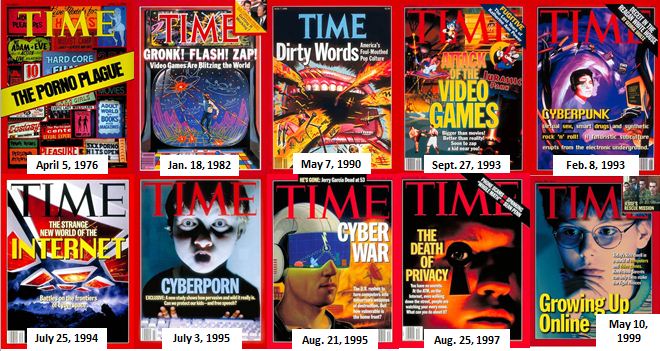
In this essay, I will suggest that (1) while “moral panics” and “techno-panics” are nothingnew, their cycles seem to be accelerating as new communications and information networks and platforms proliferate; (2) new panics often “crowd-out” or displace old ones; and (3) the current scare over online privacy and “tracking” is just the latest episode in this ongoing cycle.
What Counts as a “Techno-Panic”?
First, let’s step back and define our terms. Christopher Ferguson, a professor at Texas A&M’s Department of Behavioral, Applied Sciences and Criminal Justice, offers the following definition: “A moral panic occurs when a segment of society believes that the behavior or moral choices of others within that society poses a significant risk to the society as a whole.” By extension, a “techno-panic” is simply a moral panic that centers around societal fears about a specific contemporary technology (or technological activity) instead of merely the content flowing over that technology or medium. In her brilliant 2008 essay on “The MySpace Moral Panic,” Alice Marwick noted: Continue reading →
Today I filed roughly 30 pages worth of comments with the Federal Trade Commission (FTC) in its proceeding on “Protecting Consumer Privacy in an Era of Rapid Change: a Proposed Framework for Businesses and Policy Makers.” [Other comments filed in the proceeding can be found here.] Down below, I’ve attached the Table of Contents from my filing so you can see the major themes I’ve addressed, and I’ve also attached the entire document in a Scribd reader. In coming days and weeks, I’ll be expanding upon some of these themes in follow-up essays.
In my filing, I argue that while it remains impossible to predict with precision the impact a new privacy regulatory regime will have the Internet economy and digital consumers, regulation
will have consequences; of that much we can be certain. As the FTC and other policy makers move forward with proposals to expand regulation in this regard, it is vital that the surreal “something-for-nothing” quality of current privacy debate cease. Those who criticize data collection or online advertising and call for expanded regulation should be required to provide a strict cost-benefit analysis of the restrictions they would impose upon America’s vibrant digital marketplace.
In particular, it should be clear that the debate over Do Not Track and online advertising regulation is fundamentally tied up with the future of online content, culture, and services. Thus, regulatory advocates must explain how the content and services supported currently by advertising and marketing will be sustained if current online data collection and ad targeting techniques are restricted. Continue reading →
The Technology Liberation Front is the tech policy blog dedicated to keeping politicians' hands off the 'net and everything else related to technology. Learn more about TLF →




 The Technology Liberation Front is the tech policy blog dedicated to keeping politicians' hands off the 'net and everything else related to technology.