Are You An Internet Optimist or Pessimist? The Great Debate over Technology’s Impact on Society

by Adam Thierer on January 31, 2010 · Comments

[I’ve been working on an outline for a book I hope to write surveying technological skepticism throughout history. I first started thinking about this topic two years when I noticed that a great number of recent books about Internet policy could generally be grouped into one of two camps: Internet optimists vs. Internet pessimists. I subsequently penned an essay on the subject that generated a fair bit of attention. So, I figured I must be on to something, and the more Net policy books I read, the more I realized that the divisions between these two camps were growing wider and increasingly heated. Thus, I thought I would share this very rough draft (much of it still in outline form) of the opening chapter of that book I want to write about this great intellectual war over the impact of technology on society. I invite reader input.]

__________

The impact of technological change on culture, learning, and morality has long been the subject of intense debate, and every technological revolution brings out a fresh crop of both pessimists and pollyannas. Indeed, a familiar cycle has repeat itself throughout history whenever new modes of production (from mechanized agriculture to assembly-line production), means of transportation (water, rail, road, or air), energy production processes (steam, electric, nuclear), medical breakthroughs (vaccination, surgery, cloning), or communications techniques (telegraph, telephone, radio, television) have appeared on the scene.

The cycle goes something like this. A new technology appears. Those who fear the sweeping changes brought about by this technology see a sky that is about to fall. These “techno-pessimists” predict the death of the old order (which, ironically, is often a previous generation’s hotly-debated technology that others wanted slowed or stopped).  Embracing this new technology, they fear, will result in the overthrow of traditions, beliefs, values, institutions, business models, and much else they hold sacred.

The pollyannas, by contrast, look out at the unfolding landscape and see mostly rainbows in the air. Theirs is a rose-colored world in which the technological revolution du jour is seen as improving the general lot of mankind and bringing about a better order.  If something has to give, then the old ways be damned! For such “techno-optimists,” progress means some norms and institutions must adapt—perhaps even disappear—for society to continue its march forward.

Our current Information Revolution is no different. It too has its share of techno-pessimists and techno-optimists. Indeed, before most of us had even heard of the Internet, people were already fighting about it—or at least debating what the rise of the Information Age meant for our culture, society, and economy. Continue reading →

Comments Posted in: Digital Policy Reading List, Philosophy & Cyber-Libertarianism

New Economy Business Models (Carr vs. Anderson)

by Adam Thierer on October 31, 2008 · Comments

Somewhere between Nick Carr’s “Typology of Network Strategies” and Chris Anderson’s “Four Kinds of Free” is the secret to understanding our new economy:

Carr’s “Typology of Network Strategies”:

  1. Network effect
  2. Data mining
  3. Digital sharecropping, or “user-generated content”
  4. Complements
  5. Two-sided markets
  6. Economies of scale, economies of scope, and experience

Anderson’s “Four Kinds of Free”:

  1. Direct cross-subsidy (get one thing free, pay for another)
  2. Ad-supported (third-party subsidizes second party)
  3. “Freemium” (a few people subsidize everyone else)
  4. “Gift economy” (people give away things for non-monetary rewards)

Of course, both Carr and Anderson are building on theories and business models previously articulated by many others. A few that come to mind:

Comments Posted in: Technology, Business & Cool Toys, What We're Reading

Book Review: Nick Carr’s Big Switch

by Adam Thierer on October 30, 2008 · Comments

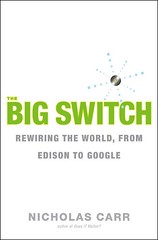
Carr Big Switch book coverI just finished reading through The Economist’s new 14-page special report on cloud computing, “Let It Rise” in which Ludwig Siegele provides an outstanding overview of cloud computing and why it is so important:

The rise of the cloud is more than just another platform shift that gets geeks excited. It will undoubtedly transform the information technology (IT) industry, but it will also profoundly change the way people work and companies operate. It will allow digital technology to penetrate every nook and cranny of the economy and of society, creating some tricky political problems along the way.

Even if you are very familiar with cloud computing, I recommend you take a look at the article. Anyway, while I was reading it, I was unsurprised to come across some comments from Nicholas Carr, whose new book The Big Switch: Rewiring the World, from Edison to Google, is essentially an early history of cloud computing and an investigation into its effects on our economy, culture, and society. And that also reminded me that, even though I have mentioned Carr’s book here several times since it was released earlier this year, I have failed to give it a dedicated review. And it certain deserves one because “The Big Switch” is easily one of the most important technology policy books of 2008.

Continue reading →

Comments Posted in: What We're Reading

Grouping Recent Net Books: Internet Optimists vs. Pessimists

by Adam Thierer on September 6, 2008 · Comments

A number of very interesting books have been released over the past year or two which debate how the Internet is reshaping our culture and the economy. I’ve reviewed a couple of them here but I have been waiting to compile a sort of mega-book review once I found a sensible way to conceptually group them together. I’m not going to have time to cover each of them here in the detail they deserve, but I think I have at least found a sensible way to categorize them. For lack of better descriptors, I’ve divided these books and thinkers into two camps: “Internet optimists” versus “Internet Pessimists.” Here’s a list of some of the individuals and books (or other articles and blogs) that I believe epitomize these two camps of thinking:

Adherents & Their Books / Writings

Internet Optimists

Internet Pessimists

Yochai Benkler, The Wealth of Networks

Andrew Keen, The Cult of the Amateur

Chris Anderson, The Long Tail and “Free!”

Lee Siegel, Against the Machine

Clay Shirky, Here Comes Everybody

Nick Carr, The Big Switch

Cass Sunstein, Infotopia

Cass Sunstein, Republic.com

Don Tapscott, Wikinomics

Todd Gitlin, Media Unlimited

Kevin Kelly & Wired mag in general

Alex Iskold, “The Danger of Free

Mike Masnick & TechDirt blog

Mark Cuban

And here’s a rough sketch of the major beliefs or key themes that separate these two schools of thinking about the impact of the Internet on our culture and economy:

Beliefs / Themes

Internet Optimists

Internet Pessimists

Culture / Social

Net is Participatory

Net is Polarizing

Net yields Personalization

Net yields Fragmentation

a “Global village

Balkanization

Heterogeneity / Diversity of Thought

Homogeneity / Close-mindedness

Net breeds pro-democratic tendencies

Net breeds anti-democratic tendencies

Tool of liberation & empowerment

Tool of frequent misuse & abuse

Economics / Business

Benefits of “free” (“Free” = future of media / business)

Costs of “free” (“Free” = end of media / business)

Increasing importance of “Gift economy

Continuing importance of property rights, profits, firms

“Wiki” model = wisdom of crowds; power of collective intelligence

“Wiki” model = stupidity of crowds; errors of collective intelligence

Mass collaboration

Individual effort

So, what to make of this intellectual war? Who’s got the story right?

Continue reading →

Comments Posted in: Philosophy & Cyber-Libertarianism, What We're Reading