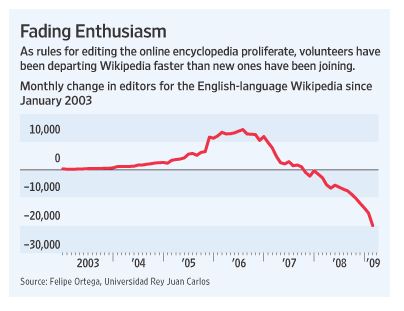
 There was a very interesting front-page article in the Wall Street Journal yesterday by Julia Angwin and Geoffrey Fowler wondering whether Wikipedia, the wildly popular online encyclopedia, was dying because of new posting guidelines which have apparently led to a drop off in the number of volunteers contributing to the site. In their article (“Volunteers Log Off as Wikipedia Ages“), Angwin and Fowler note that:
In the first three months of 2009, the English-language Wikipedia suffered a net loss of more than 49,000 editors, compared to a net loss of 4,900 during the same period a year earlier, according to Spanish researcher Felipe Ortega, who analyzed Wikipedia’s data on the editing histories of its more than three million active contributors in 10 languages. Eight years after Wikipedia began with a goal to provide everyone in the world free access to “the sum of all human knowledge,” the declines in participation have raised questions about the encyclopedia’s ability to continue expanding its breadth and improving its accuracy. Errors and deliberate insertions of false information by vandals have undermined its reliability.
The article suggests that new posting and editing guidelines may have something to do with the drop:
But as it matures, Wikipedia, one of the world’s largest crowdsourcing initiatives, is becoming less freewheeling and more like the organizations it set out to replace. Today, its rules are spelled out across hundreds of Web pages. Increasingly, newcomers who try to edit are informed that they have unwittingly broken a rule — and find their edits deleted, according to a study by researchers at Xerox Corp. “People generally have this idea that the wisdom of crowds is a pixie dust that you sprinkle on a system and magical things happen,” says Aniket Kittur, an assistant professor of human-computer interaction at Carnegie Mellon University who has studied Wikipedia and other large online community projects. “Yet the more people you throw at a problem, the more difficulty you are going to have with coordinating those people. It’s too many cooks in the kitchen.”
Let’s say it’s true that the new guidelines have resulted in fewer people contributing. Is that that automatically a bad thing? I suppose it depends on other variables that are harder to measure. Namely, quality metrics. This is where every discussion about Wikipedia gets sticky. Continue reading →

 The Technology Liberation Front is the tech policy blog dedicated to keeping politicians' hands off the 'net and everything else related to technology.