 The latest edition (Version 4.0) of my PFF special report on “Parental Controls and Online Child Protection: A Survey of Tools & Methods” is now up. For those not familiar with the report, it explores the market for parental control tools, rating schemes, education and media literacy efforts, and various other tools, methods, and initiatives aimed at promoting online child safety. After evaluating that state of this market, I conclude: “There has never been a time in our nation’s history when parents have had more tools and methods at their disposal to help them decide what constitutes acceptable media content in their homes and in the lives of their children.” Moreover, I believe that the parental controls and content management tools cataloged in the report represent a better, less restrictive alternative to government regulation.
Version 4.0 of the report is now over 250 pages long (up from 200 pages in Version 3.0) and it contains almost 70 exhibits (up from 50), 725 references (up from roughly 500), and numerous updates in all five sections of the book. Major updates have been made to the Internet, social networking, and mobile media sections, reflecting the growing importance of those sectors and issues. Other new sections or appendices have also been added to the report, including:
- a new section examining how many households really need parental control tools;
- a new appendix on the downsides of mandatory parental controls and restrictive default settings;
- a new section on the dangers of “deputizing the online middleman” solution as an approach to solving child safety concerns;
- a new appendix reviewing the findings of 5 past online safety task forces;
- … and much more.
I issue major updates once a year and 1 or 2 minor tweaks during the course of the year to reflect the evolution of the parental control and online child safety marketplace and debate. The report is available free-of-charge on the PFF website, and the previous editions of the report are housed there too in case you want to see how it has evolved over the past couple of years. For those interested in taking a quick look at the report, I have embedded it down below the fold as a Scribd file. Finally, as is always the case, I encourage readers to send me updates and suggestions for how to improve the report and I will incorporate them into future versions.
Continue reading →
Just FYI, the latest update of my booklet on “Parental Controls and Online Child Protection: A Survey of Tools & Methods” is now live. The new version, Version 3.1, provides minor updates to all sections of the book and a new appendix of relevant research in the field. I issue major updates early each year and 1 or 2 tweaks during the course of the year to reflect the evolution of the parental control and online child safety market and debate.
For those not familiar with the report, it explores the market for parental control tools, rating schemes, education efforts, and initiatives aimed at promoting online child safety. I believe that the parental controls and content management tools cataloged in the report represent a better, less restrictive alternative to government regulation. As I conclude after evaluating that state of the market: “There has never been a time in our nation’s history when parents have had more tools and methods at their disposal to help them decide what constitutes acceptable media content in their homes and in the lives of their children.”
The report is available free-of-charge on the PFF website, and the previous editions of the report are housed there too in case you want to see how it has evolved over the past two years. For those interested in taking a quick look at the report, I have embedded it down below the fold as a Scribd file. Finally, as is always the case, I encourage readers to send me updates and suggestions for how to improve the report and I will incorporate them into future versions.
Continue reading →
 The Washington Post reports today on a trend that I thought we all knew about, but one I’m glad the mainstream media is finally realizing. It turns out that people who play video games are not just virginal teenage boys with acne problems. No, even 20-something, attractive women play video games.
The
Post’s
Mike Musgrove reports on the mother and daughters of the Burguieres family of Bethesda, Maryland. Of course in good journalist fashion Musgrove uses the Burguiereses to illustrate a larger point, he even points to the relevant stats:
It used to be that this all-woman crew wouldn’t fit the standard image of the video game consumer. But the perception of gamers as being mostly young guys isn’t so true anymore. Women and girls make up 40 percent of the gamer population, according to the Entertainment Software Association.
The most interesting point brought up in the article on this demographic trend—one that most gamers realize has been happening for quite some time—is Musgrove’s observation that women once were not naturally accepted members of the gaming community. It’s a great point, but one that can be extended to tech community in general.
Continue reading →
How much platform competition is too much competition? For example, what is the optimal number of mobile operating systems or video game consoles that will spur competition and innovation in those respective sectors?
It is an interesting business question, but it also has some policy implications since some might propose laws or regulations to remedy a perceived lack of platform competition in various sectors. After all, many people would answer the above question by saying that there is
never such a thing as too much competition. The more platforms the better. But there can be costs associated with too much competition. Let’s consider those two case studies mentioned above: mobile operating systems or video game consoles.
Mobile Operating Systems
As my colleague Berin Szoka has pointed out, we are witnessing the rapid proliferation of mobile operating systems, especially on the open source front. So, we’ve got Apple’s iPhone platform, Microsoft’s Windows Mobile, Symbian, Google’s Android, the LiMo platform, and OpenMoko.
One one hand, all this platform competition sounds great. But as Ben Worthen of the
Wall Street Journal’s “Business Tech Blog” points out in a piece today:
Continue reading →
To: Hon. David Patterson, Governor, State of New York
From: Adam Thierer, life-long gamer and Senior Fellow at the Progress & Freedom Foundation
Date: July 17, 2008
Re: That video game bill (A. 11717/ S. 6401) you have been asked to sign
Dear Gov. Patterson:
I write today to ask a few questions about a measure that is currently sitting on your desk awaiting your signature. The measure (A. 11717/ S. 6401), which recently passed through the New York legislature, proposes a new regulatory regime for video games. It would include greater state-based oversight of video game labels and console controls as well as an advisory board to monitor the industry.
As a life-long gamer—and now the parent of two young gamers—this is a subject I care deeply about. I also come at this topic from an academic perspective as someone who analyzes the intersection of child safety concerns and free speech issues surrounding various types of media and communications technologies. I am the author of a frequently-updated book,
Parental Controls & Online Child Safety: A Survey of Tools & Methods, which provides a comprehensive look at the many tools and methods on the market today that can help parents deal with concerns about objectionable media content.
But mostly I write you today from the perspective of someone who just enjoys games. Actually, let me clarify that: I am utterly infatuated with video games. Gaming has been a life-long passion of mine and something I have enjoyed with friends and family since I owned my very first PONG and Atari 2600 systems in the 1970s. Since then, I have owned virtually every major video game console sold in the United States. Even today, as I approach 40 years of age, I find myself sitting down many nights to enjoy games with my son and daughter on the Xbox 360 and Sony PS3 consoles that we have in our home.
Like millions of other Americans, gaming is now fully integrated into the fabric of my life and the lives of my children. It has become one of the most enjoyable media experiences for my generation and the generation of kids that we are raising. And, although I am certain that the New York legislature had the best of intentions in mind when passing this bill, I believe I speak for a great number of those other American gamers when I say that the measure on your desk is somewhat of an insult to our intelligence. Let me explain by raising a few questions about this bill, which I will argue is unnecessary, unworkable, and unconstitutional:
Continue reading →
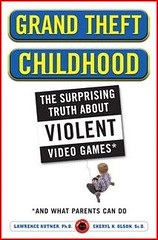 Don’t judge a book by its cover (or its title, for that matter). I’m usually faithful to that maxim, but I must admit that when I first saw the title and cover of “<a href="http://www.amazon.com/Grand-Theft-Childhood-Surprising-Violent/dp/0743299515/ref=pd_bbs_sr_1?ie=UTF8&s=books&qid=1208179493&sr=8-1″>Grand Theft Childhood: The Surprising Truth About Violent Video Games and What Parents Can Do,” I rolled my eyes and thought to myself, “here we go again.” I figured that I was in for another tedious anti-gaming screed full of myths and hysteria about games and gamers. Boy, was I wrong. Massively wrong.
Lawrence Kutner, PhD, and Cheryl K. Olson, ScD, cofounders and directors of the Harvard Medical School Center for Mental Health and Media, have written the most thoroughly balanced and refreshingly open-minded book about video games ever penned. They cut through the stereotypes and fear-mongering that have thus far pervaded the debate over the impact of video games and offer parents and policymakers common-sense advice about how to approach these issues in a more level-headed fashion. They argue that:
Today, an amalgam of politicians, health professionals, religious leaders and children’s advocates are voicing concerns about video games that are identical to the concerns raised one, two and three generations ago with the introduction of other new media. Most of these people have the best of intentions. They really want to protect children from evil influences. As in the past, a few have different agendas and are using the issue manipulatively. Unfortunately, many of their claims are based on scanty evidence, inaccurate assumptions, and pseudoscience. Much of the current research on violent video games is both simplistic and agenda driven. (p. 55)
They note that these groups, “probably worry too much about the wrong things and too little about more subtle issues and complex effects that are much more likely to affect our children.” They continue:
Continue reading →
PFF has just releasing an updated edition of my booklet on “Parental Controls and Online Child Protection: A Survey of Tools & Methods.” The new version, Version 3.0, includes two new appendixes and updates to each section to reflect new parental control tools and programs developed in the last nine months.
The updated report is timely as it comes on the heels of the recently-announced Internet Safety Technical Task Force, which is being chaired by the Berkman Center for Internet & Society at Harvard Law School. I am privileged to serve as a member of the Task Force, which is evaluating various online safety technologies and strategies and then reporting back to state attorneys general with our findings.
Those issues and much more are covered in the latest edition of my report. The report explores the market for parental control tools, rating schemes, education efforts, and initiatives aimed at promoting online child safety. I believe that the parental controls and content management tools cataloged in the report represent a better, less restrictive alternative to government regulation. As I conclude after evaluating that state of the market: “There has never been a time in our nation’s history when parents have had more tools and methods at their disposal to help them decide what constitutes acceptable media content in their homes and in the lives of their children.”
Version 3.0 of the special report, now over 200 pages, contains over fifty exhibits and numerous updates in all five sections of the book. Major updates have been made to the Internet, social networking, and mobile media sections, reflecting the growing importance of those sectors and issues. A greatly expanded section on video empowerment technologies has also been included. Finally, two appendices have also been added: a comprehensive legislative index cataloging over thirty bills introduced in Congress on these issues (complied with John Morris of Center for Democracy & Technology), and a glossary of 35 relevant terms and cases.
The report is available free-of-charge on the PFF website, as are the previous editions. And I am happy to provide hard copies to those who are interested.
http://documents.scribd.com/ScribdViewer.swf?document_id=2887320&access_key=key-um5xjvf98bfnuu8811v&page=&version=1&auto_size=true
Over at the popular gaming site 1up.com, a gentleman who worked briefly for the Entertainment Software Rating Board (ESRB) has posted a provocative article entitled, “How to Fix the Game Ratings System: An insider’s take on what’s wrong with the ESRB.” In the piece, Jerry Bonner, who worked at the ESRB for 6 months according to GamePolitics.com, argues that “Something desperately needs to happen [to reform the ESRB] because the alternative — a government mandated and controlled rating scheme — is a downright frightening concept.” He continues:
“let’s fix [the ESRB ratings process] before things really get out of hand and a new government-appointed ‘Secretary of Interactive Entertainment’ is making the decisions as to what we can and can’t play. I know I don’t want that. I know you don’t want that. And I know that the people at the ESRB don’t want that. Let’s all make damn sure it doesn’t happen, shall we?”
Well, I can certainly agree with Mr. Bonner that a “Secretary of Interactive Entertainment,” or any sort of extensive government regulation of video games, is a very frightening prospect. The problem is, the “solutions” he outlines in his essay could actual put us on that path.
Continue reading →
GamePolitics.com reports on a murder trial in Alabama in which the attorney for a disturbed teenager is blaming video games for his barbaric behavior:
The lawyer for a man being tried for murder is trying to convince an Alabama jury that the defendant believed he was acting out a video game when he murdered an 80-year-old man on Halloween, 2005.
As reported by the Decatur Daily, Andrew Reid Lackey, 24, does not dispute that he stabbed, shot and gouged out the eye of his victim, Charlie Newman. However, Lackey’s attorney, Randy Gladden, is pointing the finger at video games. From the newspaper report:
Actions that led to a deadly confrontation between a defendant and an 80-year-old widower resembled a video game to the accused… [Attorney] Gladden described Lackey… as a computer geek who had immersed himself in video games and lived in “a different world than you and I.”
Tapes of a 911 call made by the victim during the fatal confrontation, however, indicate that old-school greed may have been the motive. Lackey is heard to demand of the victim, ”Where’s the vault?” seven different times. Charlie Newman’s grandson had previously told Lackey that the victim kept a large sum of money in a vault under the stairs. However, no such vault existed.
It’s just disgraceful–but perhaps not all that surprising–that this desperate defense attorney would employ tactics like this. Video games have become the universal excuse
du jour for violent behavior. It’s absurd for all the reasons I have pointed out here before. It’s abundantly clear that old fashion greed and a disturbed mind motivated this particular crime, and if you think that sort of thing didn’t happen before video games came along, then you just haven’t read any history. Of course, they instead just blamed movies, comics, and books for the crimes back then! There’s always someone else or something else to blame. It’s the never-ending search for a universal scapegoat for irrational or criminal behavior. The twisted logic = Don’t blame the individual, blame the media.
Pathetic.
Anthony Prestia of Laws of Play, a blog dedicated to covering legal developments in the gaming industry, somehow got some face time with Supreme Court Justice Scalia and was able to ask for his feelings concerning the constitutionality of recent state video game legislation. “In particular,” Prestia says, “I asked him whether as an originalist he believed that state laws banning the sale of mature-rated video games to minors ran afoul of the First Amendment.” Here’s Prestia’s summary and analysis of Scalia’s answer:
In his most succinct reply of the day, Justice Scalia replied that he did believe such legislation was constitutional. He began by explaining his belief that sound constitutional precedent holds that minors may be subjected to prohibitions that adults are not–-he instantly drew the parallel to regulation of pornography sales. However, Justice Scalia emphasized that unprotected speech, such as obscenity–which he was unwilling to define for reasons that are immediately evident to any constitutional scholar–-can be prohibited from sale regardless of the purchaser’s age. I think the important thing to note here is that Justice Scalia did not suggest that violent and/or sexual content in games rises to the level of unprotected speech. In fact, he did not even suggest that video games themselves are not protected by the First Amendment despite his strict originalist beliefs.
That’s an interesting response in that Scalia’s latter comments imply that even older, more conservative judges are coming around to understanding how video games are a form of artistic expression deserving the protection of the First Amendment. But Scalia’s earlier suggestion that state laws banning sales of certain video games to minors maybe constitutional deserves a response.
Continue reading →

 The Technology Liberation Front is the tech policy blog dedicated to keeping politicians' hands off the 'net and everything else related to technology.