In the worlds of technology and government, I’m fond of joking, paranoia is just having a long time-horizon. Advances in data processing will make identifiable what is now anonymous. That “voluntary” pilot program will become full-fledged and mandatory.
But we need not apply the paranoid principle to the White House’s handling of the petition I started a few weeks ago asking the White House to have TSA follow the law. The petition ended on time. There’s no good evidence that its ending was hastened to cut off a late run at getting to 25,000 signatures.
Some folks had gotten the idea that we would have until midnight last Thursday, but it expired around mid-day. That’s about the same time that I created the petition weeks earlier, which is consistent with my assumption that the system is designed to expire petitions automatically when the time allowed for them to run has elapsed.
We could kvetch about losing some momentum when the petition function went down for a few hours around the time a great story came out on Wired’s Threat Level blog. But the folks at Whitehouse.gov added a full day to all petitions to make up for the maintenance outage. The time to complain was then, and I didn’t, so that complaint has expired.
There’s lots of other stuff that is interesting about all this. Continue reading →
The Obama administration seems to be working to pull defeat from the jaws of victory on the president’s “Sunlight Before Signing” campaign promise. Whitehouse.gov sometimes posts bills as “pending” before they get out of Congress, when it’s premature to ask the public for a final review.
The problem is particularly acute today, as I note in a Cato@Liberty post:
H.R. 1586 is a “shell bill” that Congress has been batting back and forth, and it has covered various subject matters in its busy life. It indeed started out as a bill to tax the bonuses of executives in TARP-subsidized firms. When it passed the House, though, it had become the “Aviation Safety and Investment Act of 2010.” And this week it was amended in the Senate to contain a potpourri of spending and revenue programs. (WashingtonWatch.com cost estimate: $125 per U.S. family.)
 Lets say a high schooler has been assigned by her teacher to monitor the bills President Obama receives from Congress. From the White House’s pending legislation page, she clicks on a link to find a bewildering hodgepodge of bill versions on the Thomas page for the bill. (Click on the image at right to see a screen capture.)
And none of the bill versions has passed Congress! Thomas, the Library of Congress’ legislative tracking service, tells visitors that the last bill listed is most recent. But the current version of the bill is item four of six, referrred to as the “XXXXXXAct ofXXXX.” Thanks to Whitehouse.gov, our high schooler is misled into believing that President Obama will soon sign a tax on bonsuses given to TARP-slurping executives when in fact a variety of other policies may soon pass.
Lets say a high schooler has been assigned by her teacher to monitor the bills President Obama receives from Congress. From the White House’s pending legislation page, she clicks on a link to find a bewildering hodgepodge of bill versions on the Thomas page for the bill. (Click on the image at right to see a screen capture.)
And none of the bill versions has passed Congress! Thomas, the Library of Congress’ legislative tracking service, tells visitors that the last bill listed is most recent. But the current version of the bill is item four of six, referrred to as the “XXXXXXAct ofXXXX.” Thanks to Whitehouse.gov, our high schooler is misled into believing that President Obama will soon sign a tax on bonsuses given to TARP-slurping executives when in fact a variety of other policies may soon pass.
The phrase, “well, 26 times, but who‘s counting?” has 26 letters and numbers in it. Each one in this Cato@Liberty blog post about the Obama administration’s moves toward implementing Sunlight Before Signing is a link to another post about Sunlight Before Signing. I do like to entertain me.
Recall that President Obama promised on the campaign trail that he would post bills Congress sends him online for five days before he signs them. His early performance was not good, but he’s improving and Whitehouse.gov took major steps in the last few weeks to advance the ball.
There are now RSS feeds on Whitehouse.gov’s new “pending legislation” page—the stuff getting that sunlight—as well as on the “signed legislation” and “vetoed legislation” pages. Readers of this blog certainly know how feeds can propagate information.
As I said in my C@L post, “A habit of civic awareness can take root thanks to these RSS feeds . . . . We’ll have a more engaged, self-governing citizenry as a result.”
Won’t you help with that process by using these feeds yourself, and by promoting them to others by writing about the feeds, forwarding this post, reTweeting and so on?
Thanks!
Sincerely,
Democracy
I’m delighted to report that the White House’s web site, Whitehouse.gov, has begun posting the bills Congress sends down Pennsylvania Avenue so they can get a final public review. This actually began some time ago, but a link from the home page now directs visitors (and search engines) to the bills that await the president’s signature.
This is an important step toward fulfilling President Obama’s campaign promise to post the bills he receives from Congress online for five days before he signs them.
Take a look for yourself: On the Whitehouse.gov home page, a link at the bottom of the “Featured Legislation” column says “Comment on Pending Legislation.”
Currently, four bills are listed there, arranged in order by the dates they were posted. The final language isn’t posted at the link, and it takes a little sophistication to find the final version at the linked-to page on the Thomas system, but this is substantial progress.
Kudos to the White House for moving toward full implementation of President Obama’s Sunlight Before Signing promise!
The White House announces its open government plans today, live at 11:00 am Eastern, on Whitehouse.gov.
But what about the president’s promise to run his own White House more transparently? In a post on Cato@Liberty this morning, I look into a new development on the Sunlight Before Signing promise, which he has violated more than 100 times since taking office.
At some point earlier this year, the White House began posting links on Whitehouse.gov to bills that were heading its direction, a half-measure the White House told the New York Times it would take.
I failed to notice the existence of these pages, but I think it is forgivable error. There is no uniform structure to them, and there is no link I can discover on Whitehouse.gov that would bring anyone to them.
Based on my spot-checking, they haven’t been crawled by any search engine, so the only way a person could find them is by searching on Whitehouse.gov for phrases on the yet unseen pages or by searching the House or Senate bill numbers of bills that you know to look for because they have already passed into law.
This doesn’t fulfill the spirit of the Sunlight Before Signing pledge. It doesn’t give the public an opportunity to review final bills and comment before the president signs them. I doubt if a single one of the people who cheered when President Obama made his Sunlight Before Signing pledge has visited one of these pages and commented to the president as he told them they would be able to do.
There are further curiosities: The pages themselves are undated, but their “posted” dates, which appear in search results, are sometimes well beyond the date on which they became law. A Whitehouse.gov search for H.R. 2131, which became Public Law 111-70 on October 9th, shows that it was posted for comment on October 23rd.
Is the White House posting bills for review after they’ve become law, trying to make it look like they’re providing some measure of sunlight?
There was some buzz earlier this year when the White House used the free, open-source Drupal content management platform for Recovery.gov. Now the administration’s marquee Web site Whitehouse.gov will be using it.
The AP story linked just above does a good job of recounting the benefits of open source in this application: chiefly, low cost and high security.
Arnold Kling wrote recently on the Library of Economics and Liberty blog relating the work Elinor Ostrom did to win the nobel prize in economics to how the Internet enables private provision of public goods—no regulation, little to no centralized authority at all.
Open source is nothing if not an example of that, and it’s good to see this use of open source joining many others across the big, beautiful Internet.
. . . you’d think that you would follow the “Speeches” link from the home page on Whitehouse.gov. If you do, today you see just four speeches.
I went looking for the text of his national security speech at the National Archives today. The New York Times has it but Whitehouse.gov doesn’t? What’s going on here?
. . . or does he?
Friday afternoon, the White House blog announced that the American Recovery and Reinvestment Act of 2009 was posted online for public comment. This is good evidence that the President intends to honor his campaign promise to post legislation online and take public comment for five days before signing it.
But it’s not great evidence of that.
The Whitehouse.gov post went up at 2:05 pm, but the House didn’t vote until 2:24 pm and the Senate voted at 05:29 pm. (Click on the “votes” to see how your representatives did.) As of Saturday afternoon, the Thomas legislative tracking system doesn’t indicate that the bill has been presented to the President yet. And news reports indicate that the President will sign the bill on Monday, three days after it was “pre-“posted.
Regular order, Mr. President. When a bill is presented to you, post it online (at a consistent place on your Web site, not just at ad hoc URLs as you’ve done up to now). Then wait five days, reviewing the comments of the public as you promised to do when you asked the public to elect you.
The steps the White House has taken toward implementing the President’s promise are good steps. (In this Cato daily podcast, I characterized the President’s record on transparency so far as “mixed.”) But the promise is not fulfilled until bills receive five days online airing after they have been presented.
Presentment is a distinct, constitutional step in the legislative process. Until every non-emergency bill is posted online for five days after presentment and before signing, President Obama will look like he’s being driven by events and maneuvered by his elders in Congress.
I’ve been following President Obama’s early moves on government transparency here on Tech Liberation and on the Cato@Liberty blog.
Last week, Obama’s first broken campaign promise was the pledge to post legislation online for five days before signing it.
Well, the White House is working to address that, but it appears to be doing so with a half-measure that comes up short. On Sunday, the White House blog announced that the SCHIP legislation pending in the Senate was up for public comment. And it is, of course, but it hasn’t passed the Senate yet.
It was implicit in the promise to post bills online for five days prior to signing that the bill posted would be the one passed by the House and Senate and presented to the President.
If the White House were to implement the promised practice of leaving bills sitting out there, unsigned, after they pass Congress, that would have significant effects. The practice would threaten to reveal excesses in parochial amendments and earmarks which could bring down otherwise good bills. President Obama’s promised five-day cooling off period would force the House and Senate to act with more circumspection.
Taking comments on a bill as it makes its way through the House and Senate does not have the same salutary effect. If the White House is trying to start the five-day clock on the SCHIP bill with the posting of a comment page on Sunday, that is not consistent with President Obama’s promise.
On the first full day of the new Obama administration, I wrote here, and later followed up, expressing regret that the Obama White House hadn’t ported the “Seat at the Table” program over from the transition. Change.gov published documents submitted to the transition on its Web site for public review and comment. Whitehouse.gov does not.
Now we learn that the White House will not honor an Obama campaign and Whitehouse.gov pledge – not more than nine days old – to post all non-emergency legislation on the White House Web site for five days before the President signs it.
One significant addition to WhiteHouse.gov reflects a campaign promise from the President: we will publish all non-emergency legislation to the website for five days, and allow the public to review and comment before the President signs it.
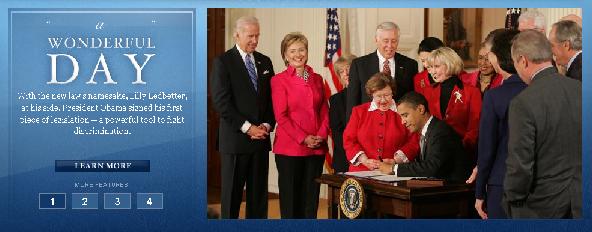
President Obama signed the “Lilly Ledbetter Fair Pay Act of 2009” into law today, one day after Congress delivered it to him. And there’s the bill law, posted on Whitehouse.gov for public review. But it sure hasn’t been up for five days. And it’s not emergency legislation: Bills like it have been floating around in Congress since at least June 2007.
If I was a little demanding about transparency from day one, it was a bit of counterpoint to folks who were going dewy about Obama’s transparency promises. Those were simply words. Judging by the Whitehouse.gov screen cap below, transparency got thrown over the side for a photo op. Welcome to Washington.
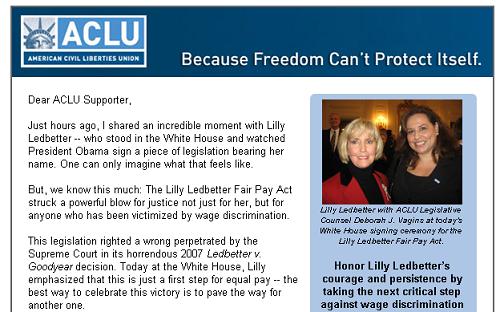
Update: Just got an email that helps illustrate why the sound practices of letting legislation cool and taking public comment would go by the wayside. Getting credit from the ACLU is much more important than pleasing the relatively tiny coterie of transparency fans – and there is almost no expectation among the public that a White House should practice good lawmaking hygiene.


 The Technology Liberation Front is the tech policy blog dedicated to keeping politicians' hands off the 'net and everything else related to technology.