[Co-authored with Connor Haaland and originally published on The Bridge as, “Do Our Leaders Believe in Free Speech and Online Freedom Anymore?”]
 A major policy battle has developed regarding the wisdom of regulating social media platforms in the United States, with the internet’s most important law potentially in the crosshairs. Leaders in both major parties are calling for sweeping regulation.
Specifically, President Trump and his presumptive opponent in the coming presidential election, former Vice President Joe Biden, have both called for “Section 230” of the Communications Decency Act to be repealed. Last week, the president took a misguided step in this direction by signing an executive order that, if fully carried out, will result in significantly greater regulation of the internet and of speech.
A Growing Call to Regulate Internet Platforms
The ramifications of these threats and steps could not be more profound. Without Section 230—also known as “the 26 words that created the internet”—we would have a much less advanced internet ecosystem. Twitter, Facebook, YouTube, and Wikipedia would have never grown as quickly. Indeed, the repeal of Section 230 means many fewer jobs, less information distribution, and, frankly, less joy.
Shockingly, by backing Trump’s recent push for regulating these internet platforms, many conservatives are betraying their own principles—the ones that support freedom of expression and the ability to run private businesses without government interference.
Section 230 limits the liability online intermediaries face for the content and communications that travel over their networks. The immunities granted by Section 230 let online speech and commerce flow freely, without the constant threat of legal action or onerous liability looming overhead for digital platforms. To put it another way, without this provision, today’s vibrant internet ecosystem likely would not exist. Continue reading →
The White House has announced a new effort to help prepare workers for the challenges they will face in the future. While it’s a well-intentioned effort, and one that I hope succeeds, I’m skeptical about it for a simple reason: It’s just really hard to plan for the workforce needs of the future and train people for jobs that we cannot possibly envision today.
Writing in the Wall Street Journal today, Ivanka Trump, senior adviser to the president, outlines the elements of new Executive Order that President Trump is issuing “to prioritize and expand workforce development so that we can create and fill American jobs with American workers.” Toward that end, the Administration plans on:
- establishing a National Council for the American Worker, “composed of senior administration officials, who will develop a national strategy for training and retraining workers for high-demand industries.” This is meant to bring more efficiency and effectiveness to the “more than 40 workforce-training programs in more than a dozen agencies, and too many have produced meager results.”
- “facilitat[ing] the use of data to connect American businesses, workers and educational institutions.” This is meant to help workers find “what jobs are available, where they are, what skills are required to fill them, and where the best training is available.”
- launching a nationwide campaign “to highlight the growing vocational crisis and promote careers in the skilled trades, technology and manufacturing.”
The Administration also plans on creating a new advisory board of experts to address these issues, and the administration is also “asking companies and trade groups throughout the country to sign our new Pledge to America’s Workers—a commitment to invest in the current and future workforce.” They hope to encourage companies to take additional steps “to educate, train and reskill American students and workers.”
Perhaps some of these steps make sense, and perhaps a few will even help workers deal with the challenges of our more complex, fast-evolving, global economy. But I doubt it.
Continue reading →
This week, my Mercatus Center colleague Andrea Castillo and I filed comments with the White House Office of Science and Technology Policy (OSTP) in a proceeding entitled, “Preparing for the Future of Artificial Intelligence.” For more background on this proceeding and the accompanying workshops that OSTP has hosted on this issue, see this White House site.
In our comments, Andrea and I make the case for prudence, patience, and a continuing embrace of “permissionless innovation” as the appropriate policy framework for artificial intelligence (AI) technologies at this nascent stage of their development. Down below, I have pasted our full comments, which were limited to just 2,000 words as required by the OSTP. But we plan on releasing a much longer report on these issues in coming months. You can find the full version of filing that includes footnotes here.
Continue reading →
Yesterday, the White House Council of Economic Advisers released an important new report entitled, “Occupational Licensing: A Framework for Policymakers.” (PDF, 76 pgs.) The report highlighted the costs that outdated or unneeded licensing regulations can have on diverse portions of the citizenry. Specifically, the report concluded that:
the current licensing regime in the United States also creates substantial costs, and often the requirements for obtaining a license are not in sync with the skills needed for the job. There is evidence that licensing requirements raise the price of goods and services, restrict employment opportunities, and make it more difficult for workers to take their skills across State lines. Too often, policymakers do not carefully weigh these costs and benefits when making decisions about whether or how to regulate a profession through licensing.
The report supported these conclusions with a wealth of evidence. In that regard, I was pleased to see that research from Mercatus Center-affiliated scholars was cited in the White House report (specifically on pg. 34). Mercatus Center scholars have repeatedly documented the costs of occupational licensing and offered suggestions for how to reform or eliminate unnecessary licensing practices. Most recently, my colleagues and I have explored the costs of licensing restrictions for new sharing economy platforms and innovators. The White House report cited, for example, the recently-released Mercatus paper on “How the Internet, the Sharing Economy, and Reputational Feedback Mechanisms Solve the ‘Lemons Problem,’” which I co-authored with Christopher Koopman, Anne Hobson, and Chris Kuiper. And it also cited a new essay by Tyler Cowen and Alex Tabarrok on “The End of Asymmetric Information.” Continue reading →
Today, the Obama administration announced 5 executive actions it is taking and 7 legislative proposals it is making to address the problem of patent trolls. While these are incremental steps in the right direction, they are still pretty weak sauce. The reforms could alleviate some of the litigation pressure on Silicon Valley firms, but there’s a long way to go if we want to have a patent system that maximized innovation.
The proposals aim to reduce anonymity in patent litigation, improve review at the USPTO, give more protection to downstream users, and improve standards at the International Trade Commission, a venue which has been gamed by patent plaintiffs. These are all steps worth taking. But they’re not enough. The White House’s press release quotes the president as saying that “our efforts at patent reform [i.e. the America Invents Act, passed in 2011] only went about halfway to where we need to go.” Presumably the White House believes these steps will take us the rest of the way there.
But the problem with computer-enabled patents isn’t merely that they result in a lot of opportunistic litigation, though they do. The problem is that almost every new idea is actually pretty obvious, in the sense that it is “invented” at the same time by lots of companies that are innovating in the same space. Granting patents in a field where everyone is innovating in the same way at the same time is a recipe for slowing down, not speeding up, innovation. Instead of just getting on with the process of building great new products, companies have to file for patents, assemble patent portfolios, license patents from competitors who “invented” certain software techniques a few months earlier, deal with litigation, and so on. A device like a smartphone requires thousands of patents to be filed, licensed, or litigated.
If we really want to speed up innovation, we need to take bolder steps. New Zealand recently abolished software patents by declaring that software is not an invention at all. It would be terrific if the White House would get behind that kind of bold thinking. In the meantime, we’ll have to watch closely as the Obama administration’s executive actions are implemented and its legislative recommendations move through Congress. I hope for the best, but for now I’m not too impressed.
I honestly don’t know. I haven’t been following his work, and, by saying I don’t know, I don’t imply that he didn’t achieve anything. But it’s utterly unclear from this interview with Nancy Scola what he achieved as chief technology officer in the Obama Administration the last few years.
I was piqued by the amusing—almost comical—claims to specificity he makes, right from the outset:
What is the elevator pitch on what you’ve been doing since you were named Chief Technology Officer of the United States?
What I do is advance the president’s innovation agenda by incorporating his bottom-up theory of change. To be very specific about it, I execute the president’s innovation strategy in a manner that taps into the expertise of the American people to solve big problems.
There is nothing specific about, “I execute the president’s innovation strategy in a manner that taps into the expertise of the American people to solve big problems.” If you were to look up “vague” in the dictionary, that sentence would illustrate the first definition of the word.
Ever notice how people say, “I don’t mean to interrupt,” when they are interrupting? How they say, “to make a long story short,” when it’s already too late? Chopra says he’s going to be specific as he heads into empty generalities. Further along in the interview , he talks about his role and his involvement, which would be interesting meta-information if it set the stage for describing accomplishment.
So the question stands: What things happened under Aneesh Chopra that wouldn’t have happened in his absence?
Caveats: Aneesh Chopra seems like a nice guy. I don’t doubt his sincerity or intention to have done good things. I don’t think he’s unique among bureaucrats in not having identifiable achievements. I am open to learning what he did achieve. He just hasn’t explained it himself.
This line of questioning also may seem disrespectful. Chopra has acted as a public servant the last few years and deserves credit for that, some would argue. But I disagree that the claim to “public service” should act as insulation against being held to account for performance. What did Aneesh Chopra achieve?
In a letter to the editor of the Washington Post last week, former FTC Commissioner Thomas Leary responded to a Post article describing the FTC’s suit against Intel as a “major step for President Obama,” consistent with his campaign promise to “reinvigorate antitrust enforcement.” Leary responded indignantly to this characterization by declaring:
People seem to forget that the FTC is a bipartisan independent agency.
As a Republican FTC commissioner appointed by a Democratic president, I can vouch for the agency’s independence. During my service from 1999 to 2005 in the administrations of presidents Bill Clinton and George Bush, I never received a direct or indirect policy recommendation on a pending matter from anyone in the White House or from any of the people in Congress who had actively supported me.
Leary’s leeriness about political encroachment on the FTC illustrates the depth of abiding faith in independent regulatory agencies as standing truly apart from the day-to-day politics of Washington—especially when the might of the regulatory state is being wielded against a particular company in quasi-judicial prosecutions, such as antitrust enforcement actions. But if the independence of the FTC is this important, what about the independence of the Federal Communications Commission, with its broad jurisdiction over the media and tools of free speech?
Leary would probably be appalled at the politicization of the FCC in recent years. Bush’s second FCC chairman, Kevin Martin, was infamous for his political Machiavellianism and widely despised by the communications law bar. By contrast, when it became clear that Obama’s high-tech advisor Julius Genachowski would succeed Martin as FCC Chairman shortly before Obama’s inauguration, he received a chorus of applause from a wide range of philosophical perspectives, including from our former president at PFF, Ken Ferree:
Julius Genachowski is an outstanding choice to chair the Commission. He is knowledgeable, experienced, and presumably will have the ear of the most influential people within the Administration.
While no one would compare the eminently likable Genachowski to Martin, his relationship to the Obama administration appears unprecedented in its closeness, and one must ask whether that’s a good thing for the head of a supposedly “independent” regulatory agency or integrity of that agency’s decision-making. Continue reading →
by Adam Thierer & Berin Szoka
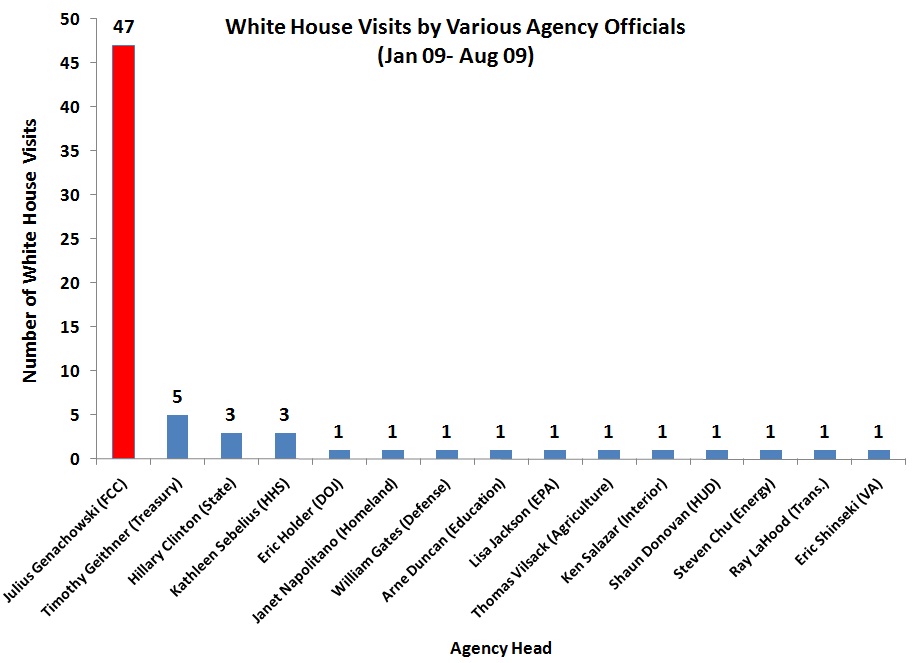
Move over, health care reform, climate change, and the economy. Judging by White House visits by various government agency heads, the Obama administration instead appears preoccupied with the re-regulation of communications, media, and the Internet. The Administration has just released logs of all visitors to the White House and Executive Office Buildings from Obama’s inauguration through August—including a staggering 47 visits by Federal Communications Commission (FCC) Chairman Julius Genachowski. By contrast, no other major agency head logged more than five visits. Chairman Genachowski obviously has an audience with those at the highest levels of power, including the President himself, but this raises questions about just how “independent” this particular regulator and his agency really are.
Unprecedented Transparency by White House
The Administration deserves credit for releasing these visitor logs, which offer unprecedented transparency into the White House’s workings. Unfortunately, the logs lack visitors’ affiliation and title, making it difficult to discern subtle patterns. Furthermore, each entry indicates only one “visitee” and the total number of people involved. Full disclosure requires identifying all meeting participants. Nonetheless, President Obama’s gesture is a great first step toward improved government accountability.
This openness allows us to ask questions we couldn’t pose for previous administrations—such as why the FCC head seems to have unparalleled access to the White House. Lacking data from previous administrations, it’s difficult to make direct comparisons with previous FCC Chairmen, but the sheer number of visits by Chairman Genachowski leaves no doubt about his uniquely close involvement with the White House. Continue reading →
Maybe Obama should invite Google CEO Eric Schmidt and Microsoft CEO Steve Ballmer over to the White House for a beer to settle the two companies’ differences!
http://www.youtube.com/v/Q0umKaGxkkE
While he’s at it, Obama might want to invite Apple CEO Steve Jobs, too, since the common cause Apple and Google once made against Microsoft now seems to be giving way to increased rivalry between the two titans of Internet cool. Or how about Facebook CEO Mark Zuckerberg, given Facebook’s growing challenge to Google? Yahoo!’s Carol Bartz seems to get along much better with everyone than the boys in the group, so she’d probably help Obama keep things under control.
The Internet industry’s war-of-all-against-all is reminiscent of Tom Lehrer‘s classic 1960s satire “National Brotherhood Week”:
http://www.youtube.com/v/aIlJ8ZCs4jY
Continue reading →
My post yesterday wondering aloud whether the Obama administration was walking away from its transparency commitments was slightly premature. Memoranda were being issued/reported on as I wrote, and this morning’s Washington Post describes some of the technical glitches that befuddled White House staff on day one. The texts of the executive orders President Obama signed yesterday are now online, but his memoranda on transparency aren’t yet. Helpfully, they’ve been posted by the Sunlight Foundation.
But I think my post was sound in the main, because I was looking for actual pro-transparency deeds from the new administration, and they haven’t materialized. I appreciate the sentiments voiced in these documents, but don’t find myself wholly impressed with the actual transparency measures the White House has taken.
What I’m hearing is the transparency dog that didn’t bark: The Obama team set a
great precedent in the transition with the Seat at the Table program, but there’s no sign that such a thing will be implemented in the White House. Why not?
We can expect an “Open Government Directive” within 120 days and new guidelines for the Freedom of Information Act, but I would have appreciated seeing President Obama’s commitment to openness illustrated the best way possible: through the direct and immediate commitment of his own White House operation.
The White House will not be run as openly as the transition was. The agencies, already predisposed against transparency, will see this as a sign of weak commitment and will whittle away even more fiercely at the good sentiments President Obama’s expressed in his transparency memoranda.
(“Thanks for inviting me!” said the skunk at the garden party.)

 The Technology Liberation Front is the tech policy blog dedicated to keeping politicians' hands off the 'net and everything else related to technology.