Congress has become a less important player in the field of technology policy. Why did that happen, and what are the ramifications for technological governance efforts going forward?
I’ve spent almost 30 years covering technology policy. There was a time in my life when I spent almost all my time as a policy analyst preoccupied with developments in the federal legislative arena. I lived in the trenches of Capitol Hill and interacted with lawmakers and their staff morning, noon, and night.
In recent years, however, I have spent very little time focused on the Legislative Branch because it has effectively become a non-actor on technology policy. It is not that congressional lawmakers stopped caring about tech policy. Interest actually remains quite high—perhaps higher than ever before. Congress also continues to introduce lots of bills, host plenty of hearings, and issue mountains of press releases related to tech policy issues.
Nonetheless, all that interest and activity has not really translated into much important legislation. Continue reading →
In my first essay for the American Institute for Economic Research, I discuss what lessons the great prophet of innovation Joseph Schumpeter might have for us in the midst of today’s “techlash” and rising tide of techopanics. I argue that, “[i]f Schumpeter were alive today, he’d have two important lessons to teach us about the techlash and why we should be wary of misguided interventions into the Digital Economy.” Specifically:
We can summarize Schumpeter’s first lesson in two words: Change happens. But disruptive change only happens in the right policy environment. Which gets to the second great lesson that Schumpeter can still teach us today, and which can also be summarized in two words: Incentives matter. Entrepreneurs will continuously drive dynamic, disruptive change, but only if public policy allows it.
On Thursday, it was my great pleasure to participate in a Washington Legal Foundation (WLF) event on “Online Privacy Regulation: The Challenge of Defining Harm.” The entire event video can be found on YouTube here, but down below I pasted the clip of just my remarks. Other speakers at the event included: FTC Commissioner Maureen K. Ohlhausen, Commissioner; John B. Morris, Jr., the Associate Administrator and Director of Internet Policy athe U.S. Department of Commerce’s National Telecommunications and Information Administration; and Katherine Armstrong, Counsel at the law firm of Hogan Lovells. Glenn Lammi of the WLF moderated the session.
My remarks drew upon a few recent law review articles I have published relating digital privacy debates to previous debates over free speech and online child safety issues. (Here are those articles: 1, 2, 3).
I suppose it was inevitable that the DRM wars would come to the world of drones. Reporting for the Wall Street Journal today, Jack Nicas notes that:
In response to the drone crash at the White House this week, the Chinese maker of the device that crashed said it is updating its drones to disable them from flying over much of Washington, D.C.SZ DJI Technology Co. of Shenzhen, China, plans to send a firmware update in the next week that, if downloaded, would prevent DJI drones from taking off within the restricted flight zone that covers much of the U.S. capital, company spokesman Michael Perry said.
Washington Post reporter Brian Fung explains what this means technologically:
The [DJI firmware] update will add a list of GPS coordinates to the drone’s computer telling it where it can and can’t go. Here’s how that system works generally: When a drone comes within five miles of an airport, Perry explained, an altitude restriction gets applied to the drone so that it doesn’t interfere with manned aircraft. Within 1.5 miles, the drone will be automatically grounded and won’t be able to fly at all, requiring the user to either pull away from the no-fly zone or personally retrieve the device from where it landed. The concept of triggering certain actions when reaching a specific geographic area is called “geofencing,” and it’s a common technology in smartphones. Since 2011, iPhone owners have been able to create reminders that alert them when they arrive at specific locations, such as the office.
This is complete overkill and it almost certainly will not work in practice. First, this is just DRM for drones, and just as DRM has failed in most other cases, it will fail here as well. If you sell somebody a drone that doesn’t work within a 15-mile radius of a major metropolitan area, they’ll be online minutes later looking for a hack to get it working properly. And you better believe they will find one. Continue reading →
Timothy B. Lee, founder of The Washington Post’s blog The Switch discusses his approach to reporting at the intersection of technology and policy. He covers how to make tech concepts more accessible; the difference between blogs and the news; the importance of investigative journalism in the tech space; whether paywalls are here to stay; Jeff Bezos’ recent purchase of The Washington Post; and the future of print news.
I caught this tidbit today in a Washington Post article about Julius Genachowski’s tenure as Federal Communications Commission chairman:
He wound up presiding over a crucial period in which the powerful companies of Silicon Valley turned into Washington power players. Lobbying the FCC has become a major economic franchise. Each day, hundreds of dark-suited lawyers crowd the antiseptic, midcentury-modern agency building.
Can anyone think this is a good thing? To be clear, I don’t think Genachowski is solely responsible for Silicon Valley innovators getting more aggressive in Washington or for tech lobbying becoming “a major economic franchise” at the FCC. There’s plenty of blame to go around in that regard. Regardless, every legislative and regulatory action that opens the door to greater regulation of the information economy also opens the door a bit wider to unproductive rent-seeking and cronyist activities. Moreover, every minute and every dollar spent focusing on making legislators and regulators happy is another minute and dollar that could have better been spent making consumers happy in the marketplace. It’s a pure deadweight loss to society.
And there has been a remarkable expansion in such tech lobbying activity over the past decade, as the following charts illustrate. The first shows the dramatic growth of lobbying by computer and Internet companies relative to other sectors and the second shows lobbying spending by specific computer and Internet companies. [Click to enlarge.]
In July 2012, the D.C. Council approved the Social E-Commerce Job Creation Tax Incentive Act of 2012. The deal provided LivingSocial, a popular online coupon service, with corporate and property tax exemptions in Washington, D.C. worth approximately $32.5 million over five years beginning in 2015. Legislators feared that LivingSocial would relocate to areas with a lower tax rate. In exchange for the $32.5 million, LivingSocial said it would attempt to add 1,000 employees to its payroll (roughly doubling its number of employees in the District), although no contractual guarantee for job creation exists and even though the firm had never been profitable. Some of the few contractual obligations required for LivingSocial to receive these tax exemptions are that it must establish a program to mentor D.C. high school students, provide internships for D.C. students, and stay located in the District. LivingSocial must also ensure 50% of newly hired employees live in the District in order to receive the Act’s full $32.5 million in exemptions.
Just a few months after the deal was struck it had already become apparent just how risky of a bet the DC government has made with taxpayer dollars. In late November 2012, LivingSocial announced a net loss of $566 million for the third quarter and that hundreds of employees would be laid off. The promise to roughly doubling the size of its DC-based workforce seems fairly unlikely and some analysts doubt the company will survive much longer.
This serves as another case study for just how foolish it is for governments to make risky, taxpayer-backed bets on information tech companies. Continue reading →
The precautionary principle generally states that new technologies should be restricted or heavily regulated until they are proven absolutely safe. In other words, out of an abundance of caution, the precautionary principle holds that it is “better to be safe than sorry,” regardless of the costs or consequences. The problem with that, as Kevin Kelly reminded us in his 2010 book, What Technology Wants, is that because “every good produces harm somewhere… by the strict logic of an absolute Precautionary Principle no technologies would be permitted.” The precautionary principle is, in essence, the arch-enemy of progress and innovation. Progress becomes impossible when experimentation and trade-offs are considered unacceptable.
I was reminded of that fact while reading this recent piece by Marc Scribner in the
Washington Post, “Driverless Cars Are on the Way. Here’s How Not to Regulate Them.” Scribner highlights the efforts of the D.C. Council to regulate autonomous vehicles. A new bill introduced by Council member Mary Cheh (D-Ward 3) proposes several preemptive regulations before driverless autos would be allowed on the streets of Washington. Scribner summarizes the provisions of the bill and their impact: Continue reading →
In the wake of last week’s big SOPA showdown, a lot of people are talking about the expanded presence and power of the Internet, online operators, and digital Netizens in Washington policy debates. I certainly don’t mean to diminish the importance of this particular episode. It certainly is historic, regardless of how you feel about the specifics of SOPA. What does concern me, however, is the way this episode is prompting questions about how much more “engagement” Internet companies need to consider inside the Beltway. For example, today’s Wall Street Journal features an article on “The Web’s Growing Muscle” and notes:
The Internet industry has found a rare sweet spot in Washington. With Google in the lead, the companies have begun building a strong traditional lobbying force in Washington. And, to complement that inside game, websites’ millions of users have become a powerful outside weight on Congress. What’s more, in a rare Washington double play, the concerns of Internet companies have found a sympathetic ear both in the Democratic White House and among Republican presidential candidates who otherwise can’t agree with Barack Obama on anything.
The piece concludes with a quote from an anonymous media executive saying “People are looking at what Google spent on lobbying and wondering, ‘Can we match that?’ It has to be a big spend.”
I cannot possibly think of anything more demoralizing than that. Continue reading →
Jack Shafer brought to my attention this terrific new Politico column by Michael Kinsley entitled, “How Microsoft Learned ABCs of D.C.” In the editorial, Kinsley touches on some of the same themes I addressed in my recent piece here “On Facebook ‘Normalizing Relations’ with Washington” as well as in my Cato Institute essay from last year on”The Sad State of Cyber-Politics.” Kinsley notes how Microsoft was originally bashed by many for not getting into the D.C. lobbying game early enough:
there even was a feeling that, in refusing to play the Washington game, Microsoft was being downright unpatriotic. Look, buddy, there is an American way of doing things, and that American way includes hiring lobbyists, paying lawyers vast sums by the hour, throwing lavish parties for politicians, aides, journalists and so on. So get with the program.
But after doing exactly that, Kinsley notes, the company got blasted for for being too aggressive in D.C.!
So that’s what Microsoft did. It moved its “government affairs” office out of distant Chevy Chase and into the downtown K Street corridor. It bulked up on lawyers and hired the best-connected lobbyists. Soon, Microsoft was coming under criticism for being heavy-handed in its attempts to buy influence.
“But the sad thing is that it seems to have worked. Microsoft is no longer Public Enemy No. 1,” Kinsley notes, and he continues on to reiterate a point I made in my last two essays: Google is the Great Satan now! Continue reading →
The Technology Liberation Front is the tech policy blog dedicated to keeping politicians' hands off the 'net and everything else related to technology. Learn more about TLF →


 In
In 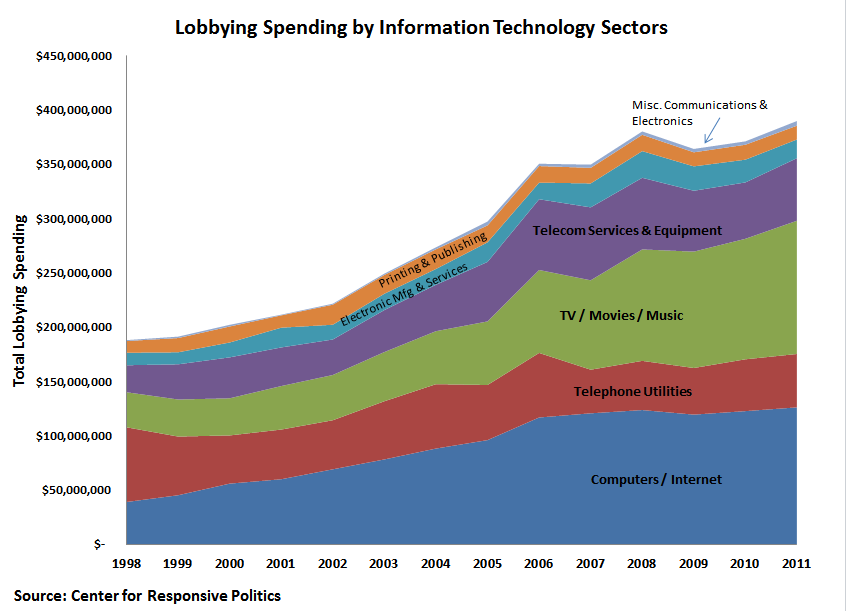

 The Technology Liberation Front is the tech policy blog dedicated to keeping politicians' hands off the 'net and everything else related to technology.