“The only thing Europe exports now on the digital-technology front is regulation,” I noted in my response, and that makes it all the more mind-boggling that Biden and Barr want to go down that same path. “[T]he EU’s big-government regulatory crusade against digital tech: Stagnant markets, limited innovation and a dearth of major players. Overregulation by EU bureaucrats led Europe’s best entrepreneurs and investors to flee to the U.S. or elsewhere in search of the freedom to innovate.”
Thus, the Biden and Barr plans for importing European-style tech mandates, “would be a stake through the heart of the ‘permissionless innovation’ that made America’s info-tech economy a global powerhouse.” In a longer response to the Biden oped that I published on the R Street blog, I note that:
“It is remarkable to think that after years of everyone complaining about the lack of bipartisanship in Washington, we might get the one type of bipartisanship America absolutely does not need: the single most destructive technological suicide in U.S. history, with mandates being substituted for markets, and permission slips for entrepreneurial freedom.”
What makes all this even more remarkable is that they calls for hyper-regulation come at a time when China is challenging America’s dominance in technology and AI. Thus, “new mandates could compromise America’s lead,” I conclude. “Shackling our tech sectors with regulatory chains will hobble our nation’s ability to meet global competition and undermine innovation and consumer choice domestically.”
This weekend, The Wall Street Journal ran my short letter to the editor entitled, “We Can Protect Children and Keep the Internet Free.” My letter was a response to columnist Peggy Noonan’s April 9 oped, “Can Anyone Tame Big Tech?” in which she proposed banning everyone under 18 from all social-media sites. She specifically singled out TikTok, Youtube, and Instagram and argued “You’re not allowed to drink at 14 or drive at 12; you can’t vote at 15. Isn’t there a public interest here?”
I briefly explained why Noonan’s proposal is neither practical nor sensible, noting how it:
would turn every kid into an instant criminal for seeking access to information and culture on the dominant medium of their generation. I wonder how she would have felt about adults proposing to ban all kids from listening to TV or radio during her youth.
Let’s work to empower parents to help them guide their children’s digital experiences. Better online-safety and media-literacy efforts can prepare kids for a hyperconnected future. We can find workable solutions that wouldn’t usher in unprecedented government control of speech.
Let me elaborate just a bit because this was the focus of much of my writing a decade ago, including my book, Parental Controls & Online Child Protection: A Survey of Tools & Methods, which spanned several editions. Online child safety is a matter I take seriously and the concerns that Noonan raised in her oped have been heard repeatedly since the earliest days of the Internet. Regulatory efforts were immediately tried. They focused on restricting underage access to objectionable online content (as well as video games), but were immediately challenged and struck down as unconstitutionally overbroad restrictions on free speech and a violation of the First Amendment of the U.S. Constitution. Continue reading →
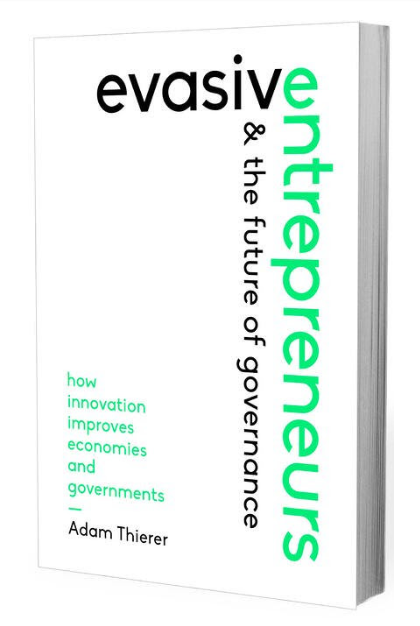
A pandemic is no time for bad governance. As the COVID-19 crisis intensified, bureaucrats and elected officials slumbered. Government regulations prevented many in the private sector from helping with response efforts. The result was a sudden surge of evasive entrepreneurialism and technological civil disobedience. With institutions and policies collapsing around them, many people took advantage of cutting‐edge technological capabilities to evade public policies that were preventing practical solutions from emerging.
Examples were everywhere. Distilleries started producing hand sanitizers to address shortages while average folks began sharing do‐it‐yourself sanitizer recipes online. The Food and Drug Administration (FDA) looked to modify hand sanitizer guidelines quickly to allow for it, but few really cared because those rules weren’t going to stop them. Gray markets in face masks, medical face shields, and respirators developed. Some people and organizations worked together to make medical devices using off‐the‐shelf hardware and open source software. More simply, others just fired up sewing machines to make masks—and then, faced with an emerging public health consensus, the guidance from the federal government shifted dramatically: where formerly ordinary people were instructed not to buy or use masks, within a matter of days, the policy reversed, and all were encouraged to make and use cloth protective masks. Continue reading →
I’ve always been perplexed by tech critiques that seek to pit “humanist” values against technology or technological processes, or that even suggest a bright demarcation exists between these things. Properly understood, “technology” and technological innovation are simply extensions of our humanity and represent efforts to continuously improve the human condition. In that sense, humanism and technology are compliments, not opposites.
I started thinking about this again after reading a recent article by Christopher Mims of The Wall Street Journal, which introduced me to the term “techno-chauvinism.” Techno-chauvinism is a new term that some social critics are using to identify when technologies or innovators are apparently not behaving in a “humanist” fashion. Mims attributes the term techno-chauvinism to Meredith Broussard of New York University, who defines it as “the idea that technology is always the highest and best solution, and is superior to the people-based solution.” [Italics added.] Later on Twitter, Mims defined and critiqued techno-chauvinism as “the belief that the best solution to any problem is technology, not changing our culture, habits or mindset.”
Everything Old is New Again
There are other terms critics have used to describe the same notion, including: “techno-fundamentalism” (Siva Vaidhyanathan), “cyber-utopianism,” and “technological solutionism” (Evgeny Morozov). In a sense, all these terms are really just variants of what scholars in the field of Science and Technology Studies (STS) have long referred to as “technological determinism.”
As I noted in a recent essay about determinism, the traditional “hard” variant of technological determinism refers to the notion that technology almost has a mind of its own and that it will plow forward without much resistance from society or governments. Critics argue that determinist thinking denies or ignores the importance of the human element in moving history forward, or what Broussard would refer to as “people-based solutions.”
The first problem with this thinking is there are no bright lines in these debates and many “softer” variants of determinism exist. The same problem is at work when we turn to discussions about both “humanism” and “technology.” Things get definitionally murky quite quickly, and everyone seemingly has a preferred conception of these terms to fit their own ideological dispositions. “Humanism is a rather vague and contested term with a convoluted history,” observes tech philosopher Michael Sacasas. And here’s an essay that I have updated many times over the years to catalog the dozens of different definitions of “technology” I have unearthed in my ongoing research. Continue reading →
The White House has announced a new effort to help prepare workers for the challenges they will face in the future. While it’s a well-intentioned effort, and one that I hope succeeds, I’m skeptical about it for a simple reason: It’s just really hard to plan for the workforce needs of the future and train people for jobs that we cannot possibly envision today.
Writing in the Wall Street Journal today, Ivanka Trump, senior adviser to the president, outlines the elements of new Executive Order that President Trump is issuing “to prioritize and expand workforce development so that we can create and fill American jobs with American workers.” Toward that end, the Administration plans on:
establishing a National Council for the American Worker, “composed of senior administration officials, who will develop a national strategy for training and retraining workers for high-demand industries.” This is meant to bring more efficiency and effectiveness to the “more than 40 workforce-training programs in more than a dozen agencies, and too many have produced meager results.”
“facilitat[ing] the use of data to connect American businesses, workers and educational institutions.” This is meant to help workers find “what jobs are available, where they are, what skills are required to fill them, and where the best training is available.”
launching a nationwide campaign “to highlight the growing vocational crisis and promote careers in the skilled trades, technology and manufacturing.”
The Administration also plans on creating a new advisory board of experts to address these issues, and the administration is also “asking companies and trade groups throughout the country to sign our new Pledge to America’s Workers—a commitment to invest in the current and future workforce.” They hope to encourage companies to take additional steps “to educate, train and reskill American students and workers.”
Perhaps some of these steps make sense, and perhaps a few will even help workers deal with the challenges of our more complex, fast-evolving, global economy. But I doubt it.
Continue reading →
In theory, the Food & Drug Administration (FDA) exists to save lives and improve health outcomes. All too often, however, that goal is hindered by the agency’s highly bureaucratic, top-down, command-and-control orientation toward drug and medical device approval.
Today’s case in point involves families of children with diabetes, many of whom are increasingly frustrated with the FDA’s foot-dragging when it comes to approval of medical devices that could help their kids. Writing today in
The Wall Street Journal, Kate Linebaugh discusses how “Tech-Savvy Families Use Home-Built Diabetes Device” to help their kids when FDA regulations limit the availability of commercial options. She documents how families of diabetic children are taking matters into their own hands and creating their own home-crafted insulin pumps, which can automatically dose the proper amount of proper amount of the hormone in response to their child’s blood-sugar levels. Families are building, calibrating, and troubleshooting these devices on their own. And the movement is growing. Linebaugh reports that:
More than 50 people have soldered, tinkered and written software to make such devices for themselves or their children. The systems—known in the industry as artificial pancreases or closed loop systems—have been studied for decades, but improvements to sensor technology for real-time glucose monitoring have made them possible.
The Food and Drug Administration has made approving such devices a priority and several companies are working on them. But the yearslong process of commercial development and regulatory approval is longer than many patients want, and some are technologically savvy enough to do it on their own.
Linebaugh notes that this particular home-built medical project (known as OpenAPS), was created by Dana Lewis, a 27-year-old with Type 1 diabetes in Seattle. Linebaugh says that: Continue reading →
I suppose it was inevitable that the DRM wars would come to the world of drones. Reporting for the Wall Street Journal today, Jack Nicas notes that:
In response to the drone crash at the White House this week, the Chinese maker of the device that crashed said it is updating its drones to disable them from flying over much of Washington, D.C.SZ DJI Technology Co. of Shenzhen, China, plans to send a firmware update in the next week that, if downloaded, would prevent DJI drones from taking off within the restricted flight zone that covers much of the U.S. capital, company spokesman Michael Perry said.
Washington Post reporter Brian Fung explains what this means technologically:
The [DJI firmware] update will add a list of GPS coordinates to the drone’s computer telling it where it can and can’t go. Here’s how that system works generally: When a drone comes within five miles of an airport, Perry explained, an altitude restriction gets applied to the drone so that it doesn’t interfere with manned aircraft. Within 1.5 miles, the drone will be automatically grounded and won’t be able to fly at all, requiring the user to either pull away from the no-fly zone or personally retrieve the device from where it landed. The concept of triggering certain actions when reaching a specific geographic area is called “geofencing,” and it’s a common technology in smartphones. Since 2011, iPhone owners have been able to create reminders that alert them when they arrive at specific locations, such as the office.
This is complete overkill and it almost certainly will not work in practice. First, this is just DRM for drones, and just as DRM has failed in most other cases, it will fail here as well. If you sell somebody a drone that doesn’t work within a 15-mile radius of a major metropolitan area, they’ll be online minutes later looking for a hack to get it working properly. And you better believe they will find one. Continue reading →
If you want a devastating portrait of how well-intentioned regulation sometimes has profoundly deleterious unintended consequences, look no further than the Federal Aviation Administration’s (FAA) current ban on commercial drones in domestic airspace. As Jack Nicas reports in a story in today’s Wall Street Journal (“Regulation Clips Wings of U.S. Drone Makers“), the FAA’s heavy-handed regulatory regime is stifling America’s ability to innovate in this space and remain competitive internationally. As Nicas notes:
as unmanned aircraft enter private industry—for purposes as varied as filming movies, inspecting wind farms and herding cattle—many U.S. drone entrepreneurs are finding it hard to get off the ground, even as rivals in Europe, Canada, Australia and China are taking off.
The reason, according to interviews with two-dozen drone makers, sellers and users across the world: regulation. The FAA has banned all but a handful of private-sector drones in the U.S. while it completes rules for them, expected in the next several years. That policy has stifled the U.S. drone market and driven operators underground, where it is difficult to find funding, insurance and customers.
Outside the U.S., relatively accommodating policies have fueled a commercial-drone boom. Foreign drone makers have fed those markets, while U.S. export rules have generally kept many American manufacturers from serving them.
Of course, the FAA simply responds that they are looking out for the safety of the skies and that we shouldn’t blame them. Continue reading →
If there is one thing I have learned in almost 23 years of covering communications and media regulation it is this: No matter how well-intentioned, regulation often has unintended consequences that hurt the very consumers the rules are meant to protect. Case in point: “universal service” mandates that require a company to serve an entire area as a condition of offering service at all. The intention is noble: Get service out to everyone in the community, preferably at a very cheap rate. Alas, the result of mandating that result is clear: You get less competition, less investment, less innovation, and less consumer choice. And often you don’t even get everyone served.
U.S. policy long favored extending service to all. AT&T touted its “universal service” in advertisements more than a century ago. The concept was codified in a 1934 law requiring nationwide “wire and radio services” to reach everyone at “reasonable charges.” In exchange for wiring a community, telecommunications providers often gained a monopoly. Cities made similar deals with cable-TV providers beginning in the 1960s.
The problem, of course, is that while this model allowed for the slow spread of service to
most communities, it came at a very steep cost: Monopoly and plain vanilla service. I documented this in a 1994 essay entitled, “Unnatural Monopoly: Critical Moments in the Development of the Bell System Monopoly.” As well-intentioned regulatory mandates started piling up, competition slowly disappeared. And a devil’s deal was eventually cut between regulators and AT&T to adopt the company’s advertising motto — “One Policy, One System, Universal Service” — as the de facto law of the land. Continue reading →
Few people have been more tireless in their defense of the notion of “permissionless innovation” than Wall Street Journal columnist L. Gordon Crovitz. In his weekly “Information Age” column for the Journal (which appears each Monday), Crovitz has consistently sounded the alarm regarding new threats to Internet freedom, technological freedom, and individual liberties. It was, therefore, a great honor for me to wake up Monday morning and read his latest post, “The End of the Permissionless Web,” which discussed my new book “Permissionless Innovation: The Continuing Case for Comprehensive Technological Freedom.”
“The first generation of the Internet did not go well for regulators,” Crovitz begins his column. “Despite early proposals to register websites and require government approval for business practices, the Internet in the U.S. developed largely without bureaucratic control and became an unstoppable engine of innovation and economic growth.” Unfortunately, he correctly notes:
Regulators don’t plan to make the same mistake with the next generation of innovations. Bureaucrats and prosecutors are moving in to undermine services that use the Internet in new ways to offer everything from getting a taxi to using self-driving cars to finding a place to stay.
This is exactly why I penned my little manifesto. As Crovitz continues on to note in his essay, new regulatory threats to both existing and emerging technologies are popping up on almost a daily basis. He highlights currently battles over Uber, Airbnb, 23andme, commercial drones, and more. And his previous columns have discussed many other efforts to “permission” innovation and force heavy-handed top-down regulatory schemes on fast-paced and rapidly-evolving sectors and technologies. Continue reading →
The Technology Liberation Front is the tech policy blog dedicated to keeping politicians' hands off the 'net and everything else related to technology. Learn more about TLF →


 The Technology Liberation Front is the tech policy blog dedicated to keeping politicians' hands off the 'net and everything else related to technology.