Andrew Orlowski of The Register (U.K.) recently posted a very interesting essay making the case for treating online copyright and privacy as essentially the same problem in need of the same solution: increased property rights. In his essay (“‘Don’t break the internet’: How an idiot’s slogan stole your privacy“), he argues that, “The absence of permissions on our personal data and the absence of permissions on digital copyright objects are two sides of the same coin. Economically and legally they’re an absence of property rights – and an insistence on preserving the internet as a childlike, utopian world, where nobody owns anything, or ever turns a request down. But as we’ve seen, you can build things like libraries with permissions too – and create new markets.” He argues that “no matter what law you pass, it won’t work unless there’s ownership attached to data, and you, as the individual, are the ultimate owner. From the basis of ownership, we can then agree what kind of rights are associated with the data – eg, the right to exclude people from it, the right to sell it or exchange it – and then build a permission-based world on top of that.”
And so, he concludes, we should set aside concerns about Internet regulation and information control and get down to the business of engineering solutions that would help us property-tize both intangible creations and intangible facts about ourselves to better shield our intellectual creations and our privacy in the information age. He builds on the thoughts of Mark Bide, a tech consultant:
For Bide, privacy and content markets are just a technical challenges that need to be addressed intelligently.”You can take two views,” he told me. “One is that every piece of information flowing around a network is a good thing, and we should know everything about everybody, and have no constraints on access to it all.” People who believe this, he added, tend to be inflexible – there is no half-way house. “The alternative view is that we can take the technology to make privacy and intellectual property work on the network. The function of copyright is to allow creators and people who invest in creation to define how it can be used. That’s the purpose of it. “So which way do we want to do it?” he asks. “Do we want to throw up our hands and do nothing? The workings of a civilised society need both privacy and creator’s rights.” But this a new way of thinking about things: it will be met with cognitive dissonance. Copyright activists who fight property rights on the internet and have never seen a copyright law they like, generally do like their privacy. They want to preserve it, and will support laws that do. But to succeed, they’ll need to argue for stronger property rights. They have yet to realise that their opponents in the copyright wars have been arguing for those too, for years. Both sides of the copyright “fight” actually need the same thing. This is odd, I said to Bide. How can he account for this irony? “Ah,” says Bide. “Privacy and copyright are two things nobody cares about unless it’s their own privacy, and their own copyright.”
These are important insights that get at a fundamental truth that all too many people ignore today: At root,
most information control efforts are related and solutions for one problem can often be used to address others. But there’s another insight that Orlowski ignores: Whether we are discussing copyright, privacy, online speech and child safety, or cybersecurity, all these efforts to control the free flow of digitized bits over decentralized global networks will be increasingly complex, costly, and riddled with myriad unintended consequences. Importantly, that is true whether you seek to control information flows through top-down administrative regulation or by assigning and enforcing property rights in intellectual creations or private information.
Let me elaborate a bit (and I apologize for the rambling mess of rant that follows).
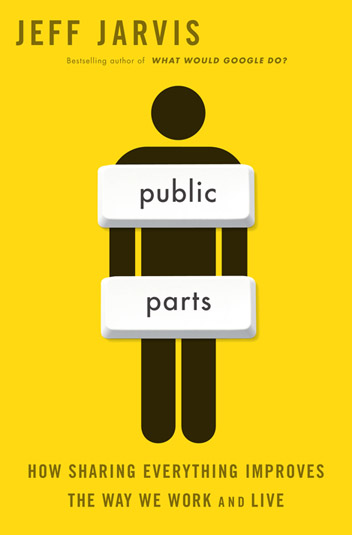 In his latest weekly Wall Street Journal column, Gordon Crovitz has penned a review of the new Jeff Jarvis book, Public Parts: How Sharing in the Digital Age Improves the Way We Work and Live
. Gordon’s review closely tracks my own thoughts on the book, which I laid out last week in my Forbes essay, “Is Privacy Overrated?” Gordon’s essay is entitled “Are We Too Hung Up on Privacy” and he finds, like I do, that Jarvis makes compelling case for understanding the benefits of publicness as the flip-side of privacy. Instead of repeating all the arguments we make in our reviews here, I’ll just ask people go check out both of our essays if they are interested.
In his latest weekly Wall Street Journal column, Gordon Crovitz has penned a review of the new Jeff Jarvis book, Public Parts: How Sharing in the Digital Age Improves the Way We Work and Live
. Gordon’s review closely tracks my own thoughts on the book, which I laid out last week in my Forbes essay, “Is Privacy Overrated?” Gordon’s essay is entitled “Are We Too Hung Up on Privacy” and he finds, like I do, that Jarvis makes compelling case for understanding the benefits of publicness as the flip-side of privacy. Instead of repeating all the arguments we make in our reviews here, I’ll just ask people go check out both of our essays if they are interested.
I did, however, want to elaborate on one thing I didn’t have time to discuss in my review of the Jarvis book. While I like the approach he used in the book, I thought Jarvis could have spent a bit more time exploring some the thorny legal issues in play when advocates of privacy regulation look to enshrine into law quite expansive views of privacy “rights.”
One of the things that both Crovitz and I appreciated about the Jarvis book was the way he tries to get us to think about privacy in the context of ethics instead of law. “Privacy is an ethic governing the choices made by the recipient of someone else’s information,” Jarvis argues, while “publicness is an ethic governing the choices made by the creator of one’s own information,” he says. In my review, I explained why this was so important: Continue reading →
A report in the U.K. Telegraph notes that the European Union is seeking to create a so-called “right to be forgotten” online, and has “drafted potential legislation that would include new, unprecedented privacy rights for citizens sharing personal data.” Details are sparse at this point, but according to this new 20-page European Commission document, “A Comprehensive Approach on Personal Data Protection in the European Union,” the EU will be:
clarifying the so-called ‘right to be forgotten’, i.e. the right of individuals to have their data no longer processed and deleted when they are no longer needed for legitimate purposes. This is the case, for example, when processing is based on the person’s consent and when he or she withdraws consent or when the storage period has expired. (p.8)
Two brief comments on this. First, it should be apparent that any “right to be forgotten” conflicts mightily with free speech rights and press freedom. As I discussed at greater length in this review of Solove’s Understanding Privacy as well as my essay on “Two Paradoxes of Privacy Regulation,” the problem with enshrining expansive privacy “rights” into law is that it means there will need to be stricter limits placed on speech and press freedoms. As Eugene Volokh noted in his 2000 law review article entitled, “Freedom of Speech, Information Privacy, and the Troubling Implications of a Right to Stop People from Speaking About You“: Continue reading →
In a post here last month on “Two Paradoxes of Privacy Regulation,” I discussed some of the interesting — and to me, troubling — similarities between rising calls for online privacy regulation and ongoing attempts to enact various types of controls on online speech or expression. In that essay, I argued that while most privacy advocates are First Amendment supporters as it pertains to content regulation, they abandon their free speech values and corresponding constitutional tests when it comes to privacy regulation. When the topic of debate shifts from concerns about potentially objectionable content to the free movement of personal information, personal responsibility and self-regulation become the last option, not the first. Privacy advocates typically ignore, downplay, or denigrate user-empowerment tools, even though many of those same advocates endorse “self-help” efforts as the superior method of dealing with objectionable speech or media content. In essence, therefore, they are claiming self-help is the right answer in one context, but not the other. Ironically, therefore, privacy advocates and moral conservatives actually share much in common in that they are using the same playbook to advance their goals: They are rejecting personal responsibility and user-empowerment tools and techniques in favor or government control for their respective issues.
Keeping that insight in mind, I want to take this comparison a step further and suggest that what really unites these two movements is a general conservatism about how our online lives and online business should be governed. For the moral conservatives, that instinct is well-understood. They want hold the line against what they believe is a decaying moral order by restricting access to potentially objectionable speech or content — dirty words, violent video games, online porn, or whatever else. The conservatism of the modern privacy movement is less obvious at first blush. I suspect that many privacy conservatives would not consider themselves “conservative” at all, and they might even be highly offended at being grouped in with moral conservatives who seek to wield government power to control online speech and expression. Nonetheless, the two groups share a common trait —
an innate hostility to the impact of technological / social change within the realm of “rights” or values they care about. In their respective arenas, they both rejected the evolutionary dynamism of the free marketplace and they long for a return to a simpler and supposedly better time. Continue reading →
As a cyber-libertarian, I’ve been lucky enough to work with people of all ideological stripes in pursuit of various public policy objectives. I’ve made selective alliances with people on the Right on economic policy issues (like opposing Net Neutrality regulation, Internet taxes, etc) and also worked closely with folks on the Left on speech and culture issues (content controls, anonymity, online safety concerns, etc).
While engaging with with people on both sides of the political fence, I’m often struck by some of their internal inconsistencies. Conservatives, for example, talk about a big game about personal responsibility on some issues, but quickly abandon that notion when they claim media content or online speech should be regulated by the State (typically “for the children.”) In this essay, I’d like to discuss interesting inconsistencies on the political Left, especially among advocates of strong privacy regulation (most of whom tend to be Left-leaning in their worldview). In particular, here are the two things I find most interesting about modern privacy advocates:
(1)
Most privacy advocates are vociferous First Amendment supporters, yet they abandon their free speech values and corresponding constitutional tests when it comes to privacy regulation. When it comes to proposals to regulate media content or online speech, most folks on the Left have a very principled, clear-cut position: people (or parents) should take responsibility for unwanted information flows in their lives (or the lives of their children). In particular, they rightly argue that the many user empowerment tools on the market (filters, monitoring software, other parental control technologies) constitute a so-called “less-restrictive means” of controlling content when compared to government regulation.
Advocacy groups that I have a great deal of respect for and work with quite closely on these issues–such as EFF, CDT and ACLU—all take this position. Generally speaking, they argue that, when it comes to speech regulation, “household standards” (user-level controls) should trump “community standards” (government regulation). And in Court—where I frequently file joint amicus briefs with them—they repeatedly employ the “less-restrictive means” test to counter government efforts to regulate information flows.
But when it comes to privacy, they throw all this out the window! Continue reading →
Congresswoman Diane E. Watson, who serves as Chair of the House Government Management, Organization, and Procurement Subcommittee, has just introduced new legislation proposing the creation of a “National Office for Cyberspace” within the Executive Office of the President. Rep. Watson’s bill, “The Federal Information Security Management Act of 2010” (H.R. 4900) amends the Federal Information Security Management Act (FISMA) of 2002 in an attempt “to strengthen and harmonize the federal government’s efforts to ensure the integrity of its information infrastructure.”
It’s hard to argue against that goal, and I won’t here. Clearly, our government needs to get it’s own house in order when it comes to network and data security. Nonetheless, an “Office for Cyberspace” gives me pause. Although I always try to be careful with slippery slope arguments (per Eugene Volokh’s excellent advice here), I think there are good reasons to fear that any Executive Branch-level “Office for Cyberspace” would quickly come to take on a wide variety of other policy matters beyond just federal cyber-security issues. The Federal Communication Commission’s past and recent history of regulatory mission creep is not encouraging in this regard. The agency has always looked to grow its mission and powers, and it has often succeeded. Of course, to be fair, the fundamental ambiguity of certain clauses and phrases within the agency’s charter document– the Communications Act of 1934 — left the door open to creative readings of things like what was in “the public interest,” or what constituted “fair and non-discriminatory” practices.
If, by contrast, the powers of this new “National Office for Cyberspace” are tightly limited to the mission of simply ensuring that the federal government keeps its own house in order — and doesn’t try to regulate our digital houses at the same time — then perhaps we have nothing to worry about. But, I remain a bit paranoid about these things and fear that the old “Hands Off the Net!” dream dies a little more each day because of bills like this.
Yesterday’s Supreme Court decision in Citizens United v. FEC essentially stands for the proposition that free speech is free speech regardless of the speaker. The 5-4 majority for the Court ruled that “We find no basis for the proposition that, in the context of political speech, the Government may impose restrictions on certain disfavored speakers. Both history and logic lead us to this conclusion.” (at 25) Echoing its early decision in Bellotti, the Court noted that “Political speech is ‘indispensable to decisionmaking in a democracy, and this is no less true because the speech comes from a corporation rather than an individual.’” (at 33) “All speakers, including individuals and the media, use money amassed from the economic marketplace to fund their speech. The First Amendment protects the resulting speech, even if it was enabled by economic transactions with persons or entities who disagree with the speaker’s ideas.” (at 35) “There is simply no support for the view that the First Amendment, as originally understood, would permit the suppression of political speech by media corporations.” (at 37)
Somehow this has proven controversial, even radical, to some. But, as George Will correctly notes, “This was radical only because after nearly four decades of such ‘reform’ the First Amendment has come to seem radical. Which, indeed, it is. The Supreme Court on Thursday restored First Amendment protection to the core speech that it was designed to protect — political speech.” Essentially, the decision gets Congress out of the game of picking who, or what platform, deserves full First Amendment protection when it comes to uttering political speech. And there’s nothing radical about that.
Indeed, as Justice Kennedy noted for the majority, there is nothing surprising about this reasoning once you realize that almost every other type legislative or regulatory speech restriction has been struck down as a violation of the First Amendment. “The law before us is an outright ban [on political speech], backed by criminal sanctions,” Kennedy noted (at 20). “If the First Amendment has any force, it prohibits Congress from fining or jailing citizens, or associations of citizens, for simply engaging in political speech.” (at 33) Think about this for a second: Criminal sanctions or jail time for political speech! How in the world did we get to the point in this nation where criminalizing political speech became acceptable to our legislators? Ignoring the obvious answer—it’s all about protecting incumbents—what is really “radical” here is not that the Supreme Court setting us back on the right path, but that our legislative branch has veered so far off of it.
Continue reading →
The Gawker offers a fascinating discussion of the legal right to anonymity:
“There is clearly a moral case that some people should be able to join the public debate and retain their anonymity,” Tench told Gawker. “And I think this will have a chilling effect. Blogs like this can only exist anonymously, and I imagine that anyone who wanted to set one up is thinking about this case.”
As well they should. But the notion that anonymous publishers have a right, in perpetuity, to keep their identities a secret—or that people who learn their identities are honor-bound not to reveal them—is nonsense.
Amen! One can resist, fiercely, government efforts to reduce online anonymity through age verification or identity authentication mandates, as Adam Thierer have argued most recently in our work about efforts to expand COPPA to cover adolescents (“COPPA 2.0,” which would indirectly mandate age verification for large numbers of adults for the first time). One might even argue that there are moral reasons to resist the urge to out pseudonymous/anonymous bloggers (just as one might avoid outing closeted gays out of respect for their privacy). But one need not accept the pernicious idea that the government should punish the outing of peusodonymous/anonymous writers, which is simply a restraint on legitimate free speech.
This exchange, cited by the Gawker article, is particularly interesting, and demonstrates how one can distinguish the question of whether outing is “right” or “appropriate” from the question of whether it should be punished by law:
When the National Review‘s Ed Whelan revealed Publius, who writes for Obsidian Wings, to be a professor of law at the South Texas College of Law named John F. Blevins earlier this month, the palpable online outrage forced Whelan to apologize.
Anyone interested in the long-running debate over how to balance online privacy with anonymity and free speech, whether Section 230‘s broad immunity for Internet intermediaries should be revised, and whether we need new privacy legislation must read the important and enthralling NYT Magazine piece “The Trolls Among Us” by Mattathias Schwartz about the very real problem of Internet “trolls“–a term dating to the 1980s and defined as “someone who intentionally disrupts online communities.”
While all trolls “do it for the lulz” (“for kicks” in Web-speak) they range from the merely puckish to the truly “malwebolent.” For some, trolling is essentially senseless web-harassment or “violence” (e.g., griefers), while for others it is intended to make a narrow point or even as part of a broader movement. These purposeful trolls might be thought of as the Yippies of the Internet, whose generally harmless anti-war counter-cutural antics in the late 1960s were the subject of the star-crossed Vice President Spiro T. Agnew‘s witticism:
And if the hippies and the yippies and the disrupters of the systems that Washington and Lincoln as presidents brought forth in this country will shut up and work within our free system of government, I will lower my voice.
But the more extreme of these “disrupters of systems” might also be compared to the plainly terroristic Weathermen or even the more familiar Al-Qaeda. While Schwartz himself does not explicitly draw such comparisons, the scenario he paints of human cruelty is truly nightmarish: After reading his article before heading to bed last night, I myself had Kafka-esque dreams about complete strangers invading my own privacy for no intelligible reason. So I can certainly appreciate how terrifying Schwartz’s story will be to many readers, especially those less familiar with the Internet or simply less comfortable with the increasing readiness of so many younger Internet users to broadcast their lives online.
But Schwartz leaves unanswered two important questions. The first question he does not ask:
Just how widespread is trolling? However real and tragic for its victims, without having some sense of the scale of the problem, it is difficult to answer the second question Schwartz raises but, wisely, does not presume to answer: What should be done about it? The policy implications of Schwartz’s article might be summed up as follows: Do we need new laws or should we focus on some combination of enforcing existing laws, user education and technological solutions? While Schwartz focuses on trolling, the same questions can be asked about other forms of malwebolence–best exemplified by the high-profile online defamation Autoadmit.com case, which demonstrates the effectiveness of existing legal tools to deal with such problems.
Continue reading →

 The Technology Liberation Front is the tech policy blog dedicated to keeping politicians' hands off the 'net and everything else related to technology.