A new study (which is actually based on an old study) by Dr. Craig Anderson of Iowa State University and two other researchers is making news today because it suggests a link between violent video games and real-world aggression. I have written extensively about such studies here in the past, and have included a list of relevant links down below. But let me just use the opportunity to restate the fundamental problem with the way the press reports these things.
- First, the press typically accepts the assertion made by authors of studies like these that the social “science” is unanimous in support of such a link between exposure to violent video games and real-world aggression. there is another side the story, but the press usually doesn’t report on it.
- Second, reporters almost always fail to ask about how the researchers define “violent” games and the resulting “aggression” found in these studies.
- Third, reporters almost never ask about how strong the correlation is or, more importantly, what other variables might have had an influence on the the subjects who were studied. (For example, did they factor in real violence in the home or at school?)
- Finally, the reporters almost never query the researchers about the biases they bring to the task of studying this issue (namely, do these researchers have strong feelings about the content in the games they review such that they think they should be regulated in some fashion?).
Luckily, other social researchers are willing to point out these deficiencies. (See, for example, my reviews of the recent books by Drs. Kutner & Olson as well as Dr. Kourosh Dini.) With reference to the new study reported in the press today, Texas A&M researcher Dr. Christopher Ferguson has challenged the study on many of the grounds I listed above. Specifically, in a letter to the journal (Pediatrics) in which the Anderson study appeared, Dr. Ferguson argues:
Continue reading →
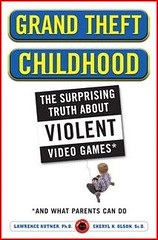 Don’t judge a book by its cover (or its title, for that matter). I’m usually faithful to that maxim, but I must admit that when I first saw the title and cover of “<a href="http://www.amazon.com/Grand-Theft-Childhood-Surprising-Violent/dp/0743299515/ref=pd_bbs_sr_1?ie=UTF8&s=books&qid=1208179493&sr=8-1″>Grand Theft Childhood: The Surprising Truth About Violent Video Games and What Parents Can Do,” I rolled my eyes and thought to myself, “here we go again.” I figured that I was in for another tedious anti-gaming screed full of myths and hysteria about games and gamers. Boy, was I wrong. Massively wrong.
Lawrence Kutner, PhD, and Cheryl K. Olson, ScD, cofounders and directors of the Harvard Medical School Center for Mental Health and Media, have written the most thoroughly balanced and refreshingly open-minded book about video games ever penned. They cut through the stereotypes and fear-mongering that have thus far pervaded the debate over the impact of video games and offer parents and policymakers common-sense advice about how to approach these issues in a more level-headed fashion. They argue that:
Today, an amalgam of politicians, health professionals, religious leaders and children’s advocates are voicing concerns about video games that are identical to the concerns raised one, two and three generations ago with the introduction of other new media. Most of these people have the best of intentions. They really want to protect children from evil influences. As in the past, a few have different agendas and are using the issue manipulatively. Unfortunately, many of their claims are based on scanty evidence, inaccurate assumptions, and pseudoscience. Much of the current research on violent video games is both simplistic and agenda driven. (p. 55)
They note that these groups, “probably worry too much about the wrong things and too little about more subtle issues and complex effects that are much more likely to affect our children.” They continue:
Continue reading →

 The Technology Liberation Front is the tech policy blog dedicated to keeping politicians' hands off the 'net and everything else related to technology.