What Unites Advocates of Speech Controls & Privacy Regulation? [pdf]
by Adam Thierer & Berin Szoka
The Progress & Freedom Foundation,
Progress on Point No. 16.19
Anyone who has spent time following debates about speech and privacy regulation comes to recognize the striking parallels between these two policy arenas. In this paper we will highlight the common rhetoric, proposals, and tactics that unite these regulatory movements. Moreover, we will argue that, at root, what often animates calls for regulation of both speech and privacy are two remarkably elitist beliefs:
- People are too ignorant (or simply too busy) to be trusted to make wise decisions for themselves (or their children); and/or,
- All or most people share essentially the same values or concerns and, therefore, “community standards” should trump household (or individual) standards.
While our use of the term “elitism” may unduly offend some understandably sensitive to populist demagoguery, our aim here is not to launch a broadside against elitism as
Time magazine culture critic William H. Henry once defined it: “The willingness to assert unyieldingly that one idea, contribution or attainment is better than another.”[1] Rather, our aim here is to critique that elitism which rises to the level of political condescension and legal sanction. We attack not so much the beliefs of some leaders, activists, or intellectuals that they have a better idea of what it in the public’s best interest than the public itself does, but rather the imposition of those beliefs through coercive, top-down mandates.
That sort of elitism—elitism enforced by law—is often the objective of speech and privacy regulatory advocates. Our goal is to identify the common themes that unite these regulatory movements, explain why such political elitism is unwarranted, and make it clear how it threatens individual liberty as well as the future of free and open Internet. As an alternative to this elitist vision, we advocate an empowerment agenda: fostering an environment in which users have the tools and information they need to make decisions for themselves and their families. Continue reading →
 The Senate Commerce Committee held a hearing yesterday where a number of Senators as well as Julius Genachowski, the new Chairman of the Federal Communications Commission, did a lot of fretting about the state of the modern children’s television programming marketplace. According to the Wall Street Journal, Senate Commerce Committee Chairman Jay Rockefeller (D-WV):
suggested that a “little red button” be required on TVs so that a child could push the button to find out how a show is rated. Democratic Sen. Mark Pryor of Arkansas agreed that a red button might help since parents often have difficulties figuring out which shows are appropriate for their children to watch.
Well, I have some good news for the Senators: There are already quite a few little buttons on every remote control made today, and at least one of those buttons can pull up an on-screen guide to get more program info! (Another of them can turn the TV off!) Moreover, the ratings for just about every program already appear at the beginning of each show, and sometimes in between. And you can find out plenty more online about every TV show under the sun if you care to look. So, I’m not sure what that fuss is all about, and we certainly don’t need to mandate “little red buttons” on every TV set when program information can be found in so many other ways.
What is more troubling about all the hand-wringing taking place at the hearing, as well as the talk of reopening the Children’s Television Act of 1990 to potentially impose more content mandates on video programmers and distributors, is that: (1) there doesn’t seem to be much appreciation for just how much wonderful children’s programming is out there today compared to the past, and (2) there doesn’t seem to be much recognition of the serious First Amendment issues at stake when government gets involved in the messy business of regulating video programming.
Continue reading →
Says Epic Games founder and CEO Tim Sweeney. I wonder what the FTC will think about this prospect in the report Congress asked them to send this year about video games. I think it’s safe to assume that the thought of life-like sex and violence will create a true technopanic.
Many folks are discussing Christopher Ferguson’s latest paper on “The School Shooting / Violent Video Game Link: Causal Relationship or Moral Panic?” And with good reason. It’s an important look at how “moral panics” develop in modern society, in this case around video games. [Moral panics is a subject I have written on at length here many times
before. Alice Marwick’s brilliant article on “technopanics” is also worth reading in this regard].
As I’ve noted here before, Ferguson has penned many important articles raising questions about the claims made by some other psychologists (and politicians) that there is causal relationship between exposure to violent video games and youth aggression. Ferguson has shown there are reasons to be skeptical of such claims — both methodologically and practically-speaking. More on that down below.
In his latest piece, however, Ferguson, a professor at Texas A&M’s Department of Behavioral, Applied Sciences and Criminal Justice, is more fully developing moral panic theory, which he describes as follows: “A moral panic occurs when a segment of society believes that the behavior or moral choices of others within that society poses a significant risk to the society as a whole.” To illustrate the various forces at work that drive moral panics, Ferguson uses this “Moral Panic Wheel”:
![Moral Panic Wheel [Ferguson]](http://farm4.static.flickr.com/3080/3219688961_6d255b309f.jpg) Continue reading →
Continue reading →

My Kid is the Man of Steel! ... in his mind.
Regular readers will recall my great interest in video games and the public policy debates surrounding efforts to regulate “violent” games in particular. One thing I bring up in almost every essay I write on this subject is how fears about kids and video games are almost always overblown and that kids can typically separate fantasy from reality. Nonetheless, kids have active imaginations and adults sometimes fear that which they cannot understand or appreciate. Friendly mentoring and open-minding parenting can go a long way to encouraging kids to make smart choices and understand where to draw lines, whereas efforts to demonize video games and youth culture almost always backfire.
Anyway, what got me thinking about all this again was an entertaining column in today’s
Washington Post by Ron Stanley (“Who Needs a TV to Play Video Games“), which describes the author’s experiences with his nephew when they played out video game-like scenarios using traditional toys and household items. It’s a wonderful piece worth reading in its entirety, but here’s the key takeaway that I’d like to discuss:
There was no evidence that television and video games had stifled the kids’ creativity. Nor was there any evidence that technology had made them smarter than earlier generations. They simply had a different frame of reference, one that included video games and computers as well as ponies, pet stores and sword fights. Children play with the tools at hand, and they’re great at thinking metaphorically — at imagining that a landspeeder is a sentient robot or that a stick is a gun or that salt-and-pepper shakers are a bride and groom or that a card table is a horse’s stable.
They’re also geniuses at figuring out simple mechanics. My 6-year-old nephew had to explain to me that miniature low-rider cars don’t roll very well on carpet and will flip over more than if racing on hardwood floors. Novice that I was, I was choosing cars that looked the coolest. And they are geniuses at intuiting rules and systems, and at re-creating these rules and systems in their own play. Children who play lots of card games will invent their own card games. Children who play lots of board games will invent their own board games. And children who play lots of video games will invent their own video-game-like games when they don’t have access to the game controllers.
Continue reading →
A new study (which is actually based on an old study) by Dr. Craig Anderson of Iowa State University and two other researchers is making news today because it suggests a link between violent video games and real-world aggression. I have written extensively about such studies here in the past, and have included a list of relevant links down below. But let me just use the opportunity to restate the fundamental problem with the way the press reports these things.
- First, the press typically accepts the assertion made by authors of studies like these that the social “science” is unanimous in support of such a link between exposure to violent video games and real-world aggression. there is another side the story, but the press usually doesn’t report on it.
- Second, reporters almost always fail to ask about how the researchers define “violent” games and the resulting “aggression” found in these studies.
- Third, reporters almost never ask about how strong the correlation is or, more importantly, what other variables might have had an influence on the the subjects who were studied. (For example, did they factor in real violence in the home or at school?)
- Finally, the reporters almost never query the researchers about the biases they bring to the task of studying this issue (namely, do these researchers have strong feelings about the content in the games they review such that they think they should be regulated in some fashion?).
Luckily, other social researchers are willing to point out these deficiencies. (See, for example, my reviews of the recent books by Drs. Kutner & Olson as well as Dr. Kourosh Dini.) With reference to the new study reported in the press today, Texas A&M researcher Dr. Christopher Ferguson has challenged the study on many of the grounds I listed above. Specifically, in a letter to the journal (Pediatrics) in which the Anderson study appeared, Dr. Ferguson argues:
Continue reading →
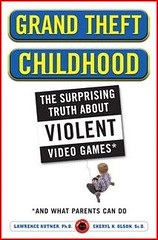 Don’t judge a book by its cover (or its title, for that matter). I’m usually faithful to that maxim, but I must admit that when I first saw the title and cover of “<a href="http://www.amazon.com/Grand-Theft-Childhood-Surprising-Violent/dp/0743299515/ref=pd_bbs_sr_1?ie=UTF8&s=books&qid=1208179493&sr=8-1″>Grand Theft Childhood: The Surprising Truth About Violent Video Games and What Parents Can Do,” I rolled my eyes and thought to myself, “here we go again.” I figured that I was in for another tedious anti-gaming screed full of myths and hysteria about games and gamers. Boy, was I wrong. Massively wrong.
Lawrence Kutner, PhD, and Cheryl K. Olson, ScD, cofounders and directors of the Harvard Medical School Center for Mental Health and Media, have written the most thoroughly balanced and refreshingly open-minded book about video games ever penned. They cut through the stereotypes and fear-mongering that have thus far pervaded the debate over the impact of video games and offer parents and policymakers common-sense advice about how to approach these issues in a more level-headed fashion. They argue that:
Today, an amalgam of politicians, health professionals, religious leaders and children’s advocates are voicing concerns about video games that are identical to the concerns raised one, two and three generations ago with the introduction of other new media. Most of these people have the best of intentions. They really want to protect children from evil influences. As in the past, a few have different agendas and are using the issue manipulatively. Unfortunately, many of their claims are based on scanty evidence, inaccurate assumptions, and pseudoscience. Much of the current research on violent video games is both simplistic and agenda driven. (p. 55)
They note that these groups, “probably worry too much about the wrong things and too little about more subtle issues and complex effects that are much more likely to affect our children.” They continue:
Continue reading →
Today and tomorrow I am attending a terrific conference at Penn State University called, “Playing to Win: The Business and Social Frontiers of Videogames.” It features panel discussions about various legal and business issues facing the video game industry, as well as discussions about how video games are used to aid teaching and learning. There are also panels on multiplayer online worlds and virtual reality environments and the issues surrounding both. [They will apparently be posting videos from the conference on their site shortly.]
 The folks at PSU were kind enough to invite me to deliver the luncheon keynote on Day 1 and I decided to provide a broad overview of the policy issues facing video games that I have covered in some of my past work. My presentation was entitled, “Video Games, Ratings, Parental Controls, & Public Policy: Where Do We Stand?” and the entire 36-slide presentation is now available online here. Down below, I thought I would just outline a couple of the key themes I touched upon in my presentation.
Continue reading →
One of the things I find most interesting about calls to regulate “excessively violent” content on television, in movies, or in video games is the way critics make massive leaps of logic and draw outrageous conclusions based on myopic, anecdotal reasoning. I was reminded of that again today when reading through an interview with Sen. Jay Rockefeller (D-W.Va), one of the most vociferous critics of all sorts of media content and a long-time proponent of regulation to censor such violent content in particular (however it is defined). (I have written about his past regulatory proposals here and here).
Here’s what he recently told the editorial board of The Register-Herald of West Virginia:
Continue reading →
The video game industry’s string of unbroken First Amendment court victories continued this week with a win in the case of Video Software Dealers Association v. Schwarzenegger. [Decision here.] In this case, the VSDA and the Entertainment Software Association brought a suit seeking a permanent injunction against a California law passed in October 2005 (A.B.1179), which would have blocked the sale of violent video games to those under 18. Offending retailers could have been fined for failure to comply with the law.
The court’s decision overturning the law was written by Judge Ronald Whyte and it echoed what every previous decision on this front has held, namely:
Continue reading →

 The Technology Liberation Front is the tech policy blog dedicated to keeping politicians' hands off the 'net and everything else related to technology.