Posts tagged as:

If there is one thing I have learned in almost 23 years of covering communications and media regulation it is this: No matter how well-intentioned, regulation often has unintended consequences that hurt the very consumers the rules are meant to protect. Case in point: “universal service” mandates that require a company to serve an entire area as a condition of offering service at all. The intention is noble: Get service out to everyone in the community, preferably at a very cheap rate. Alas, the result of mandating that result is clear: You get less competition, less investment, less innovation, and less consumer choice. And often you don’t even get everyone served.

Consider this Wall Street Journal article today, “Google Fiber Is Fast, but Is It Fair? The Company Provides Neighborhoods With Faster and Cheaper Service, but Are Some Being Left Behind?” In the story, Alistair Barr notes that:

U.S. policy long favored extending service to all. AT&T touted its “universal service” in advertisements more than a century ago. The concept was codified in a 1934 law requiring nationwide “wire and radio services” to reach everyone at “reasonable charges.” In exchange for wiring a community, telecommunications providers often gained a monopoly. Cities made similar deals with cable-TV providers beginning in the 1960s.

The problem, of course, is that while this model allowed for the slow spread of service to most communities, it came at a very steep cost: Monopoly and plain vanilla service. I documented this in a 1994 essay entitled, “Unnatural Monopoly: Critical Moments in the Development of the Bell System Monopoly.” As well-intentioned regulatory mandates started piling up, competition slowly disappeared. And a devil’s deal was eventually cut between regulators and AT&T to adopt the company’s advertising motto — “One Policy, One System, Universal Service” — as the de facto law of the land. Continue reading →

If broadband Internet infrastructure had been built to the same extent as public water-supply systems , more than twice as many Americans would lack fixed broadband Internet access.

After abandoning the “information superhighway” analogy for the Internet, net neutrality advocates began analogizing the Internet to waterworks. I’ve previously discussed the fundamental difference between infrastructure that distributes commodities (e.g., water) and the Internet, which distributes speech protected by the First Amendment – a difference that is alone sufficient to reject any notion that governments should own and control the infrastructure of the Internet. For those who remain unconvinced that the means of disseminating mass communications (e.g., Internet infrastructure) is protected by the First Amendment, however, there is another flaw in the waterworks analogy: If broadband Internet infrastructure had been built to the same extent as public water-supply systems, more than twice as many Americans would lack fixed broadband Internet access. Continue reading →

In an important essay this week entitled “Silicon Valley’s ‘Suicide Impulse’,” Wall Street Journal columnist L. Gordon Crovitz warns that “Silicon Valley has long prided itself on avoiding the lumbering relationship between big government and most industries, but somehow it has become one of the top lobbyists in Washington.” Crovitz is worried that Internet and technology companies are falling prey to what Milton Friedman labeled “The Business Community’s Suicidal Impulse”: the persistent propensity to persecute one’s competitors using regulation or the threat thereof. “Rather than lobby government to go after one another,” Crovitz argues, “Silicon Valley lobbyists should unite to go after overreaching government. Instead of the ‘suicide impulse’ of lobbying for more regulation, Silicon Valley should seek deregulation and a long-overdue freedom to return to its entrepreneurial roots.”

Crovitz’s essay touches upon a dangerous trend I have written about here and elsewhere in the past: the increasing politicization of the Internet and information technology sectors and the gradual rise of rent-seeking (i.e., favor-seeking) over time. I’ve written about this problem in essays like:

These essays have documented how tech companies are increasingly vying for the attention of legislators and regulators in Washington, statehouses, and international capitals across the globe.

Why should we care about the increasing politicization of the information technology sector? Continue reading →

Yesterday it was my privilege to speak at a Free State Foundation (FSF) event on “Ideas for Communications Law and Policy Reform in 2013.” It was moderated by my friend and former colleague Randy May, who is president of FSF, and the event featured opening remarks from the always-excellent FCC Commissioner Robert McDowell.

During the panel discussing that followed, I offered my thoughts about the problem America continues to face in cleaning up communications and media law and proposed a few ideas to get reform done right once and for all. I don’t have time to formally write-up my remarks, but I thought I would just post the speech notes that I used yesterday and include links to the relevant supporting materials. (I’ve been using a canned version of this same speech at countless events over the past 15 years. Hopefully lawmakers will take up some of these reforms some time soon so I’m not using this same set of remarks in 2027!)

Continue reading →

Those of you who spend a lot of time thinking about public choice economics and the problem of cronyism more generally might appreciate this little blurb I found today about the Universal Service Fund (USF).

It goes without saying that America’s “universal service” (telephone subsidy) system is a cesspool of cronyism, favoring some companies over others and grotesquely distorting economic incentives in the process. And the costs just keep growing without any end in sight. Just go to any FCC meeting or congressional hearing about universal service policy and listen to all the companies insisting that they need the subsidy gravy trail to keep on rolling and you’ll understand why that is the case. But plenty of policymakers (especially rural lawmakers) love the system, too, since it allows them to dispense targeted favors.

Anyway, I was flipping through the latest copy of “The RCA Voice” which is the quarterly newsletter of what used to be called the Rural Cellular Association, but now just goes by RCA.  RCA represents rural wireless carriers who, among other things, would like increased government subsidies for–you guessed it–rural wireless services. Their latest newsletter includes an interview with Rep. Don Young (R-AK) who was applauded by RCA for launching the Congressional Universal Service Fund Caucus, whose members basically want to steer even more money into the USF system (and their congressional districts). Here’s the relevant part of the Q&A with Rep. Young:

RCA VOICE: “How important is it for carriers serving rural areas to be engaged with their members of Congress on USF issues?”

REP. DON YOUNG (R-AK): “The more carriers engage with both their Representatives and Senators, the better. While the early bird may get the worm, the bird that doesn’t even try definitely won’t get any worms. The same applies to Congress.”

Well, you gotta admire chutzpah like that! It pretty much perfectly sums up why universal service has always been a textbook case study of public choice dynamics in action. Sadly, it also explains why there isn’t a snowball’s chance in hell that this racket will be cleaned up any time soon.

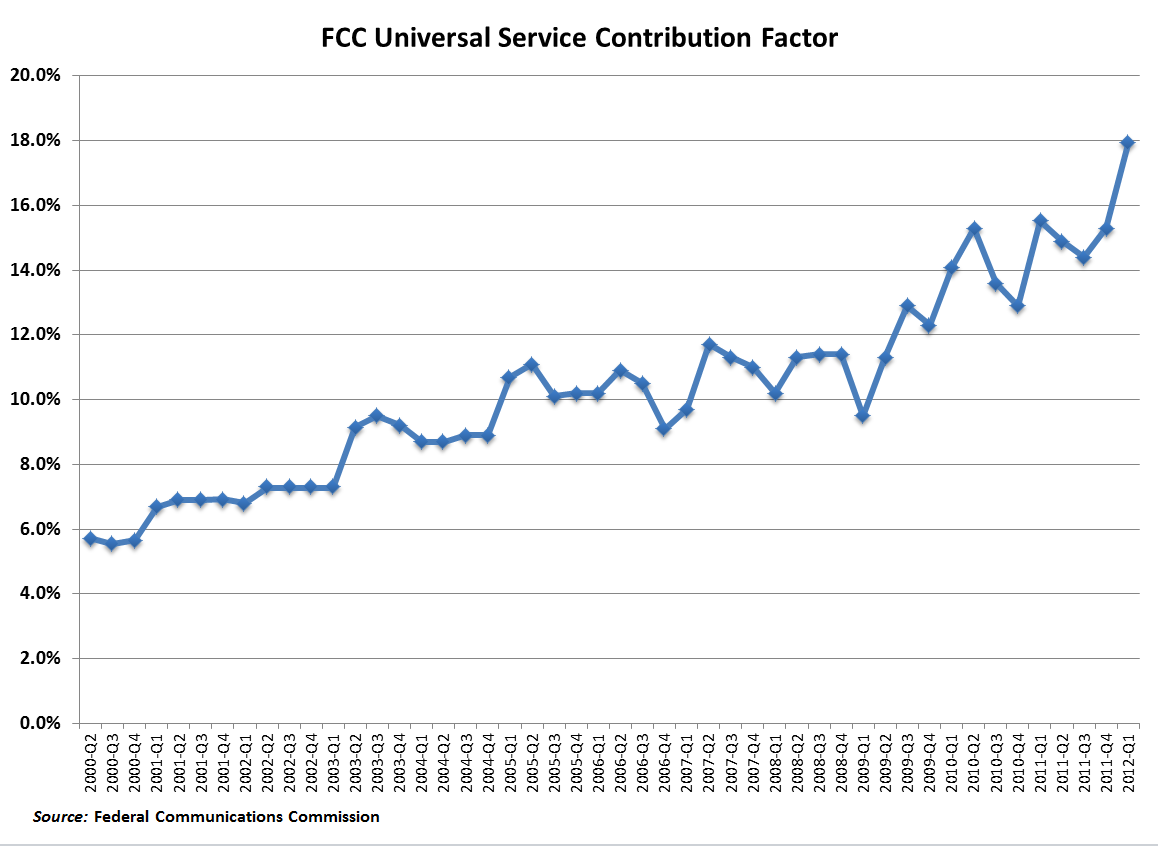
The FCC’s universal service tax is officially out of control. The agency announced yesterday that the “universal service contribution factor” for the 1st quarter of 2012 will go up to 17.9%.  This “contribution factor” is a tax imposed on telecom companies that is adjusted on a quarterly basis to accommodate universal service programs. The FCC doesn’t like people calling it a tax, but that’s exactly what it is. And it just keeps growing and growing. In fact, as the chart below reveals, it has been exploding in recent years. It was in single digits just a few years ago but is now heading toward 20%. And not only is this tax growing more burdensome, but it is completely unsustainable. As the taxable base (traditional interstate telephony) is eroded by new means of communicating, the tax rate will have to grow exponentially or the base will have to be broadened to cover new technologies and services. We should have junked the current carrier-delivered universal service subsidy system years ago and gone with a straight-forward voucher system. A means-tested voucher could have targeted assistance to those who needed it without creating an inefficient, unsustainable hidden tax like we have now. For all the ugly details, I recommend reading all of Jerry Ellig’s research on the issue.

Freelance journalist Laurence Cruz was kind enough to call me recently looking for comment on whether broadband should be considered a human right. Well, actually, he probably didn’t have many options. If you do a quick search on the topic, you’ll find an endless stream of essays in favor of the proposition.  Then, somewhere in the mix, you’ll find a few dissenting rants I’ve penned here in the past. So I’m getting used to playing the baddie in this drama.

Cruz’s essay is now up over at “The Network,” which is Cisco’s technology news site. Here’s what I had to say in opposition to the proposition:

Continue reading →

Federal Communications Chairman Genachowski previewed the universal service reform plan the commissioners are discussing in a speech today.

The speech offers a masterful summary of the myriad inefficiencies created by the current universal service subsidies and intercarrier compensation payments. Most of the examples highlight plain old-fashioned waste. The universal service program collects billions of dollars from telephone subscribers, then simply wastes a goodly portion of it by subsidizing telephone competition in places where unsubsidized service from cable or satellite already exists, subsidizing multiple mobile wireless competitors, and subsidizing local phone companies that have little incentive for cost containment because they are still subject to rate-of-return regulation. The intercarrier compensation system uses per-minute charges to collect billions of dollars from telephone subscribers and hands it to phone companies that sometimes charge as little as $8 a month for phone service. There’s also a race to game this system as the companies that benefit seek new ways to inflate the regulated charges they collect, and the companies that pay seek clever ways to avoid paying.

It’s a powerful brief for reform. Never thought I’d live to see the day whan an FCC chairman would say so many things that are substantiated by economic research.

Nevertheless, a few parts of the speech give me cause for concern about the solutions the FCC commissioners may be discussing.

First, the chairman claims that 18 million Americans live in areas without access to broadband — up from the 14 million estimated in the National Broadband Plan.  The size of this figure suggests to me that the FCC is still over-estimating the number of people without access by defining “broadband” as a speed fast enough to exclude 3G wireless, many small rural Wireless Internet Service Providers, and satellite. Absent an adjustment in the definition of broadband, the subsidy program will be larger than it needs to be, and so telephone consumers will pay excessive universal service charges. Continue reading →

A couple days before Congress announced a debt deal, half a dozen telecommunications companies filed a plan on July 29 with the Federal Communications Commission that attempts to resolve a much longer-running set of negotiations over big bucks.  The “America’s Broadband Connectivity” Plan seeks to replace Universal Service Fund subsidies for telephone service in rural areas with subsidies for broadband in rural areas.

Like the federal budget negotiations, the never-ending negotiations over USF get bogged down in arguments over distribution: who gets what.  Indeed, it’s almost exclusively an argument over which companies get what. But federal telecommunications policy is supposed to advance the overall public interest, not just haggle over what corporate interest gets what piece of my pie. Here is a quick take on the biggest strengths and weaknesses of the plan in terms of advancing overall consumer welfare. By “consumer welfare,” I mean not just the welfare of the folks receiving subsidized services, but also the welfare of the majority who are paying a 15 percent charge on interstate phone services to fund the USF.

BIGGEST STRENGTHS

Fixed-term commitment: Rural phone subsidies have become a perpetual entitlement with no definition of when the subsidies can end because the problem is considered solved.  The ABC plan proposes a 10-year commitment to rural broadband subsidies.  By 2022 the FCC should assess whether any further high-cost universal service program is needed. This idea remedies a significant deficiency in the current high-cost subsidy program, which doesn’t even have outcome goals or measures. (That’s why I like to sing the final verse from “And the Money Kept Rolling In” from Evita when I talk about universal service.  Free State Foundation President Randy May asked me for an encore of this at the end of the foundation’s July 13 program on universal service, available here.)

Intercarrier compensation: “Intercarrier compensation” refers to the per-minute charges communications companies pay when they hand off phone traffic to each other. The plan proposes to ramp down all intercarrier charges to a uniform rate of $0.0007/minute.  Economists who study telecommunications have pointed out for decades that high per-minute charges reduce consumer welfare by discouraging consumers from communicating as much as they otherwise would.  MIT economist Jerry Hausman, in a paper prepared for the filing, estimates that low, uniform intercarrier charges would increase consumer welfare by about  $9 billion annually.

Legacy obligations: Public utility regulation traditionally forced regulated companies to offer certain services or serve certain markets at a loss, then charge profitable customers higher prices to cover the losses. Judge Richard Posner referred to this opaque practice as “Taxation by Regulation“: the customers paying inflated prices get “taxed” to accomplish a public purpose, but they don’t know it.  Some of these obligations continue today as federal requirements applied to “Eligible Telecommunications Carriers” or state “Carrier of Last Resort” obligations.  The plan would remove these obligations for companies that are not receiving USF subsidies.

BIGGEST WEAKNESSES

Definition of broadband: The plan would continue to inflate the cost of rural broadband subsidies by defining “broadband” as 4 megabytes per second download and 768 kilobytes per second upload.  This means 3G wireless, satellite, and some wireless Internet service providers do not count as “broadband.” This decision more than doubles the number of households considered “unserved” and rules out some lower-cost technologies.  Jerry Brito and I have written extensively about both the economics and the legality of this.  Interestingly, the ABC coalition’s legal white paper arguing that the commission has legal authority to adopt the plan makes no effort to show that the commission has authority to subsidize 4 mbps broadband; it only shows the commission has authority to subsidize some form of broadband.

Alternative cost technology threshold: The plan includes an “alternative cost technology” threshold that allows substitution of satellite broadband for customers who would cost more than $256/month to serve.  Inclusion of a threshold is actually a strength. But the $256/month figure is way too high.  Satellite broadband with speeds of 1-2 mbps is now available for $60 – $110 per month.  Consumers who pay a 15 percent surcharge on their local phone bills to fund USF should not be expected to provide a subsidy of more than $200 per month.

Mobility: The plan appears to advocate subsidies for mobile broadband service in places where it is not currently available.  So now the rural entitlement expands to include not just basic broadband service in the home to stay connected, but also a mobile service that a lot of Americans don’t even buy unless their employers pay for it! I question whether mobile broadband satisfies the 1996 Telecommunications Act’s criteria for universal service subsidies, such as “essential” (not just nice) for education or public safety, or subscribed to by a “substantial majority” of households. These questions should be thoroughly examined before anyone receives subsidies for mobile broadband. At a minimum, households should be eligible for only one broadband subsidy — wireline or mobile — but not both.



While most folks have been obsessing over their income taxes the past few weeks, Jerry Brito and I have been obsessing about a non-tax: the universal service assessments on our phone bills.

More specifically, the Federal Communications Commission has asked for comments on its plan to gradually turn the current phone subsidy program in high-cost rural areas into a broadband subsidy program in high-cost rural areas. This opens up a big tangled can of worms.  Comments are due Monday.  We deal with two issues in our comment:

Definition of broadband: Thankfully, the FCC is asking for comments on its proposal to define broadband as 4 Mbps download/1 Mbps upload. This is an important decision with a big effect on the size of the program. The 4 Mbps definition more than doubles the number of households considered “unserved,” because it doesn’t count 3G wireless or slower DSL or slower satellite broadband as broadband. It also raises the cost of the subsidies by requiring more expensive forms of broadband.

The definition fails to fit the factors the 1996 Telecom Act says the FCC is supposed to consider when determining what communications services qualify for universal service subsidies.  A download speed of 4 Mbps is not “essential” for online education; most online education providers say any broadband speed or even dialup is satisfactory. Nor is that speed “essential” for public safety; the biggest barrier to public safety broadband deployment is creation of an interoperable public safety network, which has nothing to do with USF subsidies. And the proposed speed is not subscribed to by a “substantial majority” of US households.  The most recent FCC statistics indicate that the fastest broadband download speed subscribed to by a “substantial majority” of US households is probably 768 kbps.

Definition of performance measures: Fifteen years after passage of the legislation that authorized the high cost universal service subsidies, the FCC has proposed to measure the program’s outcomes.  Actually, the FCC wants to measure intermediate outcomes like deployment, subscribership, and urban-rural rate comparability — not ultimate outcomes like expanded economic and social opportunities for people in rural areas.  But it’s a start …  provided that the FCC actually figures out how the subsidies have affected these intermediate outcomes, rather than just measuring trends and claiming the universal service subsidies caused any positive trends observed.  We have some suggestions on how to do this.  

Our full comment is available here.