A growing number of conservatives are calling for Big Government censorship of social media speech platforms. Censorship proposals are to conservatives what price controls are to radical leftists: completely outlandish, unworkable, and usually unconstitutional fantasies of controlling things that are ultimately much harder to control than they realize. And the costs of even trying to impose and enforce such extremist controls are always enormous.
Earlier this year,
The Wall Street Journal ran a response I wrote to a proposal set forth by columnist Peggy Noonan in which she proposed banning everyone under 18 from all social-media sites (“We Can Protect Children and Keep the Internet Free,” Apr. 15). I expanded upon that letter in an essay here entitled, “Should All Kids Under 18 Be Banned from Social Media?” National Review also recently published an article penned by Christine Rosen in which she also proposes to “Ban Kids from Social Media.” And just this week, Zach Whiting of the Texas Public Policy Foundation published an essay on “Why Texas Should Ban Social Media for Minors.”
I’ll offer a few more thoughts here in addition to what I’ve already said elsewhere. First, here is my response to the Rosen essay. National Review gave me 250 words to respond to her proposal:
While admitting that “law is a blunt instrument for solving complicated social problems,” Christine Rosen (“Keep Them Offline,” June 27) nonetheless downplays the radicalness of her proposal to make all teenagers criminals for accessing the primary media platforms of their generation. She wants us to believe that allowing teens to use social media is the equivalent of letting them operate a vehicle, smoke tobacco, or drink alcohol. This is false equivalence. Being on a social-media site is not the same as operating two tons of steel and glass at speed or using mind-altering substances.
Teens certainly face challenges and risks in any new media environment, but to believe that complex social pathologies did not exist before the Internet is folly. Echoing the same “lost generation” claims made by past critics who panicked over comic books and video games, Rosen asks, “Can we afford to lose another generation of children?” and suggests that only sweeping nanny-state controls can save the day. This cycle is apparently endless: Those “lost generations” grow up fine, only to claim it’s the
next generation that is doomed!
Rosen casually dismisses free-speech concerns associated with mass-media criminalization, saying that her plan “would not require censorship.” Nothing could be further from the truth. Rosen’s prohibitionist proposal would deny teens the many routine and mostly beneficial interactions they have with their peers online every day. While she belittles media literacy and other educational and empowerment-based solutions to online problems, those approaches continue to be a better response than the repressive regulatory regime she would have Big Government impose on society.
I have a few more things to say beyond these brief comments. Continue reading →
If you haven’t yet had the chance to check out the new Progress Forum, I encourage you to do so. It’s a discussion group for progress studies and all things related to it. The Forum is sponsored by The Roots of Progress. Even though the Forum is still in pre-launch phase, there are already many interesting threads worth checking out. I was my honor to contribute one of the first on the topic, “Where is ‘Progress Studies’ Going?” It’s an effort to sort through some of the questions and challenges facing the Progress Studies movement in terms of focus and philosophical grounding. I thought I would just reproduce the essay here, but I encourage you to jump over to the Progress Forum to engage in discussion about it, or the many other excellent discussions happening there on other issues.
Continue reading →
This is a compendium of readings on “
progress studies
,” or essays and books which generally make the case for technological innovation, dynamism, economic growth, and abundance. I will update this list as additional material of relevance is brought to my attention.
[Last update: 10/11/22]
Recent Essays
- Marc Andreessen, “The Techno-Optimist Manifesto,” a16z.com, October 16, 2023.
- Will Rinehart, “The Abundance Agenda,” The Exformation Newsletter, October 15, 2022.
- Sarah Constantin, “Unblocking Abundance: A Model for Activism,” Rough Diamonds, October 10, 2022.
- Derek Thompson, “The Forgotten Stage of Human Progress,” The Atlantic, May 11, 2022.
- Adam Thierer, “Where is ‘Progress Studies’ Going?” Progress Forum, April 23, 2022.
- Katherine Boyle, “The Case for American Seriousness,” Common Sense, April 18, 2022.
- William Rinehart, “Vetocracy, the Costs of Vetos and Inaction,” Center for Growth & Opportunity at Utah State University, March 24, 2022.
- James Pethokoukis, “Forget about Left Wing and Right Wing. How about an Up Wing America?” Faster Please, March 23, 2022.
- John W. Lettieri & Kenan Fikri, “The Case for Economic Dynamism and Why it Matters for the American Worker,” Economic Innovation Group, March 2022.
- Adam Kovacevich, “Saying YIMBY (Yes In My Back Yard) to “Civic Innovation,” Chamber of Progress, March 21, 2022.
- Eli Dourado, “Remove Barriers to Productivity,” City Journal, March 18, 2022.
- “A Case for Innovation and Optimism,” (A conversation with Jason Crawford), Discourse, March 2, 2022.
- Noah Smith, “A New Industrialist Roundup,” Noahpinion, February 3, 2022.
- James Pethokoukis, “When Will the Next Big Thing Arrive?” Faster Please, February 3, 2022.
- Alec Stapp & Caleb Watney, “
Progress is a Policy Choice
,” Institute for Progress, January 20, 2022.
- Adam Thierer, “
How to Get the Future We Were Promised
,” Discourse, January 18, 2022.
- Katherine Boyle, “
Building American Dynamism
,” Future, January 14, 2022.
- Derek Thompson, “
A Simple Plan to Solve All of America’s Problems
,” The Atlantic, January 12, 2022.
- Jason Crawford, “Progress, Humanism, Agency: An Intellectual Core for the Progress Movement,” Roots of Progress, January 11, 2022.
- Adam Thierer, “Defending Innovation Against Attacks from All Sides,” Discourse, November 9, 2021.
- Matthew Yglesias, “The Case for More Energy,” October 7, 2021.
- Jason Crawford, “
We need a new philosophy of progress
,” The Roots of Progress, August 23, 2021.
- Gale Pooley & Marian L. Tupy, “The Simon Abundance Index 2021,” Human Progress, April 22, 2021.
- Noah Smith, “
Techno-optimism for the 2020s
,” December 3, 2020.
- Ezra Klein, “
Why We Can’t Build
,” Vox, April 22, 2020.
- Marc Andreesen, “
It’s Time to Build
,” Future, April 18, 2020.
- Eli Dourado, “
How do we move the needle on progress
?” September 26, 2019.
- José Luis Ricón, “
About the ‘Progress’ in Progress Studies
” September 6, 2019.
- Will Rinehart, “
Progress Studies: Some Initial Thoughts
,” August 30, 2019.
- Adam Thierer, “
Is There a Science of Progress
?” AIER, August 8, 2019.
- Patrick Collison and Tyler Cowen, “
We Need a New Science of Progress
,” The Atlantic, July 30, 2019.
- Tyler Cowen, “
The Case for the Longer Term
,” Cato Unbound, January 9, 2019.
- Vinod Khosla, “
We Need Large Innovations
,” Medium, January 1, 2018.
- Adam Thierer, “
How Technology Expands the Horizons of Our Humanity
,” Medium, November 19, 2018.
- Chelsea Follett, “Utopianism: One of the Biggest Obstacles to Progress,” Human Progress, August15, 2018.
- Eli Dourado, “
How Technological Innovation Can Massively Reduce the Cost of Living
,” PlainText, January 29, 2016.
Continue reading →
I recently posted an essay over at The Bridge about “The Pacing Problem and the Future of Technology Regulation.” In it, I explain why the pacing problem—the notion that technological innovation is increasingly outpacing the ability of laws and regulations to keep up—“is becoming the great equalizer in debates over technological governance because it forces governments to rethink their approach to the regulation of many sectors and technologies.”
In this follow-up article, I wanted to expand upon some of the themes developed in that essay and discuss how they relate to two other important concepts: the “Collingridge Dilemma” and technological determinism. In doing so, I will build on material that is included in a forthcoming law review article I have co-authored with Jennifer Skees, Ryan Hagemann (“Soft Law for Hard Problems: The Governance of Emerging Technologies in an Uncertain Future”) as well as a book I am finishing up on the growth of “evasive entrepreneurialism” and “technological civil disobedience.”
Recapping the Nature of the Pacing Problem
First, let us quickly recap that nature of “the pacing problem.” I believe Larry Downes did the best job explaining the “problem” in his 2009 book on
The Laws of Disruption. Downes argued that “technology changes exponentially, but social, economic, and legal systems change incrementally” and that this “law” was becoming “a simple but unavoidable principle of modern life.” Continue reading →
Here’s the first of two essays I’ve recently penned making “The Case for Internet Optimism.” This essay was included in the book, The Next Digital Decade: Essays on the Future of the Internet (2011), which was edited by Berin Szoka and Adam Marcus of TechFreedom. In these essays, I identify two schools of Internet pessimism: (1) “Net Skeptics,” who are pessimistic about the Internet improving the lot of mankind; and (2) “Net Lovers,” who appreciate the benefits the Net brings society but who fear those benefits are disappearing, or that the Net or openness are dying. (Regular readers of this blog will be familiar with these themes since I sketched them out in previous essays here such as, “Are You an Internet Optimist or Pessimist?” and “Two Schools of Internet Pessimism.”) The second essay is here.
This essay focuses on the first variant of Internet pessimism, which is rooted in general skepticism about the supposed benefits of cyberspace, digital technologies, and information abundance. The proponents of this pessimistic view often wax nostalgic about some supposed “good ‘ol days” when life was much better (although they can’t seem to agree when those were). At a minimum, they want us to slow down and think twice about life in the Information Age and how it’s personally affecting each of us. Occasionally, however, this pessimism borders on neo-Ludditism, with some proponents recommending steps to curtail what they feel is the destructive impact of the Net or digital technologies on culture or the economy. I identify the leading exponents of this view of Internet pessimism and their major works. I trace their technological pessimism back to Plato but argue that their pessimism is largely unwarranted. Humans are more resilient than pessimists care to admit and we learn how to adapt to technological change and assimilate new tools into our lives over time. Moreover, were we really better off in the scarcity era when we were collectively suffering from information poverty? Generally speaking, despite the challenges it presents society, information abundance is a better dilemma to be facing than information poverty. Nonetheless, I argue, we should not underestimate or belittle the disruptive impacts associated with the Information Revolution. But we need to find ways to better cope with turbulent change in a dynamist fashion instead of attempting to roll back the clock on progress or recapture “the good ‘ol days,” which actually weren’t all that good.
Down below, I have embedded the entire chapter in a Scribd reader, but the essay can also be found on the TechFreedom website for the book as well as on SSRN. I have also includes two updated tables that appeared in my old “optimists vs. pessimists” essay. The first lists some of the leading Internet optimists and pessimists and their books. The second table outlines some of the major lines of disagreement between these two camps and I divided those disagreements into (1) Cultural / Social beliefs vs. (2) Economic / Business beliefs.
Continue reading →
2009 was not as big of a year for Internet and information technology (“info-tech”) policy books as 2008 was, but there were still some notable titles released that offered interesting perspectives about the future of the Net and the impact the Digital Revolution is having on our lives, culture, and economy. So, like last year, I figured I would throw together my list of the 10 most important info-tech policy books of the year.
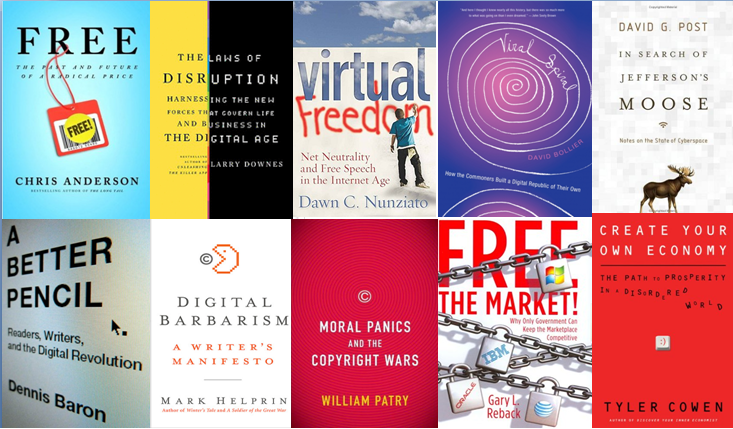 First, let me repeat a few of the same caveats and disclaimers that I set forth last year. What qualifies as an “important” info-tech policy book? Simply put, it’s a title that many people are currently discussing and that we will likely be referencing for many years to come. However, I want to be clear that merely because a book appears on my list it does not necessarily mean I agree with everything said in it. In fact, as was the case in previous years, I found much with which to disagree in my picks for the most important books of 2009 and I find that the cyber-libertarianism I subscribe to has very few fans out there.
Another caveat: Narrowly-focused titles lose a few points on my list. For example, if a book deals mostly with privacy issues, copyright law, or antitrust policy, it does not exactly qualify as the same sort of “tech policy book” as other titles found on this list since it is a narrow exploration of just one set of issues with a bearing on technology policy.
With those caveats in mind, here are my choices for the Most Important Info-Tech Policy Books of 2009. Continue reading →
 I recently finished Tyler Cowen’s latest book, Create Your Own Economy: The Path to Prosperity in a Disordered World. Like everything he writes, this book is worth reading and it will be of interest to those who follow technology policy debates since Cowen makes a passionate case for “Internet optimism” in the face of recent criticisms of the Internet and the Information Age in general.
Cowen is a Professor of Economics at George Mason University and the co-author, along with Alex Tabarrok, of the wonderful MarginalRevolution.com blog. And if you haven’t read Cowen’s
In Praise of Commercial Culture, stop what you’re doing and go get yourself a copy right now. Brilliant book. Compared to that book, Create Your Own Economy is a difficult book to summarize. Seriously, this book is all over the place… but in a good way. Even though it sometimes feels like “Tyler’s Miscellaneous Ramblings,” those ramblings will keep you engaged and entertained. Cord Blomquist did a pretty good job of summarizing the general themes of the book in this post two months ago when he noted that, “despite cultural reflexes that would have us do otherwise, we should embrace… new technologies as means to be more selective about what information we absorb and therefore welcome the increased volume of bytes into our lives. In his new book, [Cowen] explores technology as a vehicle to help you determine what you really value, not a series of a email-powered torture devices.” That’s a pretty good summation, but the book is about much more than that.
Instead of a full-blown review, I want to focus on some of passages from Cowen’s book about coping with information overload, which I think readers here might find of interest. In doing so, I will contrast Cowen’s views with those of John Freeman, who just penned “A Manifesto for Slow Communication” in The Wall Street Journal. As we will see, Cowen and Freeman’s differences exemplify the heated ongoing debate taking place among “Internet optimists & pessimists,” which I have discussed here many times before. Continue reading →
In April 2008, L. Gordon Crovitz, the former publisher of the Wall Street Journal, launched his “Information Age” column with a brilliant piece entitled “Optimism and the Digital World” (which Adam lauded here). Crovitz noted the problem of “information overload,” then creeping into the public consciousness, but was unabashed in his optimism:
My own bias is that as information becomes more accessible, individuals gain choice, control and freedom. Established institutions – governments, large companies and special-interest groups – need to work harder to justify their authority. As information and knowledge spread, financial and human capital become more global and more competitive. The uncertainties and dislocations from new technology can be wrenching, but genies don’t go back into bottles.
The First Law of Technology says that “with every change in technology that affects consumer behavior, we always overestimate the impact in the short term, but then underestimate the full impact over the long term.”
Crovitz picks up where he left off in today’s column: “Information Overload? Relax: We survived copy machines. We’ll survive Twitter.”
Our era in the information age is a transition period of learning how to navigate information abundance. Rather than pitch our BlackBerrys and iPhones into the sea, imagine the benefits once we have figured out how to manage the chaos of endless data and routine multitasking, a process that will help refine our judgment about information and refocus our attention on what’s truly important….
Humans adapt, so we’ll learn how to live with information overabundance. Young people growing up multitasking are already less anxious about using technology and may well cope better than those of us in older generations. They have no choice but to get more sophisticated at separating the important from the unimportant and the authoritative from the unreliable, even while sampling from among many new kinds of information tools…
Young people will cope first as we all evolve to become more sophisticated, less anxious users of information.
Crovitz also notes, with approval, GMU economist Tyler Cowen’s new book, “Create Your Own Economy,” which Cord blogged about here. I recently heard Cowen talk about the book and thoroughly enjoyed the talk.

 The Technology Liberation Front is the tech policy blog dedicated to keeping politicians' hands off the 'net and everything else related to technology.