Gabrielle Bauer, a Toronto-based medical writer, has just published one of the most concise explanations of what’s wrong with the precautionary principle that I have ever read. The precautionary principle, you will recall, generally refers to public policies that limit or even prohibit trial-and-error experimentation and risk-taking. Innovations are restricted until their creators can prove that they will not cause any harms or disruptions. In an essay for The New Atlantis entitled, “Danger: Caution Ahead,” Bauer uses the world’s recent experiences with COVID lockdowns as the backdrop for how society can sometimes take extreme caution too far, and create more serious dangers in the process. “The phrase ‘abundance of caution’ captures the precautionary principle in a more literary way,” Bauer notes. Indeed, another way to look at it is through the prism of the old saying, “better to be safe than sorry.” The problem, she correctly observes, is that, “extreme caution comes at a cost.” This is exactly right and it points to the profound trade-offs associated with precautionary principle thinking in practice.
In my own writing about the problems associated with the precautionary principle (see list of essays at bottom), I often like to paraphrase an ancient nugget of wisdom from St. Thomas Aquinas, who once noted in his
Summa Theologica that, if the highest aim of a captain were merely to preserve their ship, then they would simply keep it in port forever. Of course, that is not the only goal of a captain has. The safety of the vessel and the crew is essential, of course, but captains brave the high seas because there are good reasons to take such risks. Most obviously, it might be how they make their living. But historically, captains have also taken to the seas as pioneering explorers, researchers, or even just thrill-seekers.
This was equally true when humans first decided to take to the air in balloons, blimps, airplanes, and rockets. A strict application of the precautionary principle would have instead told us we should keep our feet on the ground. Better to be safe than sorry! Thankfully, many brave souls ignored that advice and took the heavens in the spirit of exploration and adventure. As Wilbur Wright once famously said, “If you are looking for perfect safety, you would do well to sit on a fence and watch the birds.” Needless to say, humans would have never mastered the skies if the Wright brothers (and many others) had not gotten off the fence and taken the risks they did. Continue reading →
In preparation for a Federalist Society teleforum call that I participated in today about the compliance costs of the EU’s General Data Protection Regulation (GDPR), I gathered together some helpful recent articles on the topic and put together some talking points. I thought I would post them here and try to update this list in coming months as I find new material. (My thanks to Andrea O’Sullivan for a major assist on coming up with all this.)
Key Points:
GDPR is no free lunch; compliance is very costly
All regulation entails trade-offs, no matter how well-intentioned rules are
$7.8 billion estimated compliance cost for U.S. firms already
Punitive fees can range from €20 million to 4 percent of global firm revenue
Vagueness of language leads to considerable regulatory uncertainty — no one knows what “compliance” looks like
Even EU member states do not know what compliance looks like: 17 of 24 regulatory bodies polled by Reuters said they were unprepared for GDPR
GDPR will hurt competition & innovation; favors big players over small
Google, Facebook & others beefing up compliance departments. (“ EU official, Vera Jourova: “They have the money, an army of lawyers, an army of technicians and so on.”)
Smaller firms exiting or dumping data that could be used to provide better, more tailored services
PwC survey found that 88% of companies surveyed spent more than $1 million on GDPR preparations, and 40% more than $10 million.
Before GDPR, half of all EU ad spend went to Google. The first day after it took effect, an astounding 95 percent went to Google.
In essence, with the GDPR, the EU is surrendering on the idea of competition being possible going forward
The law will actually benefit the same big companies that the EU has been going after on antitrust grounds. Meanwhile, the smaller innovators and innovations will suffer.
The National Academies of Sciences, Engineering, and Medicine has released an amazing new report focused on, “Assessing the Risks of Integrating Unmanned Aircraft Systems (UAS) into the National Airspace System.” In what the Wall Street Journal rightly refers to as an “unusually strongly worded report,” the group of experts assembled by the National Academies call for a sea change in regulatory attitudes and policies toward regulation of Unmanned Aircraft Systems (or “drones”) and the nation’s airspace more generally.
The report uses the term “conservative” or “overly conservative” more than a dozen times to describe the Federal Aviation Administration’s (FAA) problematic current approach toward drones. They point out that the agency has “a culture with a near-zero tolerance for risk,” and that the agency needs to adjust that culture to take into account “the various ways in which this new technology may reduce risk and save lives.” (Ch. S, p.2) The report continues on to say that:
The committee concluded that “fear of making a mistake” drives a risk culture at the FAA that is too often overly conservative, particularly with regard to UAS technologies, which do not pose a direct threat to human life in the same way as technologies used in manned aircraft. An overly conservative attitude can take many forms. For example, FAA risk avoidance behavior is often rewarded, even when it is excessively risk averse, and rewarded behavior is repeated behavior. Balanced risk decisions can be discounted, and FAA staff may conclude that allowing new risk could endanger their careers even when that risk is so minimal that it does not exceed established safety standards. The committee concluded that a better measure for the FAA to apply is to ask the question, “Can we make UAS as safe as other background risks that people experience daily?” As the committee notes, we do not ground airplanes because birds fly in the airspace, although we know birds can and do bring down aircraft.
[. . . ]
In many cases, the focus has been on “What might go wrong?” instead of a holistic risk picture: “What is the net risk/benefit?” Closely related to this is what the committee considers to be paralysis wherein ever more data are often requested to address every element of uncertainty in a new technology. Flight experience cannot be gained to generate these data due to overconservatism that limits approvals of these flights.
Ultimately, the status quo is seen as safe. There is too little recognition that new technologies brought into the airspace by UAS could improve the safety of manned aircraft operations, or may mitigate, if not eliminate, some nonaviation risks. (p. S-2)
Importantly, the report makes it clear that the problem here is not just that “an overly conservative risk culture that overestimates the severity and the likelihood of UAS risk can be a significant barrier to introduction and development of these technologies,” but, more profoundly, the report highlights how, “Avoiding risk entirely by setting the safety target too high creates imbalanced risk decisions and can degrade overall safety and quality of life.” (p. 3-6,7) In other words, we should want a more open and common sense-oriented approach to drones, not only to encourage more life-enriching innovation, but also because it could actually make us safer as a result.
No Reward without Some Risk
What the National Academies report is really saying here is that
there can be no reward without some risk. This is something I have spent a great deal of time writing about in my last book, a recent book chapter, and various other essays and journal articles over the past 25 years. As I noted in my last book, “living in constant fear of worst-case scenarios—and premising public policy on them—means that best-case scenarios will never come about.” If we want a wealthier, healthier, and safer society, we must embrace change and risk-taking to get us there.
This is exactly what that National Academies report is getting at when they note that the FAA”s “overly conservative culture prevents safety beneficial operations from entering the airspace. The focus is on what might go wrong. More dialogue on potential benefits is needed to develop a holistic risk picture that addresses the question, What is the net risk/benefit?” (p. 3-10)
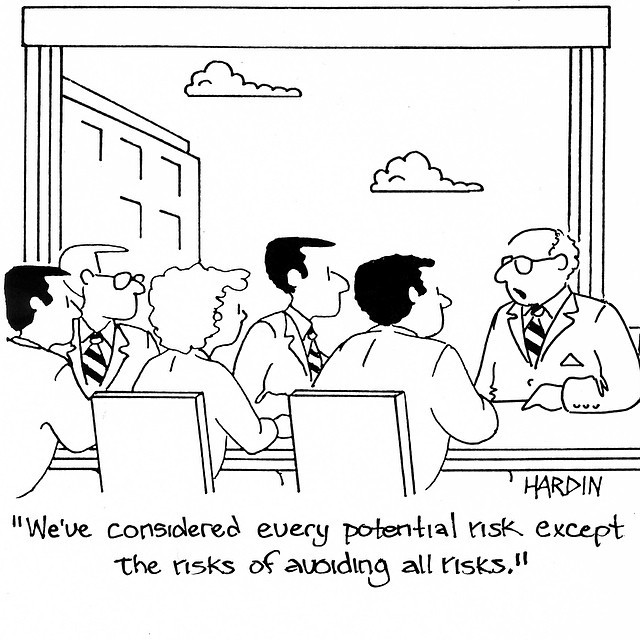
In other words, all safety regulation involves trade-offs, and if (to paraphrase a classic Hardin cartoon you’ll see to your right) we consider every potential risk except the risk of avoiding all risks, the result will be not only a decline in short-term innovation, but also a corresponding decline in safety and overall living standards over time.
Countless risk scholars have studied this process and come to the same conclusion. “We could virtually end all risk of failure by simply declaring a moratorium on innovation, change, and progress,” notes engineering historian Henry Petroski. But the costs to society of doing so would be catastrophic, of course. “The history of the human race would be dreary indeed if none of our forebears had ever been willing to accept risk in return for potential achievement,” observed H.L. Lewis, an expert on technological risk trade-offs.
The most important book ever written on this topic was Aaron Wildavsky’s 1988 masterpiece, Searching for Safety. Wildavsky warned of the dangers of “trial without error” reasoning and contrasted it with the trial-and-error method of evaluating risk and seeking wise solutions to it. Wildavsky argued that real wisdom is born of experience and that we can learn how to be wealthier and healthier as individuals and a society only by first being willing to embrace uncertainty and even occasional failure. As he put it:
The direct implication of trial without error is obvious: If you can do nothing without knowing first how it will turn out, you cannot do anything at all. An indirect implication of trial without error is that if trying new things is made more costly, there will be fewer departures from past practice; this very lack of change may itself be dangerous in forgoing chances to reduce existing hazards. . . . Existing hazards will continue to cause harm if we fail to reduce them by taking advantage of the opportunity to benefit from repeated trials.
When this logic takes the form of public policy prescriptions, it is referred to as the “precautionary principle,” which generally holds that, because new ideas or technologies could pose some theoretical danger or risk in the future, public policies should control or limit the development of such innovations until their creators can prove that they won’t cause any harms.
Again, if we adopt that attitude, human safety actually suffers because it holds back beneficial experiments aimed at improving the human condition. As the great economic historian Joel Mokyr argues, “technological progress requires above all tolerance toward the unfamiliar and the eccentric.” But the regulatory status quo all too often rejects “the unfamiliar and the eccentric” out of an abundance of caution. While usually well-intentioned, that sort of status quo thinking holds back new and better was of doing old things better, or doing all new things. The end result is that real health and safety advances are ignored or forgone.
How Status Quo Thinking at the FAA Results in Less Safety
This is equally true for air safety and FAA regulation of drones. “Ultimately, the status quo is seen as safe,” the National Acadamies report notes. “There is too little recognition that new technologies brought into the airspace by UAS could improve the safety of manned aircraft operations, or may mitigate, if not eliminate, some nonaviation risks.” The example of the life-saving potential of drones have already been well-documented.
Drones have already been used to monitor fires, help with search-and-rescue missions for missing people or animals, assist life guards by dropping life vests to drowning people, deliver medicines to remote areas, and help with disaster monitoring and recovery efforts. But that really just scratches the surface in terms of their potential.
Some people scoff at the idea of drones being used to deliver small packages to our offices or homes. But consider how many of those packages are delivered by human-operated vehicles that are far more likely to be involved in dangerous traffic accidents on our over-crowded roadways. If drones were used to make some of those deliveries, we might be able to save a lot of lives. Or how about an elderly person stuck at home during storm, only to realize they are out of some essential good or medicine that is a long drive away. Are we better off having them (or someone else) get behind the wheel to drive and get it, or might a drone be able to deliver it more safely?
The authors of the National Academies report understand this, as they made clear when they concluded that, “operation of UAS has many advantages and may improve the quality of life for people around the world. Avoiding risk entirely by setting the safety target too high creates imbalanced risk decisions and can degrade overall safety and quality of life.” (Ch. 3, p. 5-6)
Reform Ideas: Use the “Innovator’s Presumption” & “Sunsetting Imperative”
Given that reality, the National Academies report makes several sensible reform recommendations aimed at countering the FAA’s hyper-conservatism and bias for the broken regulatory status quo. I won’t go through them all, but I think they are an excellent set of reforms that deserve to be taken seriously.
I do, however, want to highly recommend everyone take a close look at this one outstanding recommendation in Chapter 3, which is aimed at keep things moving and making sure that status quo thinking doesn’t freeze beneficial new forms of airspace innovation. Specifically, the National Academies report recommends that:
The FAA should meet requests for certifications or operations approvals with an initial response of “How can we approve this?” Where the FAA employs internal boards of executives throughout the agency to provide input on decisions, final responsibility and authority and accountability for the decision should rest with the executive overseeing such boards. A time limit should be placed on responses from each member of the board, and any “No” vote should be accompanied with a clearly articulated rationale and suggestion for how that “No” vote could be made a “Yes.” (Ch. 3, p. 8)
I absolutely love this reform idea because it essentially combines elements of two general innovation policy reform ideas that I discussed in my recent essay, “Converting Permissionless Innovation into Public Policy: 3 Reforms.” In that piece, I proposed the idea of instituting an “Innovator’s Presumption” that would read: “Any person or party (including a regulatory authority) who opposes a new technology or service shall have the burden to demonstrate that such proposal is inconsistent with the public interest.” I also proposed a so-called “Sunsetting Imperative” that would read: “Any existing or newly imposed technology regulation should include a provision sunsetting the law or regulation within two years.”
The National Academies report recommendation above basically embodies the spirit of both the Innovator’s Presumption and the Sunsetting Imperative. It puts the burden of proof on opponents of change and then creates a sort of shot clock to keep things moving.
These are the kind of reforms we need to make sure status quo thinking at regulatory agencies doesn’t hold back life-enriching and life-saving innovations. It’s time for a change in the ways business is done at the FAA to make sure that regulations are timely, effective, and in line with common sense. Sadly, as the new National Academies report makes clear, today’s illogical policies governing airspace innovation are having counter-productive results that hurt society.
Two weeks ago, as Facebook CEO Mark Zuckerberg was getting grilled by Congress during a two-day media circus set of hearings, I wrote a counterintuitive essay about how it could end up being Facebook’s greatest moment. How could that be? As I argued in the piece, with an avalanche of new rules looming, “Facebook is potentially poised to score its greatest victory ever as it begins the transition to regulated monopoly status, solidifying its market power, and limiting threats from new rivals.”
With the exception of probably only Google, no firm other than Facebook likely has enough lawyers, lobbyists, and money to deal with layers of red tape and corresponding regulatory compliance headaches that lie ahead. That’s true both here and especially abroad in Europe, which continues to pile on new privacy and “data protection” regulations. While such rules come wrapped in the very best of intentions, there’s just no getting around the fact that
regulation has costs. In this case, the unintended consequence of well-intentioned data privacy rules is that the emerging regulatory regime will likely discourage (or potentially even destroy) the chances of getting the new types of innovation and competition that we so desperately need right now.
Others now appear to be coming around to this view. On April 23, both the
New York Times and The Wall Street Journal ran feature articles with remarkably similar titles and themes. The New York Times article by Daisuke Wakabayashi and Adam Satariano was titled, “How Looming Privacy Regulations May Strengthen Facebook and Google,” and The Wall Street Journal’s piece, “Google and Facebook Likely to Benefit From Europe’s Privacy Crackdown,” was penned by Sam Schechner and Nick Kostov.
“In Europe and the United States, the conventional wisdom is that regulation is needed to force Silicon Valley’s digital giants to respect people’s online privacy. But new rules may instead serve to strengthen Facebook’s and Google’s hegemony and extend their lead on the internet,” note Wakabayashi and Satariano in the
NYT essay. They continue on to note how “past attempts at privacy regulation have done little to mitigate the power of tech firms.” This includes regulations like Europe’s “right to be forgotten” requirement, which has essentially put Google in a privileged position as the “chief arbiter of what information is kept online in Europe.”
Continue reading →
In theory, the Food & Drug Administration (FDA) exists to save lives and improve health outcomes. All too often, however, that goal is hindered by the agency’s highly bureaucratic, top-down, command-and-control orientation toward drug and medical device approval.
Today’s case in point involves families of children with diabetes, many of whom are increasingly frustrated with the FDA’s foot-dragging when it comes to approval of medical devices that could help their kids. Writing today in
The Wall Street Journal, Kate Linebaugh discusses how “Tech-Savvy Families Use Home-Built Diabetes Device” to help their kids when FDA regulations limit the availability of commercial options. She documents how families of diabetic children are taking matters into their own hands and creating their own home-crafted insulin pumps, which can automatically dose the proper amount of proper amount of the hormone in response to their child’s blood-sugar levels. Families are building, calibrating, and troubleshooting these devices on their own. And the movement is growing. Linebaugh reports that:
More than 50 people have soldered, tinkered and written software to make such devices for themselves or their children. The systems—known in the industry as artificial pancreases or closed loop systems—have been studied for decades, but improvements to sensor technology for real-time glucose monitoring have made them possible.
The Food and Drug Administration has made approving such devices a priority and several companies are working on them. But the yearslong process of commercial development and regulatory approval is longer than many patients want, and some are technologically savvy enough to do it on their own.
Linebaugh notes that this particular home-built medical project (known as OpenAPS), was created by Dana Lewis, a 27-year-old with Type 1 diabetes in Seattle. Linebaugh says that: Continue reading →
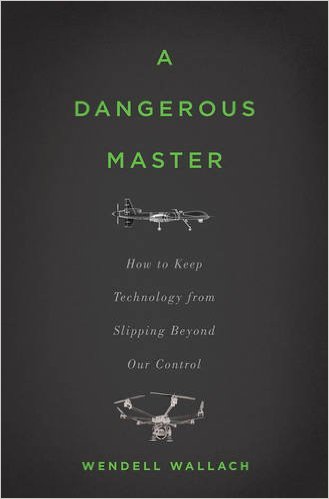
On May 3rd, I’m excited to be participating in a discussion with Yale University bioethicist Wendell Wallach at the Microsoft Innovation & Policy Center in Washington, DC. (RSVP here.) Wallach and I will be discussing issues we write about in our new books, both of which focus on possible governance models for emerging technologies and the question of how much preemptive control society should exercise over new innovations.
Of all the books of technological criticism or skepticism that I’ve read in recent years—and I have read stacks of them!—
A Dangerous Master is by far the most thoughtful and interesting. I have grown accustomed to major works of technological criticism being caustic, angry affairs. Most of them are just dripping with dystopian dread and a sense of utter exasperation and outright disgust at the pace of modern technological change.
Although he is certainly concerned about a wide variety of modern technologies—drones, robotics, nanotech, and more—Wallach isn’t a purveyor of the politics of panic. There are some moments in the book when he resorts to some hyperbolic rhetoric, such as when he frets about an impending “techstorm” and the potential, as the book’s title suggests, for technology to become a “dangerous master” of humanity. For the most part, however, his approach is deeper and more dispassionate than what is found in the leading tracts of other modern techno-critics.
One of my favorite themes, and not just in the field of tech policy, is the “Unintended Consequences of Well-Intentioned Regulations.” I believe that all laws and regulations have dynamic effects and that to fully appreciate the true impact of any particular public policy, you must always closely investigate the potential opportunity costs and unintended consequences associated with those policies. Because all too often laws and regulations are hastily put on the books with the very best of intentions in mind, only to later be shown to produce the opposite of what was intended.
Today’s case in point comes from a Wall Street Journal article by Rachel Bachman and it involves how the growing wave of cycling helmet laws are having a net negative impact on public health because they discourage ridership in the aggregate. Thus, those potential riders are then either (a) just less active overall or (b) driving their cars to get where they need to go. And both of those results are, ultimately, riskier than cycling without a helmet. For that reason, Bachman reports, cycling advocates “are pushing back against mandatory bike-helmet laws in the U.S. and elsewhere. They say mandatory helmet laws, particularly for adults, make cycling less convenient and seem less safe, thus hindering the larger public-health gains of more people riding bikes.” Supporting evidence comes from this 2012 paper in the journal Risk Analysis by Piet de Jong, a professor in the department of applied finance and actuarial studies at Sydney’s Macquarie University. His paper included an empirical model that showed how mandatory bike-helmet laws “have a net negative health impact.”
This strikes me as one of the very best examples of how to do dynamic benefit-cost analysis and show the full range of societal impacts associated with well-intentioned regulations. And it reminds me of the playground example I use in several of my papers: Laws and liability threats discouraged tall playground climbing structures in the ’80s and ’90s. Continue reading →
I want to highlight an important new blog post (“Slow Down That Runaway Ethical Trolley“) on the ethical trade-offs at work with autonomous vehicle systems by Bryant Walker Smith, a leading expert on these issues. Writing over at Stanford University’s Center for Internet and Society blog, Smith notes that, while serious ethical dilemmas will always be present with such technologies, “we should not allow the perfect to be the enemy of the good.” He notes that many ethical philosophers, legal theorists, and media pundits have recently been actively debating variations of the classic “Trolley Problem,” and its ramifications for the development of autonomous or semi-autonomous systems. (Here’s some quick background on the Trolley Problem, a thought experiment involving the choices made during various no-win accident scenarios.) Commenting on the increased prevalence of the Trolley Problem in these debates, Smith observes that:
Unfortunately, the reality that automated vehicles will eventually kill people has morphed into the illusion that a paramount challenge for or to these vehicles is deciding who precisely to kill in any given crash. This was probably not the intent of the thoughtful proponents of this thought experiment, but it seems to be the result. Late last year, I was asked the “who to kill” question more than any other — by journalists, regulators, and academics. An influential working group to which I belong even (briefly) identified the trolley problem as one of the most significant barriers to fully automated motor vehicles.
Although dilemma situations are relevant to the field, they have been overhyped in comparison to other issues implicated by vehicle automation. The fundamental ethical question, in my opinion, is this: In the United States alone, tens of thousands of people die in motor vehicle crashes every year, and many more are injured. Automated vehicles have great potential to one day reduce this toll, but the path to this point will involve mistakes and crashes and fatalities. Given this stark choice, what is the proper balance between caution and urgency in bringing these systems to the market? How safe is safe enough?
Freelance journalist Laurence Cruz was kind enough to call me recently looking for comment on whether broadband should be considered a human right. Well, actually, he probably didn’t have many options. If you do a quick search on the topic, you’ll find an endless stream of essays in favor of the proposition. Then, somewhere in the mix, you’ll find a few dissenting rants I’ve penned here in the past. So I’m getting used to playing the baddie in this drama.
Cruz’s essay is now up over at “The Network,” which is Cisco’s technology news site. Here’s what I had to say in opposition to the proposition:
Yesterday, the Federal Trade Commission (FTC) released its long-awaited proposed revisions to the Children’s Online Privacy Protection rule (the “COPPA Rule”). Below I offer a few brief thoughts on the draft document. My remarks assume a basic level of knowledge about COPPA so that I don’t have to spend pages explaining the intricacies of this complex law and regulatory regime. If you need background on the COPPA law and rule, please check out this paper by Berin Szoka and me: “COPPA 2.0: The New Battle over Privacy, Age Verification, Online Safety & Free Speech.”
Dodging the COPA / Mandatory Age Verification Bullet
The most important takeaway from yesterday’s proposal involves something the FTC chose
not to do: They agency very wisely decided to ignore some requests to extend the coverage of COPPA’s regulatory provisions from children under 13 all the way up to teens up to 18. An effort to expand COPPA’s “verifiable parental consent” requirements to all teens would have raised thorny First Amendment issues as well as a host of practical enforcement concerns. In essence, it would have required Internet-wide age verification of children and adults in order to ensure that everyone was exactly who they claimed to be online. We already had an epic decade-long legal battle over that issue when the constitutionality of the Children’s Online Protection Act (COPA), another 1998 law sometimes confused with COPPA, was tested many times over and always found to be in violation of the First Amendment.
Regardless, the FTC didn’t go there yesterday, so this concern is off the table for now. The agency deserves credit for avoiding this constitutional thicket. Continue reading →
The Technology Liberation Front is the tech policy blog dedicated to keeping politicians' hands off the 'net and everything else related to technology. Learn more about TLF →

 The Technology Liberation Front is the tech policy blog dedicated to keeping politicians' hands off the 'net and everything else related to technology.