 As we’ve noted here before, there are many ways to follow the TLF. [Did you notice those cool icons over on the upper right-hand side of the page?] But we wanted to make sure that our readers were aware of our Twitter feed, in particular, as well as the individual feeds of some of our contributors. So, in case you are interested, here ya go!
 Five years ago today the Technology Liberation Front (the “TLF”) got underway with this post. The idea for the TLF came about after I asked some tech policy wonks whether it was worth put together a blog dedicated to covering Internet-related issues from a cyber-libertarian perspective. The model I had in mind was a “Volokh Conspiracy
for Tech Issues,” if you will. I wanted to bring together a collection of sharp, liberty-loving wonks (most of whom worked in the think tank world) to talk about their research on this front and to give them a place to post their views on breaking tech policy developments. It was to be a sort of central clearinghouse for libertarian-oriented tech policy analysis and advocacy.
Five years ago today the Technology Liberation Front (the “TLF”) got underway with this post. The idea for the TLF came about after I asked some tech policy wonks whether it was worth put together a blog dedicated to covering Internet-related issues from a cyber-libertarian perspective. The model I had in mind was a “Volokh Conspiracy
for Tech Issues,” if you will. I wanted to bring together a collection of sharp, liberty-loving wonks (most of whom worked in the think tank world) to talk about their research on this front and to give them a place to post their views on breaking tech policy developments. It was to be a sort of central clearinghouse for libertarian-oriented tech policy analysis and advocacy.
At first, Tim Lee and I debated whether it even made sense to have that sort of narrow focus, but I think the passage of time and the rise of plenty of competition on this front shows that it was worthwhile. And I’ve been very pleased with the tag-team effort of all our TLF contributors and the way—without anyone planning it, in true libertarian fashion—we’ve sort of developed a nice division of labor on various tech policy issues.
Perhaps a few stats are in order on this occasion to mark our progress 5 years in. The best indication of our success is the fact that our Pagerank (Google’s logarithmic scale of website importance based on links to that site) has reached 7/10—the same score shared by the Volokh Conspiracy (our model), as well as Techmeme (the leading tech news aggregator), the Cato Institute, CDT, etc. (For comparison: ArsTechnica and EFF are 8s.) Unfortunately, we’ve only been using Google Analytics for three of the past five years, so it’s impossible to get a authoritative accounting of traffic growth since Day 1. But here are few markers:
- 4,450+ posts
- 29,000+ comments
- 2,698 RSS subscribers
- 15,763 unique visitors per month
- 1,000,000 pageviews since Nov. 2006 when we started using Google Analytics
- Besides organic search and direct links, we get the bulk of our traffic from other tech-oriented sites (in order of hits) TechDirt, Freedom to Tinker, Ars Technica, GamePolitics.com, TechMeme, Slate, etc., and aggregators such as reddit, Fark, and StumbleUpon
So, what’s our #1 post of all-time? Continue reading →
As you might have noticed, we’re giving the TLF a facelift as we approach our five-year anniversary on August 14. Our own Jerry Brito is leading the charge, with Cord Blomquist and PJ Doland providing backup vocals. Thanks, guys!
We’re still ironing out bugs and experimenting with widgets, but we’d welcome your feedback as we work things out. Please feel free to share your thoughts on the new design or features by posting comments here, or to email me at bszoka pff.org.
Party on, Wayne!
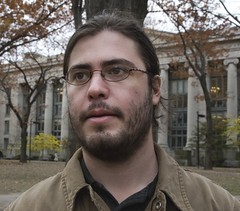 In episode #44 of “Tech Policy Weekly,” Berin Szoka and Adam Thierer engage in a debate with Internet security expert Chris Soghoian, who is a student fellow at the Berkman Center for Internet & Society at Harvard University. He is also a Ph.D. candidate at Indiana University’s School of Informatics.
Chris is an up-and-coming star in the field of cyberlaw and technology policy as he has quickly made a name for himself in debates over privacy policy, data security, and government surveillance. He straddles the line between academic and activist, and the role he often plays in many tech policy debates is somewhat akin to what Ralph Nader has done in many other fields through the years. Except, in this case, instead of “Unsafe at Any Speed” it’s more like “Unsafe at Any Setting,” since Chris is often raising a stink about what he regards as unjust or unreasonable privacy or security settings that various online websites or service providers use.
On the show, Chris talks about two of his recent crusades to get certain online providers to change their default settings to improve user security or privacy: (1) His effort this week to get major email providers—and Google in particular—to change their default security settings on their email offerings; and (2) his earlier crusade to create permanent opt-out cookies to stop behavioral advertising by advertising networks.
There are several ways to listen to today’s TLF Podcast. You can press play on the player below to listen right now, or download the MP3 file. You can also subscribe to the podcast by clicking on the button for your preferred service. (And do us a favor, Digg this podcast!)
[display_podcast]
Continue reading →
This is just a quick reminder to both faithful and fair-weather readers that there are many ways to keep up with what we’re saying here at the Technology Liberation Front, including:
(1) RSS
 Subscribe in a Reader


(2) Twitter

(3) Facebook

(4) Daily email alert
(5) Podcast



 …
Or just make the TLF your browser’s welcome page! What better way to start each day?
Finally, as always, we appreciate your support, attention, tolerance of our rants.
…
Or just make the TLF your browser’s welcome page! What better way to start each day?
Finally, as always, we appreciate your support, attention, tolerance of our rants.
I was reading this Sun Magazine interview with the always-interesting Nick Carr and I liked what he had to say here about the public’s inconsistent views on privacy:
If you ask people whether they’re concerned about the ability of the government or corporations to gather information about them online, they’ll say yes. But if you look at how they behave online, they don’t display much fear of exposing themselves. What that says about people — and it’s true for most of us — is that we will readily forgo our privacy in exchange for convenient and useful services, particularly if they’re free. That’s a trade-off you make all the time on the Internet. Even if people were more conscious of how this information might be exploited, I doubt most would change their behavior.
This reminds me of the classic “hamburgers for DNA” quip from security expert Bruce Schneier who once famously noted that:
If McDonalds in the United States would give away a free hamburger for an DNA sample they would be handing out free lunches around the clock. So people care about their privacy, but they don’t care to pay for it. In the United States we have frequent shopper cards, which will track down people’s purchases for a 5 cents discount on a can of tuna fish. I don’t think you can convince the public to care about it.
Continue reading →
 On this episode “Tech Policy Weekly,” Technology Liberation Front contributors Ryan Radia and Berin Szoka join me for a discussion of the flare-up over Facebook’s recent changes to the data retention provisions of its Terms of Use agreement and whether there are any serious privacy issues in play here—or if this is all much ado about nothing. [Ryan blogged about it here, and I did here.]
Earlier this month, Facebook announced changes to the way it handled or retained user data on its site after a user quits Facebook, raising questions about who actually owns that data and whether any privacy issues were raised by the company’s new policy. Following some intense scrutiny in the blogosphere, Facebook decided this week to revert to their old terms of service until they figured out a new approach to data management and ownership.
You can begin listening by downloading the MP3 file here or by just clicking the play button below. Or subscribe to our Podcast ( iTunes, other).
[display_podcast]
 I’m delighted to welcome to the TLF my colleague Adam Marcus, Research Fellow & Senior Technologist at The Progress & Freedom Foundation. Adam’s already written a few posts here on the TLF about edge caching and cloud computing—cross-posted over the last few months by Adam Thierer and me. He also appeared on TechPolicy Weekly 38 to discuss “The Google Kerfuffle — Edge Caching & Net Neutrality.”
Adam (a/k/a “Marcus”) brings an exceptional technological sophistication to bear on policy issues. He’s already been a real asset to our work at PFF as a sort of “technical ombudsman,” helping us delve into the nitty-gritty details behind the debates. I hope he’ll play somewhat the same role here on the TLF: keeping us honest and checking our facts.
But he’s not just another geek: With a J.D. from Santa Clara University and an MA in Communications, Culture & Technology from Georgetown University, Adam has lots to say about the legal and policy issues covered by the TLF.
I hope you all enjoy getting to know him—whether through the blog or in person at our semi-regular Alcohol Liberation Fronts—as much as I have.
First, let me just thank all the TLF readers who actively participate by commenting on the site. We really value your participation in this community built on a shared interest in technology policy!
Readers who visit the site will notice two new badges at the top righthand corner of the site for the TLF’s Twitter and Facebook pages. Please take a moment to follow us on Twitter and to become a fan of our Facebook page—and to “share” that page with your friends on Facebook. Of course, we also have RSS feeds for the blog and the Tech Policy Weekly podcast (RSS or iTunes), which should again become more “weekly” this year.
I’d love to hear any ideas any TLF readers might have about how to increase the site’s readership or upgrade its functionality. With the TLF’s five year anniversary coming up this August, we’re looking for ways to make the most of the blog as a tool for “keeping the politicans’ hands off the ‘net and everything else related to technology.”
Two quick tech tips for using the site. First, regarding Disqus (“Discuss”), our Comment Management System: If you haven’t already done so, don’t forget to “claim” comments made with your email address. As Disqus explains, this will help ensure that no one else posts a comment under your name (something only someone as dastardly as, say, Jim Harper might do):
If you’ve made a comment on a blog using Disqus, you automatically have a profile. To claim the comments and profile, verify your identity by clicking “Claim” on the profile. Once the profile is claimed, no one else will be able to use that profile or email address to comment aside from you.
Second, Adam and I often post PDFs in our posts using the nifty iPaper viewer provided by Scribd (for example here). Because it’s Flash, this tool allows you to see a PDF embedded on a page without having to download it or wait for the whole document to load. A few of our crochetier TLF colleagues have complained that the Flash viewer is too small to read easily. The simple solution is to click the rectangle-in rectangle button at the top right corner of the Scribd viewer, which will instantly expand the viewer to full-screen. If clicked again, the viewer will revert to its original size. This feature doesn’t seem to be as self-explanatory as the folks at Scribd assume.
Again, thanks for reading and for your feedback!
In several of our previous podcasts (see episodes 34, 35,and 37), we’ve discussed what we’ve called the “Comcast Kerfuffle,” which was the controversy surrounding the steps Comcast took to manage BitTorrent traffic on its networks. Critics called it a violation of Net neutrality principles while Comcast and others called it sensible network management.
This week we saw a new kerfuffle of sorts develop over the revelation in a Monday front-page Wall Street Journal story that Google had approached major cable and phone companies and supposedly proposed to create a fast lane for its own content. What exactly is it that Google is proposing, and does it mean – as the Wall Street Journal and some others have suggested – that Google is somehow going back on their support for Net neutrality principles and regulation? More importantly, what does it all mean for the future of the Internet, network management, and consumers. That’s what we discussed on the TLF’s latest “Tech Policy Weekly” podcast.
Today’s 30-minute discussion featured two of our regular contributors at the TLF, who both wrote about this issue multiple times this week.
Cord Blomquist of the Competitive Enterprise Institute wrote about the issue here and here, and Bret Swanson of the Progress & Freedom Foundation wrote about it here and here. To help us wade through some of the more technical networking issues in play, we were also joined on the podcast by Richard Bennett, a computer scientist and network engineer guru who blogs at Broadband Politics as well as Circle ID and he also pens occasional columns for The Register. Also appearing on the show was Adam Marcus, Research Fellow & Senior Technologist at PFF, who wrote a “nuts and bolts” essay full of excellent technical background on edge caching and net neutrality.
You can download the MP3 file here, or use the online player below to start listening to the show right now.
[display_podcast]

 The Technology Liberation Front is the tech policy blog dedicated to keeping politicians' hands off the 'net and everything else related to technology.