 It appears that the long legal saga of the Child Online Protection Act of 1998 (COPA) has finally come to a close. This morning, according to AP, the U.S. Supreme Court rejected the government’s latest request to revive the law, which was stuck down as an unconstitutional violation of the First Amendment by lower courts and never went into effect.
COPA was an effort by Congress to modify the Communications Decency Act of 1996 (CDA) in response to the Supreme Court’s decision in Reno v. ACLU finding that the CDA was unconstitutionally over-broad. COPA sought to narrow the scope of regulation and protect minors from sexual material on the Internet by making it a crime for someone to “knowingly” place materials online that were “harmful to minors.” The law provided an affirmative defense from prosecution, however, to those parties who made a “good faith” effort to “restrict[ ] access by minors to material that is harmful to minors” using credit cards or age verification schemes. Although narrower than the CDA, COPA was immediately challenged and also blocked by lower courts because it was still too sweeping in effect. Moreover, the courts found there were other “less restrictive means” that parents could use to deal with objectionable content — such as Internet filters.
Following the initial challenge, COPA then became the subject of an epic, decade-long legal battle that finally concluded today when the U.S. Supreme Court refused to revisit the law. COPA had already been reviewed by the Supreme Court twice before — in 2002 and 2004. Thus, a third visit to the Supreme Court by COPA would have been something of a historical development in the world of First Amendment jurisprudence. But with the Supreme Court’s rejection of the government’s appeal today, lower court rulings stand and COPA will remain unconstitutional and unenforceable.
The key recent legal battle occurred in the Third Circuit Court of Appeals, which upheld a lower court ruling striking down COPA. The Third Circuit’s full decision is here. And I penned a 3-part series on the lower court ruling by Judge Lowell Reed Jr., senior judge of the U.S. District Court for the Eastern District of Pennsylvania, here, here, and here. Also make sure to check out this summary of COPA’s legal journey that Alex Harris penned last November.
While COPA is now dead and buried, it would be foolish to think this is the end of efforts to legislate on this front. Although it remains unclear what the legislative response will look like during a time of Democratic rule, I am certain that legislation will be floated in short order (i.e., “Son of COPA”) to try to get around the constitutional issues and regulate objectionable online content. If legislators were smart, they’d avoid legally risky solutions like more centralized filtering mandates or age verification requirements. They’d be on safer ground to consider going the subsidy route and finding a way to get parental control tools in the hands of more families and institutions. I’m not saying that I favor such subsidies, merely that such an approach would almostly certainly pass legal muster and probably wouldn’t even be challenged in court. They might also consider more public education / PSA-driven approached to online safety. Those approaches may end up finding more support in a Democratic Congress and administration anyway.
[More coverage at NYT, Reuters, CNet and Ars.]
Today was a big day — and not just because there was an election going on! As I mentioned yesterday, the other big news was that the U.S. Supreme Court was hearing oral arguments in the potentially historic free speech case of Federal Communications Commission v. Fox Television Stations, Inc. Again, all the background you need can be found in my post yesterday, so here I will just be summarizing my general thoughts about how the oral arguments played out this morning.
Unfortunately, because no electronic devices or even notepads are allowed in the courtroom, much of what I am relaying here is from memory or from the notes that I surreptitiously scribbled on a tiny piece of scrap paper when the guards weren’t looking. (And yes, I have been reprimanded before for taking notes in the Court!) The transcript has just been released, however, so you can read it through and judge for yourself. Anyway, here are some general thoughts:
Continue reading →
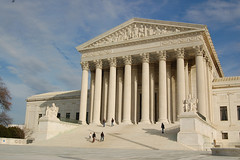 Tomorrow morning, the U.S. Supreme Court will hear oral arguments in the potentially historic free speech case of Federal Communications Commission v. Fox Television Stations, Inc. I plan on attending and will try to post some thoughts about how the arguments played out here later tomorrow afternoon or evening. [I won’t be able to live blog of Twitter it because no electronic devices are allowed in the courtroom, which I’ve always thought is outrageous.] In the meantime, here again is the background of the case.
The
FCC v. Fox case is the indecency case involving the FCC’s new policy for “fleeting expletives.” I wrote about the Second Circuit Court of Appeals decision here and the full 2nd Circuit decision is here. [By contrast, the so-called “Janet Jackson case” — CBS v. FCC — took place in the Third Circuit Court of Appeals and that court recently handed down a decision that also went against the FCC. I wrote about the Third Circuit’s decision here.]
In a 2-1 decision, the Second Circuit ruled that “the FCC’s new policy sanctioning “fleeting expletives” is arbitrary and capricious under the Administrative Procedure Act for failing to articulate a reasoned basis for its change in policy.” The decision demonstrates how, over just the past few years, the FCC has arbitrarily thrown out 30+ years worth of precedent and greatly expand the scope of its regulatory authority over speech on broadcast TV and radio. As a result, the FCC’s order was vacated and remanded to the agency. The agency appealed the decision, however, and the Supreme Court accepted it for review.
Continue reading →
Along with my friends John Morris and Sophia Cope of the Center for Democracy & Technology, I have just submitted an amicus brief to the Supreme Court in the potentially historic free speech case FCC v. Fox, which will be heard in November.
[Reminder: The
FCC v. Fox case is the indecency case involving the FCC’s new policy for “fleeting expletives.” I wrote about the Second Circuit Court of Appeals decision here. The full decision is here. By contrast, the so-called “Janet Jackson case” — CBS v. FCC — took place in the Third Circuit Court of Appeals and that court recently handed down a decision that also went against the FCC. I wrote about the Third Circuit’s decision here.]
The
FCC v. Fox case could become the most important First Amendment-related Supreme Court case since FCC v. Pacifica Foundation, which just turned 30 years old last month. Of course, it could be that the Supreme Court simply sticks to the procedural questions regarding whether the FCC moved too far, too fast in reversing it’s long-standing policy of restraint regarding “fleeting expletives.” That’s essentially what the Second Circuit did. On the other hand, the Supremes might reach the substantive First Amendment issues tied up in the Pacifica case. We just won’t know for sure until the case is handed down.
Regardless, in the joint CDT-PFF amicus brief filed today, we argue that the FCC has both gone too far procedurally and that “the time is rapidly approaching for this Court to find that broadcast, like the Internet and other means of mass communication, ‘is entitled to the highest protection from government intrusion’ and that there is no longer a factual ‘basis for qualifying the level of First Amendment scrutiny that should be applied to this medium.'” Citing
Reno v. ACLU, 521 U.S. at 863, 870.”
A more detailed summary of our argument follows below.
Continue reading →
The Federal Communications Commission (FCC) lost another major First Amendment-related case today involving its recent efforts to expand the parameters of “indecency” enforcement for broadcast programming. The case involves the now infamous “wardrobe malfunction” that occurred during an unscripted 2004 Super Bowl halftime performance involving singers Justin Timberlake and Janet Jackson. When Ms. Jackson’s breast was exposed on camera for nine-sixteenths of one second, the FCC immediately launched an investigation into the incident and fines were eventually levied on the grounds that the fleeting exposure of Ms. Jackson’s breast was a violation of broadcast decency standards. CBS challenged the FCC’s decision, leading to a legal showdown in the U.S. Court of Appeals for the Third Circuit.
In today’s decision,
CBS Corp. v. FCC, the three-judge panel of the 3rd Circuit ruled that the Federal Communications Commission “acted arbitrarily and capriciously” when it imposed a $550,000 fine on CBS for the incident. The court’s 102-page decision, which can be found here, was decided squarely on procedural grounds. That is, it didn’t touch the more substantive speech-related issues or precedents such as the Pacifica or Red Lion decisions that constitute the foundations of all modern FCC broadcast regulation.
The case is important because it now joins the June 2007 decision handed down by the Second Circuit Court of Appeals in the case of Fox Television Stations v. FCC. That was the indecency case involving the FCC’s new policy for “fleeting expletives.” In that 2-1 decision, the Second Circuit ruled that “the FCC’s new policy sanctioning ‘fleeting expletives’ is arbitrary and capricious under the Administrative Procedure Act for failing to articulate a reasoned basis for its change in policy.” As a result, the FCC’s order was vacated and remanded to the agency. [And the FCC is now challenging the decision in the Supreme Court.]
This is very similar to what the 3rd Circuit said today in the
CBS case.
Continue reading →

 The Technology Liberation Front is the tech policy blog dedicated to keeping politicians' hands off the 'net and everything else related to technology.