My friend and frequent co-blogger Larry Downes has shown how lawmaking in the information age is inexorably governed by “The Law of Disruption” or the fact that “technology changes exponentially, but social, economic, and legal systems change incrementally.” This law is “a simple but unavoidable principle of modern life,” he said, and it will have profound implications for the way businesses, government, and culture evolve going forward. “As the gap between the old world and the new gets wider,” he argues, “conflicts between social, economic, political, and legal systems” will intensify and “nothing can stop the chaos that will follow.” This has profound ramifications for high-tech policymaking, or at least it should.
A powerful illustration of the Law of Disruption in action comes from this cautionary tale told by telecom attorney Jonathan Askin in his new essay, “A Remedy to Clueless Tech Lawyers.” In the early 2000s, Askin served as legal counsel to Free World Dialup (FWD), “a startup that had the potential to dramatically disrupt the telecom sector” with its peer-to-peer IP network that could provide free global voice communications. Askin notes that “FWD paved the way for another startup—Skype. But FWD was Skype before Skype was Skype. The difference was that FWD had U.S. attorneys who put the reigns on FWD to seek FCC approvals to launch free of regulatory constraints.” Here’s what happened to FWD according to Askin: Continue reading →
2009 was not as big of a year for Internet and information technology (“info-tech”) policy books as 2008 was, but there were still some notable titles released that offered interesting perspectives about the future of the Net and the impact the Digital Revolution is having on our lives, culture, and economy. So, like last year, I figured I would throw together my list of the 10 most important info-tech policy books of the year.
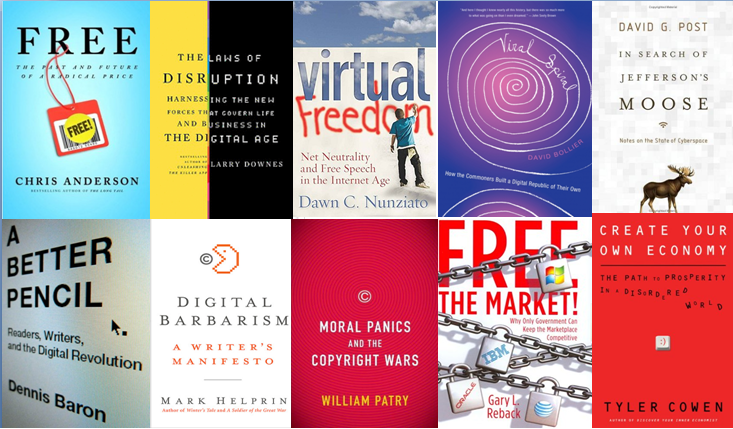 First, let me repeat a few of the same caveats and disclaimers that I set forth last year. What qualifies as an “important” info-tech policy book? Simply put, it’s a title that many people are currently discussing and that we will likely be referencing for many years to come. However, I want to be clear that merely because a book appears on my list it does not necessarily mean I agree with everything said in it. In fact, as was the case in previous years, I found much with which to disagree in my picks for the most important books of 2009 and I find that the cyber-libertarianism I subscribe to has very few fans out there.
Another caveat: Narrowly-focused titles lose a few points on my list. For example, if a book deals mostly with privacy issues, copyright law, or antitrust policy, it does not exactly qualify as the same sort of “tech policy book” as other titles found on this list since it is a narrow exploration of just one set of issues with a bearing on technology policy.
With those caveats in mind, here are my choices for the Most Important Info-Tech Policy Books of 2009. Continue reading →

 The Technology Liberation Front is the tech policy blog dedicated to keeping politicians' hands off the 'net and everything else related to technology.