Those who advocate regulating Internet service providers as common carriers subject to “open access” mandates (a/k/a “Net Neutrality”) want us to believe that their cause is the “Civil Rights” issue of the digital age, with huge popular support and opposed only by self-interested cable companies and their henchmen. In fact, such regulations would actually harm consumers, increase broadband prices, retard the heretofore-explosive growth of bandwidth, and dramatically increase government control over the Internet. Of course, the degree of public interest in a cause doesn’t actually tell us anything about its justice and, fortunately, we live in a democratic oligarchic republic, not a pure democracy. But it’s worth asking whether Americans are really up in arms about the need for “Net Neutrality” regulations. Google Trends suggests not:
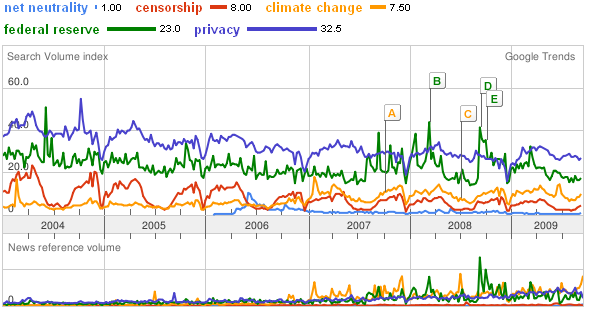 This kind of comparison should dispel once and for all the myth of a popular groundswell for net neutrality regulation—especially since online search volumes heavily over-represent the interests of the digerati, thus over-stating general interest in web-related topics.
In fact, “Net Neutrality” regulation is a
niche cause trumpeted incessantly by the blogosphere with about the same level of broad popular interest online as “housing rights”—a topic about which most of us probably don’t often fall into conversation (unless we happen to live in Bakuninist Berkeley or the Bolivarian Caliphate of Cambridge, MA, ground-zero of American Chavismo). Continue reading →
 The Wall Street Journal reports today that student loan borrowing for college “in the 2008-09 academic year grew about 25% over the previous year, to $75.1 billion,” with the average student borrowing $13,172 to pay for college. So it should come as an enormous relief that one Internet start-up, StraighterLine, has essentially made the university fully virtual, offering classes for just $99/month. While this may seem like a boon for students, especially the millions of Americans for whom even community college tuition seems an insurmountable obstacle to climbing up the economic ladder, such “e-Learning” offerings are already, predictably, coming under attack by entrenched interests in “Big Ed” (the professoriat!) as the “media-software–publishing–E-learning-complex.”
In Washington Monthly, Kevin Carey explains why “The next generation of online education could be great for students—and catastrophic for universities.” In a nutshell, the story is the same basic theme of Chris Anderson’s book Free!: digital distribution of information will ultimately drive costs down to zero. Carey shows how universities are essentially facing the same sorts of pressure from disruptive innovation as newspapers—except with more capital costs:
Colleges are caught in the same kind of debt-fueled price spiral that just blew up the real estate market. They’re also in the information business in a time when technology is driving down the cost of selling information to record, destabilizing lows.
In combination, these two trends threaten to shake the foundation of the modern university, in much the same way that other seemingly impregnable institutions have been torn apart. In some ways, the upheaval will be a welcome one. Students will benefit enormously from radically lower prices—particularly people like Solvig who lack disposable income and need higher learning to compete in an ever-more treacherous economy. But these huge changes will also seriously threaten the ability of universities to provide all the things beyond teaching on which society depends: science, culture, the transmission of our civilization from one generation to the next.
Whether this transformation is a good or a bad thing is something of a moot point—it’s coming, and sooner than you think.
Continue reading →
I’m listening to the audiobook of Telecosm, George Gilder’s prophetic book about how abundant broadband would revolutionize the planet—which I recommend to everyone. I came across this passage, which reminded me just how good we really have it:
Reported to catalog only 16 percent of web pages, the best Internet search engines are foundering under the load, taking as long as six months to add new content.
If that was Search 1.0, Search 2.0 is great! Today’s search engines will index this post in a matter of minutes and while there are still parts of the “Deep Web” that aren’t crawled, a number of Search 3.0 upstarts are working on solving that problem, too!

 The Technology Liberation Front is the tech policy blog dedicated to keeping politicians' hands off the 'net and everything else related to technology.