Evan Selinger, a super-sharp philosopher of technology up at the Rochester Institute of Technology, is always alerting me to interesting new essays and articles and this week he brought another important piece to my attention. It’s a short new article by Arturo Casadevall, Don Howard, and Michael J. Imperiale, entitled, “The Apocalypse as a Rhetorical Device in the Influenza Virus Gain-of-Function Debate.” The essay touches on something near and dear to my own heart: the misuse of rhetoric in debates over the risk trade-offs associated with new technology and inventions. Casadevall, Howard, and Imperiale seek to “focus on the rhetorical devices used in the debate [over infectious disease experiments] with the hope that an analysis of how the arguments are being framed can help the discussion.”
They note that “humans are notoriously poor at assessing future benefits and risks” and that this makes many people susceptible to rhetorical ploys based on the artificial inflation of risks. Their particular focus in this essay is the debate over so-called “gain-of-function” (GOF) experiments involving influenza virus, but what they have to say here about how rhetoric is being misused in that field is equally applicable to many other fields of science and the policy debates surrounding various issues. The last two paragraphs of their essay are masterful and deserve everyone’s attention: Continue reading →
If there are two general principles that unify my recent work on technology policy and innovation issues, they would be as follows. To the maximum extent possible:
- We should avoid preemptive and precautionary-based regulatory regimes for new innovation. Instead, our policy default should be innovation allowed (or “permissionless innovation”) and innovators should be considered “innocent until proven guilty” (unless, that is, a thorough benefit-cost analysis has been conducted that documents the clear need for immediate preemptive restraints).
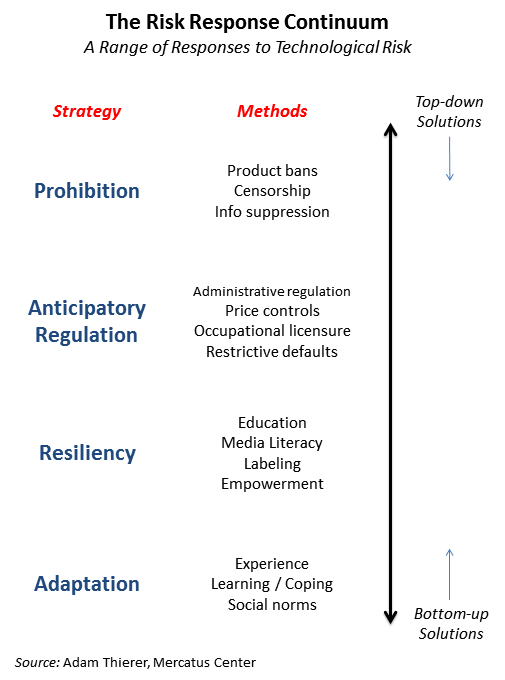
- We should avoid rigid, “top-down” technology-specific or sector-specific regulatory regimes and/or regulatory agencies and instead opt for a broader array of more flexible, “bottom-up” solutions (education, empowerment, social norms, self-regulation, public pressure, etc.) as well as reliance on existing legal systems and standards (torts, product liability, contracts, property rights, etc.).
I was very interested, therefore, to come across two new essays that make opposing arguments and proposals. The first is this recent
Slate oped by John Frank Weaver, “We Need to Pass Legislation on Artificial Intelligence Early and Often.” The second is Ryan Calo’s new Brookings Institution white paper, “The Case for a Federal Robotics Commission.”
Weaver argues that new robot technology “is going to develop fast, almost certainly faster than we can legislate it. That’s why we need to get ahead of it now.” In order to preemptively address concerns about new technologies such as driverless cars or commercial drones, “we need to legislate early and often,” Weaver says. Stated differently, Weaver is proposing “precautionary principle”-based regulation of these technologies. The precautionary principle generally refers to the belief that new innovations should be curtailed or disallowed until their developers can prove that they will not cause any harms to individuals, groups, specific entities, cultural norms, or various existing laws, norms, or traditions.
Calo argues that we need “the establishment of a new federal agency to deal with the novel experiences and harms robotics enables” since there exists “distinct but related challenges that would benefit from being examined and treated together.” These issues, he says, “require special expertise to understand and may require investment and coordination to thrive.
I’ll address both Weaver and Calo’s proposals in turn. Continue reading →
On Thursday, it was my great pleasure to present a draft of my forthcoming paper, “The Internet of Things & Wearable Technology: Addressing Privacy & Security Concerns without Derailing Innovation,” at a conference that took place at the Federal Communications Commission on “Regulating the Evolving Broadband Ecosystem.” The 3-day event was co-sponsored by the American Enterprise Institute and the University of Nebraska College of Law.
The 65-page working paper I presented is still going through final peer review and copyediting, but I posted a very rough first draft on SSRN for conference participants. I expect the paper to be released as a Mercatus Center working paper in October and then I hope to find a home for it in a law review. I will post the final version once it is released. [UPDATE:The final version of this working paper was released on November 19, 2014.]
In the meantime, however, I thought I would post the 46 slides I presented at the conference, which offer an overview of the nature of the Internet of Things and wearable technology, the potential economic opportunities that exist in this space, and the various privacy and security challenges that could hold this technological revolution back. I also outlined some constructive solutions to those concerns. I plan to be very active on these issues in coming months.
Continue reading →
I’ve spent a lot of time here through the years trying to identify the factors that fuel moral panics and “technopanics.” (Here’s a compendium of the dozens of essays I’ve written here on this topic.) I brought all this thinking together in a big law review article (“Technopanics, Threat Inflation, and the Danger of an Information Technology Precautionary Principle”) and then also in my new booklet, “Permissionless Innovation: The Continuing Case for Comprehensive Technological Freedom.”
One factor I identify as contributing to panics is the fact that “bad news sells.” As I noted in the book, “Many media outlets and sensationalist authors sometimes use fear-based tactics to gain influence or sell books. Fear mongering and prophecies of doom are always effective media tactics; alarmism helps break through all the noise and get heard.”
In line with that, I want to highly recommend you check out this excellent new oped by John Stossel of Fox Business Network on “Good News vs. ‘Pessimism Porn‘.” Stossel correctly notes that “the media win by selling pessimism porn.” He says:
Are you worried about the future? It’s hard not to be. If you watch the news, you mostly see violence, disasters, danger. Some in my business call it “fear porn” or “pessimism porn.” People like the stuff; it makes them feel alive and informed.
Of course, it’s our job to tell you about problems. If a plane crashes — or disappears — that’s news. The fact that millions of planes arrive safely is a miracle, but it’s not news. So we soak in disasters — and warnings about the next one: bird flu, global warming, potential terrorism. I won Emmys hyping risks but stopped winning them when I wised up and started reporting on the overhyping of risks. My colleagues didn’t like that as much.
He continues on to note how, even though all the data clearly proves that humanity’s lot is improving, the press relentlessly push the “pessimism porn.” Continue reading →
 In a recent essay here “On the Line between Technology Ethics vs. Technology Policy,” I made the argument that “We cannot possibly plan for all the ‘bad butterfly-effects’ that might occur, and attempts to do so will result in significant sacrifices in terms of social and economic liberty.” It was a response to a problem I see at work in many tech policy debates today: With increasing regularity, scholars, activists, and policymakers are conjuring up a seemingly endless parade of horribles that will befall humanity unless “steps are taken” to preemptive head-off all the hypothetical harms they can imagine. (This week’s latest examples involve the two hottest technopanic topics du jour: the Internet of Things and commercial delivery drones. Fear and loathing, and plenty of “threat inflation,” are on vivid display.)
I’ve written about this phenomenon at even greater length in my recent law review article, “Technopanics, Threat Inflation, and the Danger of an Information Technology Precautionary Principle,” as well as in two lengthy blog posts asking the questions, “Who Really Believes in ‘Permissionless Innovation’?” and “What Does It Mean to ‘Have a Conversation’ about a New Technology?” The key point I try to get across in those essays is that letting such “precautionary principle” thinking guide policy poses a serious threat to technological progress, economic entrepreneurialism, social adaptation, and long-run prosperity. If public policy is guided at every turn by the precautionary mindset then innovation becomes impossible because of fear of the unknown; hypothetical worst-case scenarios trump all other considerations. Social learning and economic opportunities become far less likely under such a regime. In practical terms, it means fewer services, lower quality goods, higher prices, diminished economic growth, and a decline in the overall standard of living.
Indeed, if we live in constant fear of the future and become paralyzed by every boogeyman scenario that our creative little heads can conjure up, then we’re bound to end up looking as silly as this classic 2005 parody from
The Onion, “Everything That Can Go Wrong Listed.” Continue reading →
Washington Post columnist Robert J. Samuelson published an astonishing essay today entitled, “Beware the Internet and the Danger of Cyberattacks.” In the print edition of today’s Post, the essay actually carries a different title: “Is the Internet Worth It?” Samuelson’s answer is clear: It isn’t. He begins his breathless attack on the Internet by proclaiming:
If I could, I would repeal the Internet. It is the technological marvel of the age, but it is not — as most people imagine — a symbol of progress. Just the opposite. We would be better off without it. I grant its astonishing capabilities: the instant access to vast amounts of information, the pleasures of YouTube and iTunes, the convenience of GPS and much more. But the Internet’s benefits are relatively modest compared with previous transformative technologies, and it brings with it a terrifying danger: cyberwar.
And then, after walking through a couple of worst-case hypothetical scenarios, he concludes the piece by saying:
the Internet’s social impact is shallow. Imagine life without it. Would the loss of e-mail, Facebook or Wikipedia inflict fundamental change? Now imagine life without some earlier breakthroughs: electricity, cars, antibiotics. Life would be radically different. The Internet’s virtues are overstated, its vices understated. It’s a mixed blessing — and the mix may be moving against us.
What I found most troubling about this is that Samuelson has serious intellectual chops and usually sweats the details in his analysis of other issues. He understands economic and social trade-offs and usually does a nice job weighing the facts on the ground instead of engaging in the sort of shallow navel-gazing and anecdotal reasoning that many other weekly newspaper columnist engage in on a regular basis.
But that’s not what he does here. His essay comes across as a poorly researched, angry-old-man-shouting-at-the-sky sort of rant. There’s no serious cost-benefit analysis at work here; just the banal assertion that a new technology has created new vulnerabilities. Really, that’s the extent of the logic at work here. Samuelson could have just as well substituted the automobile, airplanes, or any other modern technology for the Internet and drawn the same conclusion: It opens the door to new vulnerabilities (especially national security vulnerabilities) and, therefore, we would be better off without it in our lives. Continue reading →
In mid-April, the Federal Trade Commission (FTC) requested comments regarding “the consumer privacy and security issues posed by the growing connectivity of consumer devices, such as cars, appliances, and medical devices” or the so-called “Internet of Things.” This is in anticipation of a November 21 public workshop that the FTC will be hosting on the same issue.
These issues are finally starting to catch the attention of the public and policymakers alike with the rise of wearable computing, remote home automation and monitoring technologies, smart grids, autonomous vehicles and intelligent traffic systems, and so on. The Internet of Things represents the next great wave of Internet innovation, but it also represents the next great battleground in the field of Internet policy.
I filed comments with the FTC today in this proceeding and made a few simple points about why they should proceed cautiously here. A summary of my filing follows. Continue reading →
Yesterday on TechCrunch, Josh Constine posted an interesting essay about how some in the press were “Selling Digital Fear” on the privacy front. His specific target was The Wall Street Journal, which has been running an ongoing investigation of online privacy issues with a particular focus on online apps. Much of the reporting in their “What They Know” series has been valuable in that it has helped shine light on some data collection practices and privacy concerns that deserve more scrutiny. But as Constine notes, sometimes the articles in the WSJ series lack sufficient context, fail to discuss trade-offs, or do not identify any concrete harm or risk to users. In other words, some of it is just simple fear-mongering. Constine argues:
Reality has yet to stop media outlets from yelling about privacy, and because the WSJ writers were on assignment, they wrote the “Selling You On Facebook” hit piece despite thin findings. These kind of articles can make mainstream users so worried about the worst-case scenario of what could happen to their data, they don’t see the value they get in exchange for it. “Selling You On Facebook” does bring up the important topic of how apps can utilize personal data granted to them by their users, but it overstates the risks. Yes, the business models of Facebook and the apps on its platform depend on your personal information, but so do the services they provide. That means each user needs to decide what information to grant to who, and Facebook has spent years making the terms of this value exchange as clear as possible.
“While sensationalizing the dangers of online privacy sure drives page views and ad revenue,” Constine also noted, “it also impedes innovation and harms the business of honest software developers.” These trade-offs are important because, to the extent policymakers get more interested in pursing privacy regulations based on these fears, they could force higher prices or less innovation upon us with very little benefit in exchange.
Of course, the press generating hypothetical fears or greatly inflating dangers is nothing new. We have seen it happen many times in the past and it can be seen at work in many other fields today (online child safety is a good example). In my recent 80-page paper on “Technopanics, Threat Inflation, and the Danger of an Information Technology Precautionary Principle,” I discussed how and why the press and other players inflate threats and sell fear. Here’s a passage from my paper: Continue reading →


 The Technology Liberation Front is the tech policy blog dedicated to keeping politicians' hands off the 'net and everything else related to technology.