On Tuesday, UN Secretary-General Ban Ki-Moon delivered an address to the UN Security Council “on the Non-Proliferation of Weapons of Mass Destruction.” He made many of the same arguments he and his predecessors have articulated before regarding the need for the Security Council “to develop further initiatives to bring about a world free of weapons of mass destruction.” In particular, he was focused on the great harm that could come about from the use of chemical, biological and nuclear weapons. “Vicious non-state actors that target civilians for carnage are actively seeking chemical, biological and nuclear weapons,” the Secretary-General noted. A stepped-up disarmament agenda is needed, he argued, “to prevent the human, environmental and existential destruction these weapons can cause . . . by eradicating them once and for all.”
The UN has created several multilateral mechanisms to pursue those objectives, including the Nuclear Non-Proliferation Treaty, the Chemical Weapons Convention, and the Biological Weapons Convention. Progress on these fronts has always been slow and limited, however. The Secretary-General observed that nuclear non-proliferation efforts have recently “descended into fractious deadlock,” but the effectiveness of those and similar UN-led efforts have long been challenged by the dual realities of (1) rapid ongoing technological change that has made WMDs more ubiquitous than ever, plus (2) a general lack of teeth in UN treaties and accords to do much to slow those advances, especially among non-signatories.
Despite those challenges, the Secretary-General is right to remain vigilant about the horrors of chemical, biological and nuclear attacks. But what was interesting about this address is that the Secretary-General continued on to discuss his concerns about a rising class of emerging technologies, which we usually don’t hear mentioned in the same breath as those traditional “weapons of mass destruction”: Continue reading →
In a terrific little essay on “Local Economic Revival and The Unpredictability of Technological Innovation,” Michael Mandel, the chief economic strategist at the Progressive Policy Institute, makes several important points regarding the fundamental folly for future forecasting efforts as it pertains to new innovations. He notes, for example:
There are plenty of candidates for the “next big thing,” ranging from the Internet of Things to additive manufacturing to artificial organ factories to autonomous cars to space commerce to Elon Musk’s hyperloop. Each of these has the potential to revolutionize an industry, and to create many thousands or even millions of jobs in the process–not just for the highly-educated, but a whole range of workers.
Yet the problem–and the beauty–is that technological innovation is fundamentally unpredictable, even at close range. Consider this: The two most important innovations of the past decade, economically, have been the smartphone and fracking. The smartphone transformed the way that we communicate and hydraulic fracturing has driven down the price of energy, not to mention shifting the geopolitical balance of power.
But few saw the smartphone and fracking revolutions coming, he notes. The pundits and the press were too focused on technologies of the past. Continue reading →
Last week, it was my pleasure to speak at a Cato Institute event on “The End of Transit and the Beginning of the New Mobility: Policy Implications of Self-Driving Cars.” I followed Cato Institute Senior Fellow Randal O’Toole and Marc Scribner, a Research Fellow at the Competitive Enterprise Institute. They provided a broad and quite excellent overview of all the major issues at play in the debate over driverless cars. I highly recommend you read the excellent papers that Randal and Marc have published on these issues.
My role on the panel was to do a deeper dive into the privacy and security implications of not just the autonomous vehicles of our future, but also the intelligent vehicle technologies of the present. I discussed these issues in greater detail in my recent Mercatus Center working paper, “Removing Roadblocks to Intelligent Vehicles and Driverless Cars,” which was co-authored with Ryan Hagemann. (That article will appear in a forthcoming edition of the Wake Forest Journal of Law & Policy.) I’ve embedded the video of the event down below (my remarks begin at the 38:15 mark) as well as my speaking notes. Again, please consult the longer paper for details.
I was honored to be asked by the editors at Reason magazine to be a part of their “Revolutionary Reading” roundup of “The 9 Most Transformative Books of the Last 45 Years.” Reason is celebrating its 45th anniversary and running a wide variety of essays looking back at how liberty has fared over the past half-century. The magazine notes that “Statism has hardly gone away, but the movement to roll it back is stronger than ever.” For this particular feature, Reason’s editors “asked seven libertarians to recommend some of the books in different fields that made [the anti-statist] cultural and intellectual revolution possible.”
When Jesse Walker of
Reason first contacted me about contributing my thoughts about which technology policy books made the biggest difference, I told him I knew exactly what my choices would be: Ithiel de Sola Pool’s Technologies of Freedom (1983) and Virginia Postrel’s The Future and Its Enemies (1998). Faithful readers of this blog know all too well how much I love these two books and how I am constantly reminding people of their intellectual importance all these years later. (See, for example, this and this.) All my thinking and writing about tech policy over the past two decades has been shaped by the bold vision and recommendations set forth by Pool and Postrel in these beautiful books.
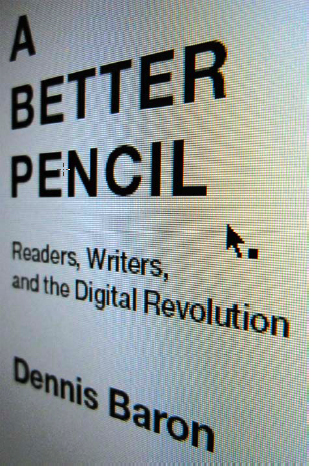
I very much enjoyed Dennis Baron’s new book, A Better Pencil: Readers, Writers, and the Digital Revolution, and highly recommend you pick it up. Baron does a wonderful job exploring the history of techno-pessimism and the endless battles about the impact of new technologies on life and learning, something I have written about here before in my essays on “Internet optimists vs. pessimists” (See: 1, 2, 3).
I have a complete review of Baron’s
A Better Pencil now up on the City Journal‘s website here. I’ve also pasted it down below.
In the beginning, Dennis Baron reminds us in his new book,
A Better Pencil, there was the word—the spoken word, that is. Oral tradition, the passing of knowledge through stories and lectures, was the primary method of instruction and learning throughout early human civilization. But then a few innovative souls decided to start writing everything down on stones and clay. Almost as soon as they did, a great debate began on the impact of new communications technology on culture and education. And it rages on today, with a new generation of optimists and skeptics battling over the impact that computing, the Internet, and digital technologies have on our lives and on how we learn about the world.
Today I was invited to the Federal Communications Commission (FCC) to testify at one of the agency’s Broadband Working Group workshops. This particular workshop was on “Broadband Consumer Context,” which focused on “a range of challenges and opportunities as the internet becomes a focal point for commercial transactions, social networking, and a host of activities pertaining to information gathering and exchange.”
I was asked to address the issue of whether there is a relationship between online safety concerns and broadband uptake. In my testimony, I noted that, in my 15 years of research in this area, I have never unearthed any substantive empirical evidence suggesting a correlation between parental concerns about online activity and overall household broadband uptake. I have seen occasional anecdotal news stories discussing the concerns some parents have had about their kids online that led them to reject online connectivity, but these stories have been exceedingly rare (and I haven’t seen any in recent memory).
I also argued that I did not think it at all surprising that such anecdotes are harder to find, or that empirical evidence on this front seems non-existent. I argued that there were four logical explanations for why parental concerns about online safety haven’t “moved the broadband needle” much in the negative direction:
Not every home has children present
Parents use a variety of household media rules to control media & Internet usage
A vibrant marketplace of parental control technologies exists
Likely that most parents believe that the benefits of broadband outweigh the potential downsides
For all the details on each of those, read my entire testimony or check out the presentation embedded below that I made to the FCC today. Continue reading →
The Technology Liberation Front is the tech policy blog dedicated to keeping politicians' hands off the 'net and everything else related to technology. Learn more about TLF →



 The Technology Liberation Front is the tech policy blog dedicated to keeping politicians' hands off the 'net and everything else related to technology.