 This year marks the 30th anniversary of the publication of Technologies of Freedom: On Free Speech in an Electronic Age by the late communications theorist Ithiel de Sola Pool. It was, and remains, a remarkable book that is well worth your time whether you read it long ago or are just hearing about it for the first time. It was the book that inspired me when I first read in 1994 to abandon my chosen field of study (trade policy) and do a deep dive into the then uncharted waters of information technology policy.
A Technological Nostradamus
Long before most of the world had heard about this thing called “the Internet” or using terms like “cyberspace” or even “electronic superhighway,” Pool was describing this emerging medium, thinking about its ramifications, and articulating the optimal policies that should govern it. In
Technologies of Freedom, Pool set forth both a predictive vision of future communications and “electronic publishing” markets as well as a policy vision for how those markets should be governed. “Networked computers will be the printing presses of the twenty-first century,” Pool argued in a remarkably prescient chapter on the future of electronic publishing. “Soon most published information will disseminated electronically,” and “there will be networks on networks on networks,” he predicted. “A panoply of electronic devices puts at everyone’s hands capacities far beyond anything that the printing press could offer.” As if staring into a crystal ball, Pool predicted: Continue reading →
I’m very excited to announce that I now have a regular Forbes column that will fly under the banner, “Technologies of Freedom.” My first essay for them is already live and it addresses a topic I’ve dealt with here extensively through the years: Irrational fears about tech monopolies and “information empires.” Jump over to Forbes to read the whole thing.
Regular readers of this blog will understand why I chose “Technologies of Freedom” as the title for my column, but I thought it was worth reiterating. No book has had a more formative impact on my thinking about technology policy than Ithiel de Sola Pool’s 1983 masterpiece,
Technologies of Freedom: On Free Speech in an Electronic Age. As I noted in my short Amazon.com review, Pool’s technological tour de force is simply breathtaking in its polemical power and predictive capabilities. Reading this book almost three decades after it was published, one comes to believe that Pool must have possessed a crystal ball or had a Nostradamus-like ability to foresee the future.
For example, long before anyone else had envisioned what we now refer to as “cyberspace,” Pool was describing it in this book. “Networked computers will be the printing presses of the twenty-first century,” he argued in his remarkably prescient chapter on electronic publishing. “Soon most published information will disseminated electronically,” and “there will be networks on networks on networks,” he predicted. “A panoply of electronic devices puts at everyone’s hands capacities far beyond anything that the printing press could offer.” Few probably believed his prophecies in 1983, but no one doubts him now! Continue reading →
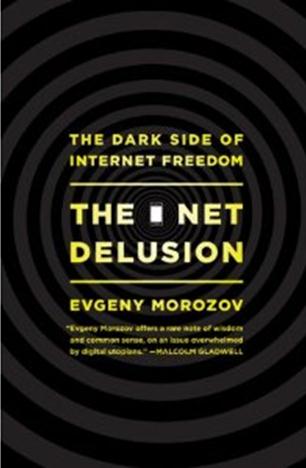 In his new book, The Net Delusion: The Dark Side of Internet Freedom, Evgeny Morozov aims to prick the bubble of hyper-optimism that surrounds debates about the Internet’s role in advancing human freedom or civic causes. Morozov, a native of Belarus, is a tremendously gifted young cyber-policy scholar affiliated with Stanford University and the New America Foundation. He’s an expert on the interaction of digital technology and democracy and writes frequently on that topic for a variety of respected media outlets.
In
Net Delusion, as with many of his previous columns and essays, Morozov positions himself the ultimate Net “realist,” aiming to bring a dose of realpolitik to discussions about how much of a difference the Net and digital technologies make to advancing democracy and freedom. His depressing answer: Not much. Indeed, Morozov’s book is one big wet blanket on the theory that “technologies of freedom” can help liberate humanity from the yoke of repressive government.
Morozov clearly relishes his skunk at the garden party role, missing few opportunities to belittle those who subscribe to such theories. If you’re one of those who tinted your Twitter avatar green as an expression of solidarity with Iranian “Green Movement” dissidents, Morozov’s view is that, at best, you’re wasting your time and, at worst, you’re aiding and abetting tyrants by engaging in a form of “slacktivism” that has little hope of advancing real regime change. The portrait he paints of technology and democracy is a dismal one in which cyber-utopian ideals of information as liberator are not just rejected but inverted. He regards such “cyber-utopian” dreams as counter-productive, even dangerous, to the advance of democracy and human freedom. Continue reading →
We often talk about the problem of having all 50 states impose different regulatory requirements on the Internet, with the most restrictive standard effectively applying to all Internet actors.Fortunately, in the U.S. such efforts can be stamped down either by invoking the “Dormant Commerce Clause” (DCC) in court or by passing “preemptive federal regulation.” (Unfortunately, most who complain about patchwork approaches, both in industry and the advocacy community, usually forget about the DCC and move right to federal legislation.)
But what about the 195 independent countries in the world (to say nothing of their regional/local subdivisions)? What if they each tried regulating Internet activity? Our friends at the Center for Democracy at Technology report on a scary precedent set by a Belgian court in March when it ruled that Belgian law applied to Yahoo! merely because Belgian citizens could access Yahoo! Mail. Thus, the court ruled that Yahoo! violated Belgian law when the company refused to hand over user data in response to an email from a Belgian prosecutor. CDT rightly applauds Yahoo! for insisting that the Belgians “follow established diplomatic and legal processes in order to gain access to user information.” But as the post notes, the really scary prospect is that of one country asserting authority over every site or service on the Internet that can be accessed in their country.
If this precedent stands, it’s likely to cause, at the very least, many companies to limit access to their sites or services by persons from countries with burdensome regulatory approaches. Even if those foreign laws are well-intentioned and laudable—such as efforts to punish fraud (as in the Belgian case) or to crack down on, say, child porn or protect user privacy)—the result could be to balkanize Internet services. This would be especially unfortunate, given the incredible importance of services that might previously have seemed “un-serious” like Twitter or Facebook as “technologies of freedom.” CDT notes the danger to Internet freedom:
To understand how problematic this ruling is, we need only imagine how the governments of China, Iran, Vietnam or other repressive regime of your choice may decide that the precedent set here is one well worth following. Such actions undermine Belgium’s moral authority since, after all, it would only be hypocritical for Western democracies to criticize such radically overbroad assertions of jurisdiction by other nations.
Stephen Schultze is an up-and-coming technology policy analyst who is a fellow at the Berkman Center for Internet and Society at Harvard University. He is also finishing up his Masters of Science in Comparative Media Studies up at MIT. He’s been kind enough to stop by here at the TLF on occasion and comment on some of the things we have written — usually to give us grief, but we welcome that too! He’s very sharp and always has something of substance to say, and he says it in a respectful way. So I look forward to many years of intellectual combat with him. (Incidentally, we also share a mutual admiration for the work of Ithiel de Sola Pool, especially his 1983 classic, “Technologies of Freedom: On Free Speech in an Electronic Age , which I have noted is my favorite tech policy book of all-time.]
Anyway, Stephen has just posted his master’s thesis: “The Business of Broadband and the Public Interest: Media Policy for the Network Society.” It’s a noble attempt to defend and extend the “public interest” concept in the Digital Age. Stephen attempts to “identify the several dimensions in which it remains relevant today.” In his thesis, Stephen cites some of my past work on the issue since I have articulated a very different view on the issue. Specifically, he cites a line of mine that I have used in multiple studies and essays on the issue:
“The public interest standard is not really a “standard” at all since it has no fixed meaning; the definition of the phrase has shifted with the political winds to suit the whims of those in power at any given time.”
I stand by that quote and down below I have pasted a lengthy passage on the mythology surrounding the public interest standard, which I pulled directly from my old 2005 “Media Myths” book. It explains in more detail why I feel that way.
“Right now is a critical point of media in transition that will affect the shape communications ecosystem going forward,” Stephen states in his thesis. I couldn’t agree more, but I completely disagree that that somehow justifies breathing new life into a standard-less standard that justifies open-ended, arbitrary governance of the Internet and digital media. Read on to understand why I feel that way…
Continue reading →
 … environmental attorney Dusty Horwitt, who recently published this outlandishly stupid and highly offensive editorial in the Washington Post calling for an information tax to reduce the supply of information in society. “[I]n our information-overloaded society,” he argues, “the concept of [too much information] is no joke. The information avalanche coming from all sides — the Internet, PDAs, hundreds of television channels — is burying us in extraneous data that prevent important facts and knowledge from reaching a broad audience.” His repressive solution?
It’s possible that over time, an energy tax, by making some computers, Web sites, blogs and perhaps cable TV channels too costly to maintain, could reduce the supply of information. If Americans are finally giving up SUVs because of high oil prices, might we not eventually do the same with some information technologies that only seem to fragment our society, not unite it? A reduced supply of information technology might at least gradually cause us to gravitate toward community-centered media such as local newspapers instead of the hyper-individualistic outlets we have now.
Mike Masnick of TechDirt and Richard Kaplar of the Media Institute do a fine job of ripping Mr. Horwitt’s absurd proposal to shreds. As Kaplar argues, it is “sheer lunacy” to “tax the technologies of freedom.” Unlike gasoline, there are no good reasons — not one — for government to ever take steps to reduce the supply of information. Mr. Horwitt is calling for public officials to use their taxing powers to destroy or limit opportunities for human communications and the free exchange of speech and expression. It is completely antithetical to a free society.
Moreover, if Mr. Horwitt really thinks there is too much information in this world, then perhaps he should lead by example and take his own site offline first! The rest of us will take a world of information abundance over a world of information scarcity any day of the week.
 This year marks the 30th anniversary of the publication of Technologies of Freedom: On Free Speech in an Electronic Age by the late communications theorist Ithiel de Sola Pool. It was, and remains, a remarkable book that is well worth your time whether you read it long ago or are just hearing about it for the first time. It was the book that inspired me when I first read in 1994 to abandon my chosen field of study (trade policy) and do a deep dive into the then uncharted waters of information technology policy.
 The Technology Liberation Front is the tech policy blog dedicated to keeping politicians' hands off the 'net and everything else related to technology.