In an earlier essay, I explored “Why the Future of AI Will Not Be Invented in Europe” and argued that, “there is no doubt that European competitiveness is suffering today and that excessive regulation plays a fairly significant role in causing it.” This essay summarizes some of the major academic literature that leads to that conclusion.
Since the mid-1990s, the European Union has been layering on highly restrictive policies governing online data collection and use. The most significant of the E.U.’s recent mandates is the 2018 General Data Protection Regulation (GDPR). This regulation established even more stringent rules related to the protection of personal data, the movement thereof, and limits what organizations can do with data. Data minimization is the major priority of this system, but there are many different types of restrictions and reporting requirements involved in the regulatory scheme. This policy framework also has ramifications for the future of next-generation technologies, especially artificial intelligence and machine learning systems, which rely on high-quality data sets to improve their efficacy.
Whether or not the E.U.’s complicated regulatory regime has actually resulted in truly meaningful privacy protections for European citizens relative to people in other countries remains open to debate. It is very difficult to measure and compare highly subjective values like privacy across countries and cultures. This makes benefit-cost analysis for privacy regulation extremely challenging — especially on the benefits side of the equation.
What is no longer up for debate, however, is the cost side of the equation and the question of what sort of consequences the GDPR has had on business formation, competition, investment, and so on. On these matters, standardized metrics exist and the economic evidence is abundantly clear: the GDPR has been a disaster for Europe. Continue reading →
President Biden began his 2023 State of the Union remarks by saying America is defined by possibilities. Correct! Unfortunately, his tech-bashing will undermine those possibilities by discouraging technological innovation & online freedom in the United States.
America became THE global leader on digital tech because we rejected heavy-handed controls on innovators & speech. We shouldn’t return to the broken model of the past by layering on red tape, economic controls & speech restrictions.
What has the tech economy done for us lately? Here is a look at the value added to the U.S. economy by the digital sector from 2005-2021. That’s $2.4 TRILLION (with a T) added in 2021. These are astonishing numbers.
FACT: According to the BEA, in 2021, “the U.S. digital economy accounted for $3.70 trillion of gross output, $2.41 trillion of value added (translating to 10.3 % of U.S. GDP), $1.24 trillion of compensation + 8.0 million jobs.”
In 2021…
$3.70 trillion of gross output
$2.41 trillion of value added (=10.3% percent GDP)
$1.24 trillion of compensation
8.0 million jobs
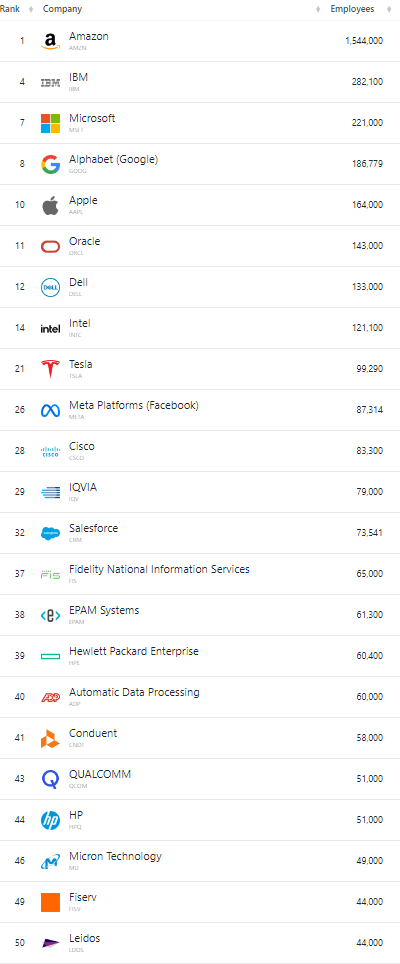
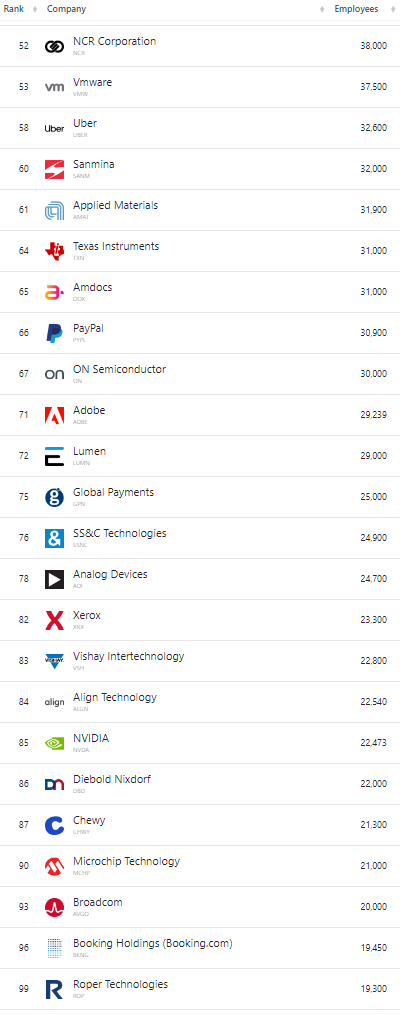
FACT: globally, 49 of the top 100 digital tech firms with most employees are US companies. Here they are. Smart public policy made this list possible.
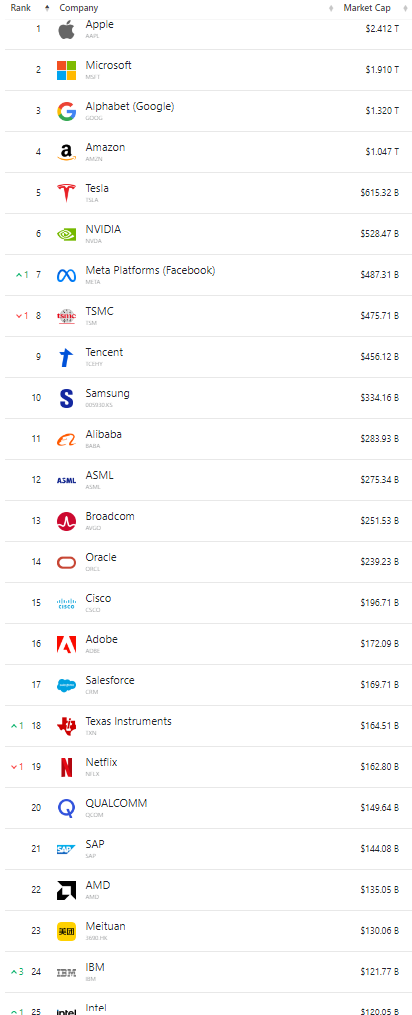
FACT: 18 of the world’s Top 25 tech companies by Market Cap are US-based firms.
It’d be a huge mistake to adopt Europe’s approach to tech regulation. As I noted recently in the Wall Street Journal, “The only thing Europe exports now on the digital-technology front is regulation.” Yet, Biden would have us import the EU model to our shores.
My R Street colleague Josh Withrow has also noted how, “the EU’s approach appears to be, in sum, ‘If you can’t innovate, regulate.’” America should not be following the disastrous regulatory path of the European Union on digital technology policy.
On antitrust regulation, here is a study by my R Street colleague Wayne Brough on the dangerous approach that the Biden administration wants, which would swing a wrecking ball through the tech economy. We have to avoid this.
It is particularly important that the US not follow the EU’s lead on artificial intelligence regulation at a time when we are in heated competition w China on the AI front as I noted here.
American tech innovators flourished thanks to a positive innovation culture rooted in permissionless innovation & policies like Section 230, which allowed American firms to become global powerhouses. And we’ve moved from a world of information scarcity to one of information abundance. Let’s keep it that way.
“The only thing Europe exports now on the digital-technology front is regulation,” I noted in my response, and that makes it all the more mind-boggling that Biden and Barr want to go down that same path. “[T]he EU’s big-government regulatory crusade against digital tech: Stagnant markets, limited innovation and a dearth of major players. Overregulation by EU bureaucrats led Europe’s best entrepreneurs and investors to flee to the U.S. or elsewhere in search of the freedom to innovate.”
Thus, the Biden and Barr plans for importing European-style tech mandates, “would be a stake through the heart of the ‘permissionless innovation’ that made America’s info-tech economy a global powerhouse.” In a longer response to the Biden oped that I published on the R Street blog, I note that:
“It is remarkable to think that after years of everyone complaining about the lack of bipartisanship in Washington, we might get the one type of bipartisanship America absolutely does not need: the single most destructive technological suicide in U.S. history, with mandates being substituted for markets, and permission slips for entrepreneurial freedom.”
What makes all this even more remarkable is that they calls for hyper-regulation come at a time when China is challenging America’s dominance in technology and AI. Thus, “new mandates could compromise America’s lead,” I conclude. “Shackling our tech sectors with regulatory chains will hobble our nation’s ability to meet global competition and undermine innovation and consumer choice domestically.”
I spent much of 2022 writing about the growing policy debate over artificial intelligence, machine learning, robotics, and the Computational Revolution more generally. Here are some of the major highlights of my work on this front.
POLICY DEFAULTS: “The Proper Governance Default for AI” – Which policy default should we choose for algorithmic technologies: The Precautionary Principle or The Proactionary Principle? This is the single most important issue in AI policy today.
Everywhere you look in tech policy land these days, people decry China as a threat to America’s technological supremacy or our national security. Many of these claims are well-founded, while others are somewhat overblown. Regardless, as I argue in a new piece for National Review this week, “America Won’t Beat China by Becoming China.” Many pundits and policymakers seem to think that only a massive dose of central planning and Big Government technocratic bureaucracy can counter the Chinese threat. It’s a recipe for a great deal of policy mischief.
Some of these advocates for a ‘let’s-be-more-like-China’ approach to tech policy also engage in revisionist histories about America’s recent success stories in the personal computing revolution and internet revolution. As I note in my essay, “[t]he revisionists instead prefer to believe that someone high up in government was carefully guiding this decentralized innovation. In the new telling of this story, deregulation had almost nothing to do with it.” In fact, I was asked by
National Review to write this piece in response to a recent essay by Wells King of American Compass, who has penned some rather remarkable revisionist tales of government basically being responsible for all the innovation in digital tech sectors over the past quarter century. Markets and venture capital had nothing to do with it by his reasoning. It’s what Science writer Matt Ridley correctly labels “innovation creationism,” or the notion that it basically takes a village to raise an innovator. Continue reading →
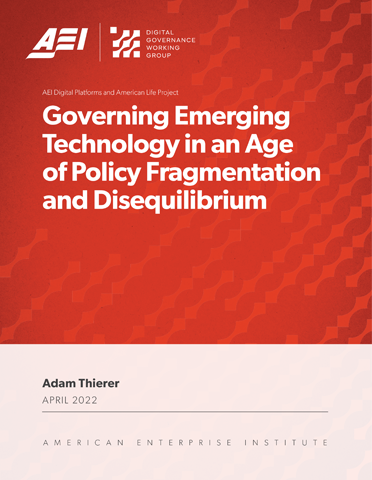
The American Enterprise Institute (AEI) has kicked off a new project called “Digital Platforms and American Life,” which will bring together a variety of scholars to answer the question: How should policymakers think about the digital platforms that have become embedded in our social and civic life? The series, which is being edited by AEI Senior Fellow Adam J. White, highlights how the democratization of knowledge and influence in the Internet age comes with incredible opportunities but also immense challenges. The contributors to this series will approach these issues from various perspectives and also address different aspects of policy as it pertains to the future of technological governance.
It is my honor to have the lead paper in this new series. My 19-page essay is entitled, Governing Emerging Technology in an Age of Policy Fragmentation and Disequilibrium, and it represents my effort to concisely tie together all my writing over the past 30 years on governance trends for the Internet and related technologies. The key takeaways from my essay are:
Traditional governance mechanisms are being strained by modern technological and political realities. Newer technologies, especially digital ones, are developing at an ever-faster rate and building on top of each other, blurring lines between sectors.
Congress has failed to keep up with the quickening pace of technological change. It also continues to delegate most of its constitutional authority to agencies to deal with most policy concerns. But agencies are overwhelmed too. This situation is unlikely to change, creating a governance gap.
Decentralized governance techniques are filling the gap. Soft law—informal, iterative, experimental, and collaborative solutions—represents the new normal for technological governance. This is particularly true for information sectors, including social media platforms, for which the First Amendment acts as a major constraint on formal regulation anyway.
No one-size-fits-all tool can address the many governance issues related to fast-paced science and technology developments; therefore, decentralized governance mechanisms may be better suited to address newer policy concerns.
My arguments will frustrate many people of varying political dispositions because I adopt a highly pragmatic approach to technological governance. Continue reading →
This weekend, The Wall Street Journal ran my short letter to the editor entitled, “We Can Protect Children and Keep the Internet Free.” My letter was a response to columnist Peggy Noonan’s April 9 oped, “Can Anyone Tame Big Tech?” in which she proposed banning everyone under 18 from all social-media sites. She specifically singled out TikTok, Youtube, and Instagram and argued “You’re not allowed to drink at 14 or drive at 12; you can’t vote at 15. Isn’t there a public interest here?”
I briefly explained why Noonan’s proposal is neither practical nor sensible, noting how it:
would turn every kid into an instant criminal for seeking access to information and culture on the dominant medium of their generation. I wonder how she would have felt about adults proposing to ban all kids from listening to TV or radio during her youth.
Let’s work to empower parents to help them guide their children’s digital experiences. Better online-safety and media-literacy efforts can prepare kids for a hyperconnected future. We can find workable solutions that wouldn’t usher in unprecedented government control of speech.
Let me elaborate just a bit because this was the focus of much of my writing a decade ago, including my book, Parental Controls & Online Child Protection: A Survey of Tools & Methods, which spanned several editions. Online child safety is a matter I take seriously and the concerns that Noonan raised in her oped have been heard repeatedly since the earliest days of the Internet. Regulatory efforts were immediately tried. They focused on restricting underage access to objectionable online content (as well as video games), but were immediately challenged and struck down as unconstitutionally overbroad restrictions on free speech and a violation of the First Amendment of the U.S. Constitution. Continue reading →
Almost every argument against technological innovation and progress that we hear today was identified and debunked by Samuel C. Florman a half century ago. Few others since him have mounted a more powerful case for the importance of innovation to human flourishing than Florman did throughout his lifetime.
Chances are you’ve never heard of him, however. As prolific as he was, Florman did not command as much attention as the endless parade of tech critics whose apocalyptic predictions grabbed all the headlines. An engineer by training, Florman became concerned about the growing criticism of his profession throughout the 1960s and 70s. He pushed back against that impulse in a series of books over the next two decades, including most notably:
The Existential Pleasures of Engineering (1976), Blaming Technology: The Irrational Search for Scapegoats (1981), and The Civilized Engineer (1987). He was also a prolific essayist, penning hundreds of articles for a wide variety of journals, magazines, and newspapers beginning in 1959. He was also a regular columnist for MIT Technology Review for sixteen years.
Florman’s primary mission in his books and many of those essays was to defend the engineering profession against attacks emanating from various corners. More broadly, as he noted in a short autobiography on his personal website, Florman was interested in discussing, “the relationship of technology to the general culture.”
Florman could be considered a “rational optimist,” to borrow Matt Ridley’s notable term[1] for those of us who believe, as I have summarized elsewhere, that there is a symbiotic relationship between innovation, economic growth, pluralism, and human betterment.[2] Rational optimists are highly pragmatic and base their optimism on facts and historical analysis, not on dogmatism or blind faith in any particular viewpoint, ideology, or gut feeling. But they are unified in the belief that technological change is a crucial component of moving the needle on progress and prosperity.
Florman’s unique contribution to advancing rational optimism came in the way he itemized the various claims made by tech critics and then powerfully debunked each one of them. Continue reading →
I recently joined Rep. Dan Crenshaw on his Hold These Truths podcast to discuss, “What’s Wrong with Industrial Policy.” We chatted for 25 minutes about a wide range of issues related to the the growing push for grandiose industrial policy schemes in the US, including the massive new 3,000-page, $350 billion “COMPETES Act” legislation that recently passed in the House and which will soon be conferenced with a Senate bill that already passed.
On the same day this podcast was released this week, I also had a new op-ed appear in
The Hill on “The Coming Industrial Policy Hangover.” In both that essay and the podcast with Rep. Crenshaw, I stress that, beyond all the other problems with these new industrial policy measures, no one is talking about the fiscal cost of it all. As I note:
In the rush to pass legislation, we’ve barely heard a peep about the $250-$350 billion price tag. This follows a massive splurge of recent government borrowing, which led to the U.S. national debt hitting another lamentable new record: $30 trillion. China already owns over $1 trillion of that debt, making one wonder if we’re really countering China by adopting a massive, new and unfunded industrial policy that they will end up financing indirectly.
The Technology Liberation Front is the tech policy blog dedicated to keeping politicians' hands off the 'net and everything else related to technology. Learn more about TLF →



 The Technology Liberation Front is the tech policy blog dedicated to keeping politicians' hands off the 'net and everything else related to technology.