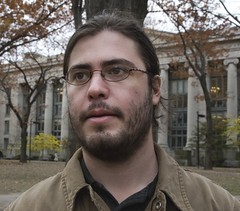
 In episode #44 of “Tech Policy Weekly,” Berin Szoka and Adam Thierer engage in a debate with Internet security expert Chris Soghoian, who is a student fellow at the Berkman Center for Internet & Society at Harvard University. He is also a Ph.D. candidate at Indiana University’s School of Informatics.
Chris is an up-and-coming star in the field of cyberlaw and technology policy as he has quickly made a name for himself in debates over privacy policy, data security, and government surveillance. He straddles the line between academic and activist, and the role he often plays in many tech policy debates is somewhat akin to what Ralph Nader has done in many other fields through the years. Except, in this case, instead of “Unsafe at Any Speed” it’s more like “Unsafe at Any Setting,” since Chris is often raising a stink about what he regards as unjust or unreasonable privacy or security settings that various online websites or service providers use.
On the show, Chris talks about two of his recent crusades to get certain online providers to change their default settings to improve user security or privacy: (1) His effort this week to get major email providers—and Google in particular—to change their default security settings on their email offerings; and (2) his earlier crusade to create permanent opt-out cookies to stop behavioral advertising by advertising networks.
There are several ways to listen to today’s TLF Podcast. You can press play on the player below to listen right now, or download the MP3 file. You can also subscribe to the podcast by clicking on the button for your preferred service. (And do us a favor, Digg this podcast!)
[display_podcast]
Continue reading →
Conversations about how the Internet can be used to increase the openness and accountability of government usually focuses on the Executive and Legislative branches of the Federal government. But on this week’s episode of Technology Policy Weekly, I hosted a discussion of the equally vital issue of public access to court records, joined by:
We discussed a wide range of issues, including:
- Why lay people should care—this is ultimately about reducing the legal profession’s monopoly over access to the courts!
- The philosophical reasons why better access to court records is important – little things like democracy, fairness, consistency, equality, the rule of law, etc.
- The copyrightability of legal records
- The history of the problem & what can be done about it
There are several ways to listen to the TLF Podcast. You can press play on the player below to listen right now, or download the MP3 file. You can also subscribe to the podcast by clicking on the button for your preferred service. And do us a favor, Digg this podcast!
[display_podcast]
I’ve been catching up on Radio Berkman, the podcast produced by our friends at the Berkman Center for Internet & Society and a great companion to the TLF’s own Tech Policy Weekly Podcast. There’s been a lot of talk about government transparency on the TLF lately, including TPW 40: Obama, e-Government & Transparency. But that conversation has been mainly focused on how to make “public” records accessible.
The most recent Radio Berkman episode, “Can you Keep a Secret?” explores the thorny questions about what should be deemed public in the first place, and what should be classified:
The government keeps secrets. We take that for granted. But should we? Some speculate that intelligence agencies and elected officials are a little bit trigger happy with the “Top Secret” stamp, and that society would benefit from greater openness. With the government classifying millions of pages of documents per year – in a recent year the U.S. classified about five times the number of pages added to the Library of Congress – a great deal of useful human knowledge gets put under lock and key. But some argue that secrecy is still crucial to our national security.
Radio Berkman pokes its head into a recent talkback with the directors of the film
Secrecy, Harvard University professors Peter Galison and Robb Moss. They are joined by Harvard Law School professors Jonathan Zittrain, Martha Minow, and Jack Goldsmith.
I look forward to seeing the film (when it comes out on Netflix).
What I found most interesting was the discussion of the essential trade-off in the relationship between the media and the state has always been between the media’s “independence” and its “responsibility” (~33:30 in). Even the staunchest critics of the national security state would probably accept that there are
some stories in the media shouldn’t publish because they’d jeopardize the safety of Americans. But we all want the media to blow the whistle on the bad stuff that goes on behind a veil of secrecy. Drawing that line is a terribly difficult task. But it becomes even more complicated with the decline of traditional professional investigative journalism and the rise of blog/amateur journalism. Continue reading →
 On this episode “Tech Policy Weekly,” Technology Liberation Front contributors Ryan Radia and Berin Szoka join me for a discussion of the flare-up over Facebook’s recent changes to the data retention provisions of its Terms of Use agreement and whether there are any serious privacy issues in play here—or if this is all much ado about nothing. [Ryan blogged about it here, and I did here.]
Earlier this month, Facebook announced changes to the way it handled or retained user data on its site after a user quits Facebook, raising questions about who actually owns that data and whether any privacy issues were raised by the company’s new policy. Following some intense scrutiny in the blogosphere, Facebook decided this week to revert to their old terms of service until they figured out a new approach to data management and ownership.
You can begin listening by downloading the MP3 file here or by just clicking the play button below. Or subscribe to our Podcast ( iTunes, other).
[display_podcast]

 The Technology Liberation Front is the tech policy blog dedicated to keeping politicians' hands off the 'net and everything else related to technology.