I want to bring to everyone’s attention an important new white paper by Dr. Robert Graboyes, a colleague of mine at the Mercatus Center at George Mason University who specializes in the economics of health care. His new 67-page study, Fortress and Frontier in American Health Care, seeks to move away from the tired old dichotomies that drive health care policy discussions: Left versus Right, Democrat versus Republican, federal versus state, and public versus private, and so on. Instead, Graboyes seeks to reframe the debate over the future of health care innovation in terms of “Fortress versus Frontier” and to highlight what lessons we can learn from the Internet and the Information Revolution when considering health care policy.
What does Graboyes mean by “Fortress and Frontier”? Here’s how he explains this conflict of visions:
The Fortress is an institutional environment that aims to obviate risk and protect established producers (insiders) against competition from newcomers (outsiders). The Frontier, in contrast, tolerates risk and allows outsiders to compete against established insiders. . . . The Fortress-Frontier divide does not correspond neatly with the more familiar partisan or ideological divides. Framing health care policy issues in this way opens the door for a more productive national health care discussion and for unconventional policy alliances. (p. 4)
Heritage Foundation released a new study this week arguing that “Congress Should Not Authorize States to Expand Collection of Taxes on Internet and Mail Order Sales.” It’s a good contribution to the ongoing debate over Internet tax policy. In the paper, David S. Addington, the Vice President for Domestic and Economic Policy at Heritage, takes a close look at the constitutional considerations in play in this debate. Specifically, he examines the wisdom of S. 1832, “The Marketplace Fairness Act.” Addington argues that, “enactment of S. 1832 would discourage free market competition” and raise a host of other issues:
The Constitution of the United States has set the legal baseline—the level playing field—around which the American free-market economy has built itself. The Constitution, as reflected in the Quill decision, is the source of the present arrangement regarding collection of state sales and use taxes by remote sellers. Ever since the Supreme Court decided Quill in 1992, American businesses have made millions of business decisions in the competitive marketplace based in part on settled expectations regarding state taxation affecting their sales transactions. The states and businesses advocating S. 1832 seek to change the current, constitutionally prescribed playing field. They seek to use governmental power to intervene in the economy to help in-state, store-based businesses by imposing a new tax-collection burden on out-of-state competitors who sell over the Internet, through mail order catalogs, or by telephone. Free-market principles generally discourage such government intervention in the economy to pick winners and losers based on legislative policy preferences.
Veronique de Rugy and I raised similar concerns in both a recent Mercatus white paper (“The Internet, Sales Taxes, and Tax Competition
“) and an earlier 2003 Cato white paper, (“The Internet Tax Solution: Tax Competition, Not Tax Collusion”). We argued that there are better ways to achieve “tax fairness” without sacrificing tax competition or opening the doors to unjust, unconstitutional, and burdensome state-based taxation of interstate sales. Specifically, we point out that an “origin-based” sourcing rule would be the cleanest, most pro-constitutional, and pro-competitive alternative. I also discussed these issues at a recent Cato event. [Video follows.]
On Monday it was my great pleasure to participate in a Cato Institute briefing on Capitol Hill about “Internet Taxation: Should States Be Allowed to Tax outside Their Borders?” Also speaking was my old friend Dan Mitchell, a senior fellow with Cato. From the event description: “State officials have spent the last 15 years attempting to devise a regime so they can force out-of-state vendors to collect sales taxes, but the Supreme Court has ruled that such a cartel is not permissible without congressional approval. Congress is currently considering the Main Street Fairness Act, a bill that would authorize a multistate tax compact and force many Internet retailers to collect sales taxes for the first time. Is this sensible? Are there alternative ways to address tax “fairness” concerns in this context?”
Watch the video for our answers. Also, here’s the big Cato paper that Veronique de Rugy and I penned for Cato on this back in 2003 and here’s a shorter recent piece we did for Mercatus.
Reps. Jackie Speier (D-Calif.) and Steve Womack (R-Ark.) have introduced “The Marketplace Equity Act,” which would open the floodgates to anything-goes State-based taxation of the Internet and interstate commerce. The bill essentially sacrifices constitutional fairness at the alter of “tax fairness.” Building on concerns raised by state and local officials as well as “bricks-and-mortar” retailers, Speier and Womack claim that, as “a matter of states’ rights” and “leveling the playing field,” Congress should bless state efforts to impose sales tax collection obligation on interstate (“remote”) companies.The measure would allow States to do so using one of three rate structures: (1) a single blended state/local rate; (2) a single maximum State rate; or (3) the actual local jurisdiction destination rate + the State rate (so long as the State “make(s) available adequate software to remote sellers that substantially eases the burden of collecting at multiple rates within the State.”)
This builds on a long-standing effort by some States to devise a multistate sales tax compact to collude and impose taxes on interstate transactions. In the Senate, Sen. Dick Durbin (D-IL) has floated legislation (“The Main Street Fairness Act”) that would bless such a state-based de facto national sales tax regime for the Internet.
There is a better way to achieve fairness without sacrificing tax competition or opening the doors to unjust, unconstitutional, and burdensome state-based taxation of interstate sales. In a new Mercatus Center essay,”The Internet, Sales Taxes, and Tax Competition,” Veronique de Rugy and I argue that: Continue reading →
The debate over the imposition of sales tax collection obligations on interstate vendors is heating up again at the federal level with the introduction of S. 1452, “The Main Street Fairness Act.” [pdf] The measure would give congressional blessing to a multistate compact that would let states impose sales taxes on interstate commerce, something usually blocked by the Commerce Clause of the U.S. Constitution. Senator Dick Durbin (D-IL) introduced the bill in the Senate along with Tim Johnson (D-SD) and Jack Reed (D-RI). The measure is being sponsored in the House of Representatives by John Conyers (D-MI) and Peter Welch (D-VT). At this time, there are no Republican co-sponsors even though Sen. Mike Enzi was rumored to be a considered co-sponsoring the measure before introduction.
Without any Republicans on board the effort, the measure may not advance very far in Congress. Nonetheless, to the extent the measure gets any traction, it is worth itemizing a few of the problems with this approach. My Mercatus Center colleague Veronique de Rugy and I have done some work on this issue together in the past and we are planning a short new paper on the topic. It will build on this lengthy Cato Institute paper we authored together in 2003, “The Internet Tax Solution: Tax Competition, Not Tax Collusion.” The key principle we set forth was this: “Congress must.. take an affirmative stand against efforts by state and local governments to create a collusive multistate tax compact to tax interstate sales.” “It would be wrong,” we argued, “for members of Congress to abdicate their responsibility to safeguard the national marketplace by giving the states carte blanche to tax interstate commercial activities through a tax compact. The guiding ethic of this debate must remain tax competition, not tax collusion.” Continue reading →
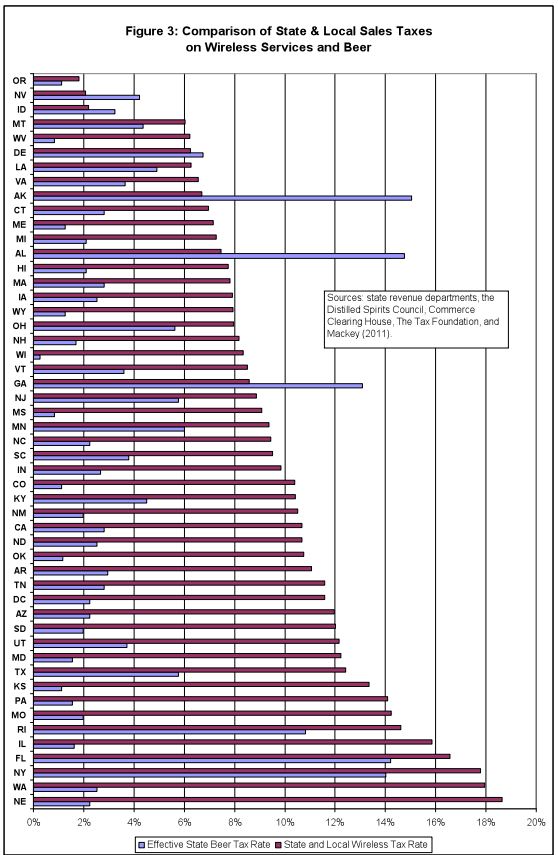
As we’ve noted herebefore, state and local politicians just love wireless taxes. They are going up, up, up. Dan Rothschild outlined this disturbing trend in his recent Mercatus Center paper making “The Case Against Taxing Cell Phone Subscribers,” and I discussed it in my recent Forbes essay lambasting the “Talking Tax.” Another new study by Glenn Woroch of the Georgetown University School of Business notes how “The ‘Wireless Tax Premium’ Harms American Consumers and Squanders the Potential of the Mobile Economy.” Woroch estimates that “the American consumer forgoes over $15 billion in surplus annually compared to when cell phones receive the
same tax treatment as other goods and service.” Read the entire study but I want to draw everyone’s attention to this chart that appears on page 7 of the report comparing state and local wireless taxes burdens to beer taxes. It really makes you realize just how drunk on wireless taxes are local lawmakers have become! [Click to enlarge. Red bar = wireless taxes.]
My latest Forbes column notes how “Taxes On Talking Are On the Rise Across the U.S.” with levies on mobile phones and devices skyrocketing. I build my argument around data and arguments found in Dan Rothschild’s excellent recent Mercatus Center paper, which makes “The Case Against Taxing Cell Phone Subscribers,” as well as an important recent study by Scott Mackey, an economist and partner at KSE Partners LLP, which documents the growing burden of these wireless taxes and fees.
“Wireless users now face a combined federal, state, and local tax and fee burden of 16.3%, a rate two times higher than the average retail sales tax rate and the highest wireless rate since 2005,” Mackey finds. Mobile tax rates range from a high of 23.7% in Nebraska to a low of 6.9% in Oregon. 48 states have an average combined wireless tax rate above 11%. These burdensome taxes on talking just don’t make any sense, argues Rothschild. “There is no economic justification for these high tax rates: reducing cell phone ownership is not a public policy goal, cell phone use by one customer does not affect other customers or other people, and these taxes fall disproportionately on lower-income households.”
You can read my entire essay here, but also make sure to re-read Dan Rothschild’s guest post here at the TLF on the issue. It’s much better than my own treatment. For me, the key point is this: If the primary policy goal in this arena is to build out a first-class communications and data infrastructure and make sure all Americans have access to it, discriminatory taxes on wireless services and networks are highly counter-productive. Policymakers should hang up on the Talking Tax.
[The following essay is a guest post from Dan Rothschild, Managing Director of the State and Local Policy Project at the Mercatus Center at George Mason University.]
Policy makers may be tempted to hike taxes on cell phones, or to create (or “equalize”) taxes on untaxed (or “under taxed”) parts of wireless telephony, such as cell phone data plans or e-readers with cellular connections. As I argue in a recent issue of Mercatus on Policy, this is a bad idea for a number of reasons. Continue reading →
I was particularly pleased to see both Will and Jacoby take on bogus federalism arguments in favor of allowing States to form a multistate tax cartel to collect out-of-state sales taxes. Senators Dick Durbin (D-IL) and Mike Enzi (R-WY) will soon introduce the “Main Street Fairness Act,” which would force all retailers to collect sales tax for states who join a formal compact. It’s a novel—and regrettable—ploy to get around constitutional hurdles to taxing out-of-state vendors. Sadly, it is gaining support in some circles based on twisted theories of what federalism is all about. Real federalism is about a tension between various levels of government and competition among the States, not a cozy tax cartel.
Will rightly notes that “Federalism — which serves the ability of businesses to move to greener pastures — puts state and local politicians under pressure, but that is where they should be, lest they treat businesses as hostages that can be abused.” And Jacoby argues that an “origin-based” sales tax sourcing rule is the more sensible solution to leveling the tax playing field: Continue reading →
The Technology Liberation Front is the tech policy blog dedicated to keeping politicians' hands off the 'net and everything else related to technology. Learn more about TLF →
 I want to bring to everyone’s attention an important new white paper by Dr. Robert Graboyes, a colleague of mine at the Mercatus Center at George Mason University who specializes in the economics of health care. His new 67-page study, Fortress and Frontier in American Health Care, seeks to move away from the tired old dichotomies that drive health care policy discussions: Left versus Right, Democrat versus Republican, federal versus state, and public versus private, and so on. Instead, Graboyes seeks to reframe the debate over the future of health care innovation in terms of “Fortress versus Frontier” and to highlight what lessons we can learn from the Internet and the Information Revolution when considering health care policy.

 The Technology Liberation Front is the tech policy blog dedicated to keeping politicians' hands off the 'net and everything else related to technology.