Posts tagged as:

Yesterday, the Supreme Court dropped a decision in Wayfair v. South Dakota, a case on the issue of online sales tax. As always, the holding is key: “Because the physical presence rule of Quill is unsound and incorrect, Quill Corp. v. North Dakota, 504 U. S. 298, and National Bellas Hess, Inc. v. Department of Revenue of Ill., 386 U. S. 753, are overruled.” What follows below is a roundup of reactions and comments to the decision. Continue reading →

The war among the states to see who can lavish the film industry with more generous tax credits in their attempt to become “the next Hollywood” continues, and it is quickly descending into a classic race to the bottom. A front-page article in today’s Wall Street Journal notes that the tax incentive bidding war has gotten so intense that it is hollowing out the old Hollywood labor pool and sending it on a road trip across the America in search of tax-induced job activity:

As film and TV production scatters around the country, more workers…  are packing up from California and moving to where the jobs are. Driving this exodus of lower-wage workers — stunt doubles, makeup artists, production assistants and others who keep movie sets humming — are successful efforts by a host of states to use tax incentives to poach production business from California. […]  Only two movies with production budgets higher than $100 million filmed in Los Angeles in 2013, according to Film L.A. Inc., the city’s movie office. In 1997, the year “Titanic” was released, every big-budget film but one filmed at least partially in the city. The number of feature-film production days in Los Angeles peaked in 1996 and fell by 50% through last year, according to Film L.A. Projects such as reality television and student films have picked up some of the slack. But overall entertainment-industry employment has slid. About 120,000 Californians worked in the industry in 2012, down from 136,000 in 2004, according to the U.S. Bureau of Labor Statistics. The labor migration has arisen in part because California hasn’t competed aggressively on the tax-break front, officials and executives say, while states like Georgia have made efforts to grab a sizable chunk of the industry. More than 40 states and 30 foreign countries are offering increasingly generous and creative tax incentives to lure entertainment producers.

On one hand, hooray for labor mobility! But seriously, this stinks because this labor shift is taking place in a wholly unnatural way, with a complex and growing web of tax inducements leading to massive distortions in this marketplace. Continue reading →

In July 2012, the D.C. Council approved the Social E-Commerce Job Creation Tax Incentive Act of 2012. The deal provided LivingSocial, a popular online coupon service, with corporate and property tax exemptions in Washington, D.C. worth approximately $32.5 million over five years beginning in 2015. Legislators feared that LivingSocial would relocate to areas with a lower tax rate. In exchange for the $32.5 million, LivingSocial said it would attempt to add 1,000 employees to its payroll (roughly doubling its number of employees in the District), although no contractual guarantee for job creation exists and even though the firm had never been profitable. Some of the few contractual obligations required for LivingSocial to receive these tax exemptions are that it must establish a program to mentor D.C. high school students, provide internships for D.C. students, and stay located in the District. LivingSocial must also ensure 50% of newly hired employees live in the District in order to receive the Act’s full $32.5 million in exemptions.

Just a few months after the deal was struck it had already become apparent just how risky of a bet the DC government has made with taxpayer dollars. In late November 2012, LivingSocial announced a net loss of $566 million for the third quarter and that hundreds of employees would be laid off. The promise to roughly doubling the size of its DC-based workforce seems fairly unlikely and some analysts doubt the company will survive much longer.

This serves as another case study for just how foolish it is for governments to make risky, taxpayer-backed bets on information tech companies. Continue reading →

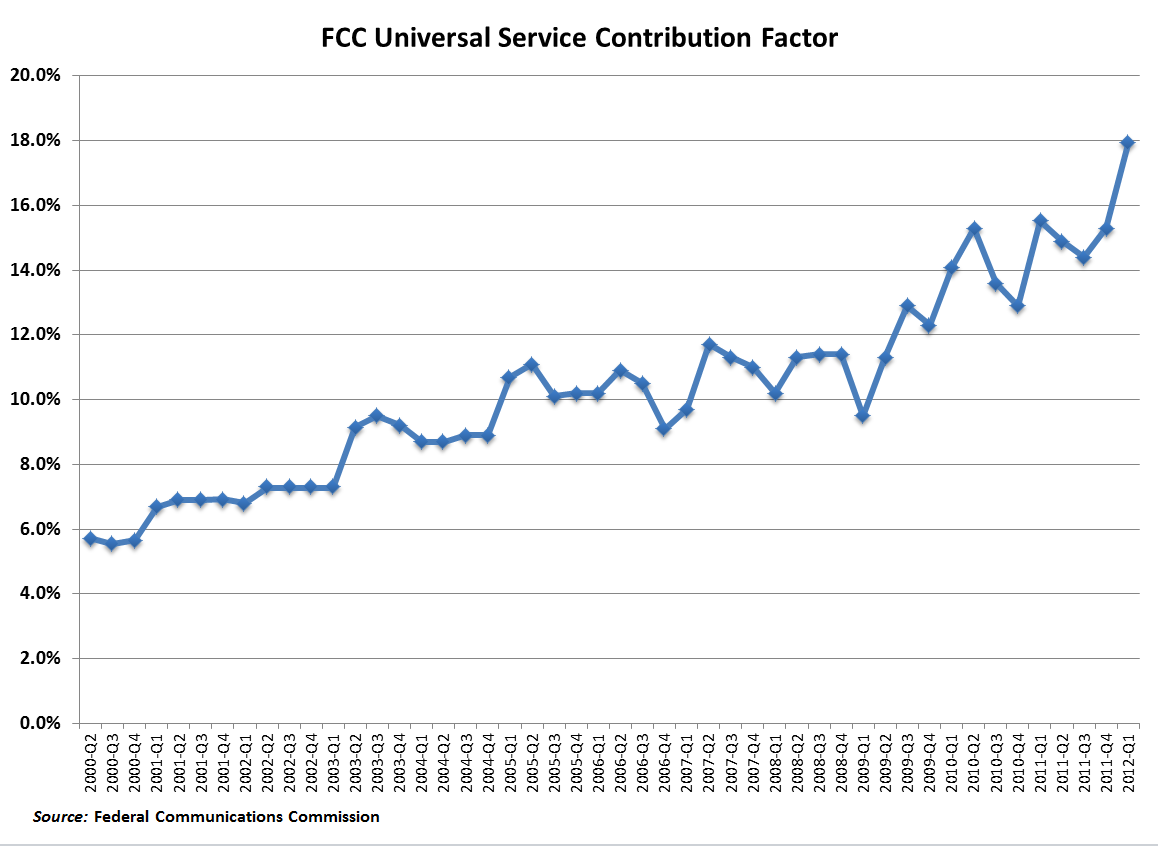
The FCC’s universal service tax is officially out of control. The agency announced yesterday that the “universal service contribution factor” for the 1st quarter of 2012 will go up to 17.9%.  This “contribution factor” is a tax imposed on telecom companies that is adjusted on a quarterly basis to accommodate universal service programs. The FCC doesn’t like people calling it a tax, but that’s exactly what it is. And it just keeps growing and growing. In fact, as the chart below reveals, it has been exploding in recent years. It was in single digits just a few years ago but is now heading toward 20%. And not only is this tax growing more burdensome, but it is completely unsustainable. As the taxable base (traditional interstate telephony) is eroded by new means of communicating, the tax rate will have to grow exponentially or the base will have to be broadened to cover new technologies and services. We should have junked the current carrier-delivered universal service subsidy system years ago and gone with a straight-forward voucher system. A means-tested voucher could have targeted assistance to those who needed it without creating an inefficient, unsustainable hidden tax like we have now. For all the ugly details, I recommend reading all of Jerry Ellig’s research on the issue.

The debate over the imposition of sales tax collection obligations on interstate vendors is heating up again at the federal level with the introduction of S. 1452, “The Main Street Fairness Act.” [pdf]  The measure would give congressional blessing to a multistate compact that would let states impose sales taxes on interstate commerce, something usually blocked by the Commerce Clause of the U.S. Constitution.  Senator Dick Durbin (D-IL) introduced the bill in the Senate along with Tim Johnson (D-SD) and Jack Reed (D-RI).  The measure is being sponsored in the House of Representatives by John Conyers (D-MI) and Peter Welch (D-VT). At this time, there are no Republican co-sponsors even though Sen. Mike Enzi was rumored to be a considered co-sponsoring the measure before introduction.

Without any Republicans on board the effort, the measure may not advance very far in Congress. Nonetheless, to the extent the measure gets any traction, it is worth itemizing a few of the problems with this approach. My Mercatus Center colleague Veronique de Rugy and I have done some work on this issue together in the past and we are planning a short new paper on the topic. It will build on this lengthy Cato Institute paper we authored together in 2003, “The Internet Tax Solution: Tax Competition, Not Tax Collusion.” The key principle we set forth was this: “Congress must.. take an affirmative stand against efforts by state and local governments to create a collusive multistate tax compact to tax interstate sales.” “It would be wrong,” we argued, “for members of Congress to abdicate their responsibility to safeguard the national marketplace by giving the states carte blanche to tax interstate commercial activities through a tax compact. The guiding ethic of this debate must remain tax competition, not tax collusion.” Continue reading →

My latest Forbes column notes how “Taxes On Talking Are On the Rise Across the U.S.” with levies on mobile phones and devices skyrocketing.  I build my argument around data and arguments found in Dan Rothschild’s excellent recent Mercatus Center paper, which makes “The Case Against Taxing Cell Phone Subscribers,” as well as an important recent study by Scott Mackey, an economist and partner at KSE Partners LLP, which documents the growing burden of these wireless taxes and fees.

“Wireless users now face a combined federal, state, and local tax and fee burden of 16.3%, a rate two times higher than the average retail sales tax rate and the highest wireless rate since 2005,” Mackey finds. Mobile tax rates range from a high of 23.7% in Nebraska to a low of 6.9% in Oregon.  48 states have an average combined wireless tax rate above 11%.  These burdensome taxes on talking just don’t make any sense, argues Rothschild. “There is no economic justification for these high tax rates: reducing cell phone ownership is not a public policy goal, cell phone use by one customer does not affect other customers or other people, and these taxes fall disproportionately on lower-income households.”

You can read my entire essay here, but also make sure to re-read Dan Rothschild’s guest post here at the TLF on the issue. It’s much better than my own treatment.  For me, the key point is this: If the primary policy goal in this arena is to build out a first-class communications and data infrastructure and make sure all Americans have access to it, discriminatory taxes on wireless services and networks are highly counter-productive. Policymakers should hang up on the Talking Tax.

[The following essay is a guest post from Dan Rothschild, Managing Director of the State and Local Policy Project at the Mercatus Center at George Mason University.]

As cell phone ownership has tripled in the United States over the last decade, policymakers have increasingly seen mobile devices as a cash cow. In some states, consumers now pay as much as a quarter of their cell phone bills in taxes. And while state revenues are beginning to tick back up from their low point during the recession, Medicaid costs are fast on their tails. So it’s likely that over the coming years, states will be looking to find taxes to hike or new taxes to create — all without calling them tax hikes, of course.

Policy makers may be tempted to hike taxes on cell phones, or to create (or “equalize”) taxes on untaxed (or “under taxed”) parts of wireless telephony, such as cell phone data plans or e-readers with cellular connections. As I argue in a recent issue of Mercatus on Policy, this is a bad idea for a number of reasons. Continue reading →

I was pleased to see columnists George Will of The Washington Post and Jeff Jacoby of The Boston Globe take on the Internet sales tax issue in two smart recent essays. Will’s Post column (“Working Up a Tax Storm in Illinois) and Jacoby’s piece,”There’s No Fairness in Taxing E-Sales,” are both worth a read. They are very much in line with my recent Forbes column on the issue (“The Internet Tax Man Cometh,”) as well as this recent oped by CEI’s Jessica Melugin, which Ryan Radia discussed here in his recent essay “A Smarter Way to Tax Internet Sales.”

I was particularly pleased to see both Will and Jacoby take on bogus federalism arguments in favor of allowing States to form a multistate tax cartel to collect out-of-state sales taxes.  Senators Dick Durbin (D-IL) and Mike Enzi (R-WY) will soon introduce the “Main Street Fairness Act,” which would force all retailers to collect sales tax for states who join a formal compact. It’s a novel—and regrettable—ploy to get around constitutional hurdles to taxing out-of-state vendors. Sadly, it is gaining support in some circles based on twisted theories of what federalism is all about. Real federalism is about a tension between various levels of government and competition among the States, not a cozy tax cartel.

Will rightly notes that “Federalism — which serves the ability of businesses to move to greener pastures — puts state and local politicians under pressure, but that is where they should be, lest they treat businesses as hostages that can be abused.” And Jacoby argues that an “origin-based” sales tax sourcing rule is the more sensible solution to leveling the tax playing field: Continue reading →

By Adam Thierer & Berin Szoka

In a series of upcoming essays, we will be examining proposals being put forward today that would have the government play a greater role in sustaining struggling media enterprises, “saving journalism,” or promoting more “public interest” content. The reason we’re working up this multi-part series is because, with many traditional media operators struggling, and questions being raised about how journalism in particular will be supported in the future, Washington policymakers are currently considering what role government can and should play in helping media providers reinvent themselves in the face of tumultuous technological change wrought by the Digital Revolution.

For example, the Federal Communications Commission (FCC) recently kicked off a new “Future of Media” effort with a workshop on “Serving the Public Interest in the Digital Era.” (The  filing deadline for the FCC’s “Future of Media” proceeding is May 7th).  Likewise, the Federal Trade Commission (FTC) has hosted two workshops asking “How Will Journalism Survive the Internet Age?”  Meanwhile, the Senate has already held hearings about “the future of journalism,” and Senator Benjamin L. Cardin (D-MD) recently introduced the “Newspaper Revitalization Act,” which would allow newspapers to become tax-exempt non-profits in an effort to help them stay afloat.

Thus, in light of Washington’s sudden interest in the future of media and journalism, we will be taking a hard look at several issues and proposals that are being floated today, including:

  • Taxes on media devices, mobile phones, or broadband bills to channel money to media enterprises / content;
  • Taxes / fees on broadcasters to funnel support to their public sector competitors or to public interest programs;
  • “News vouchers” or “public interest vouchers” that would encourage citizens to channel support to media providers;
  • Taxes on private advertising to subsidize non-commercial / public media content;
  • Expanded postal subsidies for media mail; and
  • Targeted welfare programs for out-of-work journalists or corporate welfare in the form of bailouts for failing media enterprises.

You won’t be surprised to hear that we are generally quite skeptical of most of these ideas, but we promise to give each one serious consideration.  We’ll kick things off tomorrow with our essay on why taxing media devices or distribution systems to fund media content is not a particularly good idea.

A new study in the December 2009 Archives of Ophthalmology reports the beginnings of a new public health epidemic: a dramatic increase in nearsightedness (myopia).  The authors compared the prevalence of myopia in Americans aged 12-54  in 1971-72 and 1999-2004. Prevalence of myopia increased from 25 percent of the population in 1971-72 to 41.6 percent in 1999-2004 — a 66.4 percent increase!  Myopia increased for both blacks and whites (the only two racial categories investigated in the study) and for both men and women (the only two gender categories investigated in the study).

According to the article, genetics and environment both play a role in myopia. It cites several previous studies showing that people with more education are at greater risk, presumably because they’re more likely to spend a lot of time doing “up-close” work like reading and using computers. The authors note that although it’s easy to treat myopia with contact lenses or eyeglasses, the costs of having 25 percent of the population with myopia are about $2 billion per year. 

So stop reading this, get outside, and throw that football around! 

More seriously, I am counting the days until some advocate gloms onto this study to justify a tax on e-mails and social networking, the same way advocates have cited the costs of obesity, alcoholism, and smoking to justify higher taxes on “sins” like soda pop, alcohol, and cigarettes. (Yes, a soda pop tax was under discussion to fund this year’s health care bill!) In fairness to the study’s authors, I should note that they suggest no such thing.

Education is a risk factor for myopia, but I doubt anyone would propose a tax on education as a cure. Education, after all, is generally regarded as a good thing that generates significant private and social benefits. E-mails, Facebook, and Twitter, on the other hand, have a “fun” aspect that makes it much easier to classify them as sins in the same category as getting drunk, smoking, and sipping Coca-Cola. They may also be addictive; anybody heard the term “crackberry”?

There are, of course, some counter-arguments:

  • The biggest costs of myopia are borne privately; they are not “externalities” imposed on unwilling recipients. I always wear glasses because I simply hate having blurred vision. My daughter asked for eyeglasses because she couldn’t read the blackboard from the back of the classroom. Bumping into and tripping over things are also costs of myopia that are borne almost completely by the person who has myopia. Those are pretty strong incentives to get it corrected or change behavior to reduce the risk of becoming myopic. Therefore, an e-mail or social networking tax would not likely have a marginal effect on myopia.
  • Social costs of myopia can be corrected with targeted, less restrictive alternatives. My state driver’s license has a restriction saying I have to wear glasses or contacts to drive. This controls the aspect of my myopia that poses the biggest risk of harm to other people.
  • To the extent that treating myopia is costly, we can find ways to reduce the cost. For example, James C. Cooper’s research has found that online vendors and warehouse clubs sell contact lenses for 20 percent less than other brick-and-mortar sellers. State laws or regulations that prevent online sales, or prevent warehouse clubs from selling contacts, increase the cost of treating myopia substantially. 
  • A majority of the population does not have myopia! For them, an e-mail tax would merely siphon money from their electronic wallets or induce them to cut back e-mail use with no effect on the social ills the tax is supposed to cure.  These folks are like the responsible majority who drink rum, cola, or both in moderation and just keep paying the taxes.

That last analogy reminds me —  those counter-arguments might apply to a lot of existing sin taxes too!