Posts tagged as:

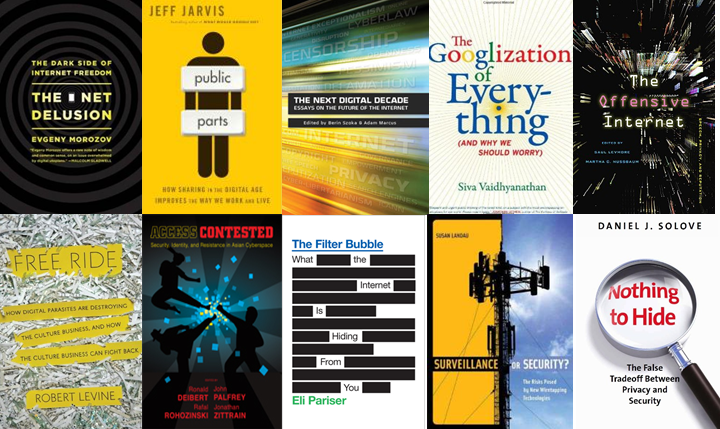
It’s time again to look back at the major cyberlaw and information tech policy books of the year. I’ve decided to drop the top 10 list approach I’ve used in past years (see 2008, 2009, 2010) and just use a more thematic listing of major titles released in 2011.  This thematic approach gets me out of hot water since I have found that people take numeric lists very seriously, especially when they are the author of one of the books and their title isn’t #1 on the list! Nonetheless, at the end, I will name what I regard as the most important Net policy book of the year.

I hope I’ve included all the major titles released during the year, but I ask readers to please let me know what I have missed that belongs on this list. I want this to be a useful resource to future scholars and students in the field. [Reminder: Here’s my compilation of major Internet policy books from the past decade.] Where relevant, I’ve added links to my reviews as well as discussions with the authors that Jerry Brito conducted as part of his “Surprisingly Free” podcast series. Finally, as always, I apologize to international readers for the somewhat U.S.-centric focus of this list.

Continue reading →

What Unites Advocates of Speech Controls & Privacy Regulation? [pdf]

by Adam Thierer & Berin Szoka The Progress & Freedom Foundation, Progress on Point No. 16.19

Anyone who has spent time following debates about speech and privacy regulation comes to recognize the striking parallels between these two policy arenas. In this paper we will highlight the common rhetoric, proposals, and tactics that unite these regulatory movements. Moreover, we will argue that, at root, what often animates calls for regulation of both speech and privacy are two remarkably elitist beliefs:

  1. People are too ignorant (or simply too busy) to be trusted to make wise decisions for themselves (or their children); and/or,
  2. All or most people share essentially the same values or concerns and, therefore, “community standards” should trump household (or individual) standards.

While our use of the term “elitism” may unduly offend some understandably sensitive to populist demagoguery, our aim here is not to launch a broadside against elitism as Time magazine culture critic William H. Henry once defined it: “The willingness to assert unyieldingly that one idea, contribution or attainment is better than another.”[1] Rather, our aim here is to critique that elitism which rises to the level of political condescension and legal sanction. We attack not so much the beliefs of some leaders, activists, or intellectuals that they have a better idea of what it in the public’s best interest than the public itself does, but rather the imposition of those beliefs through coercive, top-down mandates.

That sort of elitism—elitism enforced by law—is often the objective of speech and privacy regulatory advocates. Our goal is to identify the common themes that unite these regulatory movements, explain why such political elitism is unwarranted, and make it clear how it threatens individual liberty as well as the future of free and open Internet. As an alternative to this elitist vision, we advocate an empowerment agenda: fostering an environment in which users have the tools and information they need to make decisions for themselves and their families. Continue reading →

Larry MagidMy friend Larry Magid, the co-director of ConnectSafely.org (with Anne Collier) and founder of SafeKids.com, has a sharp new piece up at CBS News.com entitled, “Stop Cyberbullying with Education,” in which he rightly points out how “we need to be careful with legislation that would outlaw cyberbullying.”  He points out that although cyberbullying is “not an epidemic and it’s not killing our children”:

Bullying has always been a problem among adolescents and, sadly, so has suicide. In the few known cases of suicide after cyberbullying, there are other contributing factors. That’s not to diminish the tragedy or suggest that the cyberbullying didn’t play a role but–as with all online youth risk, we need to look at what else was going on in the child’s life. Even when a suicide or other tragic event doesn’t occur, cyberbullying is often accompanied by a pattern of offline bullying and sometimes there are other issues including long-term depression, problems at home, and self-esteem issues.

He goes on to provide some solid advice:

Continue reading →

Lori Drew was convicted late last year on charges related to her role in a cruel hoax that led to the tragic suicide of thirteen-year old Megan Meier in Missouri in 2006. But today, at her sentencing, the judge threw out her convictions. Millions around the world were horrified by Megan’s fate, and many will probably be upset that Drew might go unpunished. But we need to separate three questions in this case:

  1. Should the federal anti-hacking law under which she was convicted really be applied in such cases?
  2. What, precisely, was Drew’s involvement?
  3. The key question: What should be done about the general problems of cyberbullying and cyberharassment?

Misuse of the Anti-Hacking Statute

Judge Wu has yet to issue his written opinion but seems to have agreed with the various experts on Internet law who argued that, however tragic the Meier case was, the Computer Fraud & Abuse Act (CFAA) should not have been applied to Drew. Most notably, the Electronic Frontier Foundation filed an Amicus Brief in support of Drew’s motion to dismiss the charges against her—summarized by Groklaw and the Harvard Journal of Law & Technology. Orin Kerr, a leading Internet law professor, felt so strongly about the consequences of using the CFAA to criminalize violations of privately written terms of service that he joined Drew’s defense team. Kerr demonstrated the problems of essentially allowing private parties to create the grounds for criminal offenses (if violated by users) by suggesting obviously ridiculous new terms of service for the Volokh Conspiracy, the group blog he writes on.

Hard as it may be for those who want to “see justice done” in this case, the CFAA just isn’t the right law to apply—which raises the question of whether new laws are needed, discussed below.

Uncertainty About Drew’s Role

The judge may also have been influenced by uncertainty as to Drew’s actual role in the case. Initial coverage of the story suggested that Drew created the fake MySpace persona of a teen boy (“Josh Evans”), then used that profile to woo Meier, a classmate of Drew’s daughter, only to deliberately—and cruelly—break her heart. After Missouri prosecutors and the FBI declined to press charges against Drew, federal prosecutors in California decided to do so, but Drew consistently maintained that it was not her idea to create the account. Continue reading →

By Berin Szoka & Adam Thierer

hand on mouseWe’ve just released a new PFF white paper (PDF) entitled, “Cyberbullying Legislation: Why Education is Preferable to Regulation.” In this 24-page study we note that, compared to previous fears about online predation, which have been greatly overblown, concerns about cyberbullying are more well-founded. Evidence suggests the cyberbullying is on the rise and that it can have profoundly damaging consequences for children.

Unsurprisingly, in the wake of a handful of high-profile cyberbullying incidents that resulted in teen/tween suicides, some state lawmakers began floating legislation to address the issue. More recently, two very different federal approaches have been proposed. One approach is focused on the creation of a new federal crime to punish cyberbullying, which would include fines and jail time for violators. In April 2008, Rep. Linda Sánchez (D-CA) introduced H.R. 1966 (originally H.R. 6123), the “Megan Meier Cyberbullying Prevention Act,” a bill that would create a new federal felony:

“Whoever transmits in interstate or foreign commerce any communication, with the intent to coerce, intimidate, harass, or cause substantial emotional distress to a person, using electronic means to support severe, repeated, and hostile behavior, shall be fined under this title or imprisoned not more than two years, or both.”

The other legislative approach is education-based and would create an Internet safety education grant program to address the issue in schools and communities. In mid-May, the “School and Family Education about the Internet (SAFE Internet) Act” (S. 1047) was introduced in the Senate by Sen. Robert Menendez (D-NJ) and in the House by Rep. Debbie Wasserman Schultz (D-FL). The measure proposes an Internet safety education grant program that will be administered by the Department of Justice, in concurrence with the Department of Education, and the Department of Health & Human Services. These agencies will also work in consultation with education, Internet safety, and other relevant experts to administer a five-year grant program, under which each grant will be awarded for a two-year period.

Continue reading →

Adam Thierer noted in mid-December that the FCC was considering allowing the experimental use of cellphone jammers in prison.  The FCC just issued (PDF) a Special Temporary Authorization to allow the DC Department of Corrections to test a cell phone jamming technology.

This technology sounds like an excellent solution to a serious problem:  The illicit use of cell phones inside correctional facilities by prisoners across the country.  In particular, the technology appears to be “directional,” meaning that unlike traditional jammers, which simply block signals within a certain radius around the jammer, this technology appears to be capable of blocking signals inside the confines of a particular room or building.  In fact, I’m sure millions of Americans would love to see such technologies implemented in cinemas, theatres, and other performing arts venues across the country.  I, for one, am tired of having the exquisite acoustic delicacies of Bach interrupted by annoying ring tones, such as  the (painfully) immortal “Who Let the Dogs Out?”

So Much for The Rule of Law

But there’s one important problem: The FCC isn’t waiving a rule here against cell phone jammer. unless I’m missing some subtle statutory quirk, they’re essentially “waiving” a statute—specifically 47 U.S.C. 333:

No person shall willfully or maliciously interfere with or cause interference to any radio communications of any station licensed or authorized by or under this chapter or operated by the United States Government.

You don’t need to be an administrative lawyer to know that agencies can’t just ignore acts of Congress—no matter how good the policy reason for the waiver is. That’s a big part of what the “rule of law” means.  Period.  Do not pass ‘Go’.  Do not collect $3,101.09 (today’s equivalent of $200 in 1935, when Monopoly debuted).

Fortunately, as noted in the WSJ article Adam cited, at least one legislator realizes this and thinks it’s worth fixing:  U.S. Rep. Kevin Brady (R., Texas) told the Journal that his office is “drafting the necessary legislation to remove this outdated FCC roadblock.”  The FCC, of course, sped right past that particular roadblock.  But then, what should we expect from an agency that has, under its outgoing (and none-too-soon!) chairman Kevin Martin, simply disregarded statutory limits on its authority when it found Comcast in violation of the agency’s non-binding net neutrality principles this summer?  (My PFF colleague Barbara Esbin has eloquently condemned this violation of the rule of law in, “The Law is Whatever the Nobles Do: Undue Process at the FCC” (PDF).)

Now, when Congress considers this question, let us hope that they draw the right lesson from this episode:   Whatever the wisdom of outright bans on particular technologies, writing such bans into statutes is a really bad idea.  At least if such decisions were left up to regulatory agencies, they would have the flexibility to decide when to depart from a general ban.  Thus, the best approach would be to repeal the ban altogether.   Continue reading →
Microsoft’s share of the browser market across all versions of Internet Explorer has dropped, by one estimate, dropped from 78.58%  in December 2007 to 68.15% in December 2008 (or by just under 8% in another estimate).

[IE’s] share dropped from 69.77% in November to 68.15% in December. [During the same period,] Firefox gained more than half a point and ended up at 21.34%, Safari approaches the [10%] hurdle with 7.93% and Chrome came in at 1.04%, the first time Google was able to cross the 1% mark.

This is particularly interesting: 

Since IE6 is used primarily within corporations, its market share is much higher during the week than it is on weekends. As a result, all other browsers gain on weekends and especially during a holiday. Because of that circumstance, Net Applications noted that the December numbers should be taken with a grain of salt. However, it is worth the note that IE6 achieved … market share numbers of about 28% during the week and about 21% on weekends in early 2008. In December, these numbers were down to about 20% during the week and 15% on weekends.    

So, Microsoft still has an established base among corporate users, where IT administrators  generally prevent employees from installing new applications (including browsers) and the sysadmins often don’t roll out alternative browsers across a corporate network for any one of several possible reasons, including:

  • They just don’t want to bother having to install, regularly upgrade and support another piece of software;
  • They may overestimate the security vulnerability of such alternative browsers compared to Internet Explorer;
  • The crustier sysadmins may not realize that today’s browsers are not only free for individual users, but also for corporate users–unlike the old Netscape Navigator; and
  • Corporate intranets may be designed for IE, in which case rolling out an alternative browser might cause confusion among less tech-savvy employees.

Microsoft may still have an advantage that could be considered “unfair,” but so what?   Continue reading →