 Ian Brown and Christopher T. Marsden’s new book, Regulating Code: Good Governance and Better Regulation in the Information Age, will go down as one of the most important Internet policy books of 2013 for two reasons. First, their book offers an excellent overview of how Internet regulation has unfolded on five different fronts: privacy and data protection; copyright; content censorship; social networks and user-generated content issues; and net neutrality regulation. They craft detailed case studies that incorporate important insights about how countries across the globe are dealing with these issues. Second, the authors endorse a specific normative approach to Net governance that they argue is taking hold across these policy arenas. They call their preferred policy paradigm “prosumer law” and it envisions an active role for governments, which they think should pursue “smarter regulation” of code.
In terms of organization, Brown and Marsden’s book follows the same format found in Milton Mueller’s important 2010 book Networks and States: The Global Politics of Internet Governance; both books feature meaty case studies in the middle bookended by chapters that endorse a specific approach to Internet policymaking. (Incidentally, both books were published by MIT Press.) And, also like Mueller’s book, Brown and Marsden’s Regulating Code does a somewhat better job using case studies to explore the forces shaping Internet policy across the globe than it does making the normative case for their preferred approach to these issues. Continue reading →
In this new Money Morning article, “The Antitrust Curse: What Apple Can Learn From Microsoft, IBM,” David Zeiler wonders whether the antitrust lawsuit filed against Apple and several book publishers by the U.S. Department of Justice last week could open the door to a broader case against Apple or, at a minimum, simply become a major distraction to the firm and it’s ability to innovate going forward. He uses IBM and Microsoft as case studies in this regard and notes that, “the problem with being in the DOJ’s gunsight is that it distracts management, makes the company hesitant to innovate, and blemishes the company’s public image. While antitrust woes may not have been entirely responsible for Microsoft and IBM ceding their dominant positions in tech, they were clearly a major factor,” he says. “And worse for Apple, the e-book case could be just the beginning.”
Quite right. I raised the same concern in my recent
Forbes column,”Regulatory, Antitrust and Disruptive Risks Threaten Apple’s Empire,” which Zeiler was kind enough to quote in his essay. In that piece, I argued:
Even if Apple beats back [the eBooks] investigation, broader questions are being raised about the company’s power that could invite a much broader investigation. The danger for Apple is that antitrust becomes an omnipresent threat that must be factored into all ongoing business decisions. Antitrust is a particular danger to Apple because the firm is highly vertically integrated and that integration is the source of many of their innovations. As earlier tech titans like IBM and Microsoft learned, when antitrust hangs like the Sword of Damocles, every decision about how to evolve and innovate becomes a calculated gamble.
Regarding the earlier impact that antitrust Sword of Damocles had on Microsoft, Zeiler unearthed this terrific 2005 quote from Mark Kroese, a general manager of information services at the Microsoft Network, who described the impact of the MS antitrust case on innovation at the firm as follows: “Working at Microsoft today vs. five years ago is different,” Kroese said. “If anyone thinks the antitrust case hasn’t slowed us down, you’re wrong. If I want to meet with a products manager for Windows, there needs to be three lawyers in the room. We have to be so careful, we err on the side of caution. We are on such a fine line of conduct.” Regarding how antitrust chilled IBM, Zeiler cites veteran tech journalist Steve Wildstrom of Tech.pinions who noted, “Twelve years of litigation were an enormous distraction in a time of rapid technological and business change. IBM management became cautious and over-lawyered, constantly looking over its shoulder-a condition that persisted for years after the case ended. The antitrust case was almost certainly a major cause of the serious decline of IBM in the late 1980s and early 90s,” Wildstrom said.
Of course, it is impossible to scientifically determine to what degree antitrust harassment contributed to either IBM or Microsoft’s inability to innovate and adapt to the rapidly changing market conditions. And let’s be clear: both IBM and MS have found ways to rebound and innovate in other ways. But one wonders what was lost in the process as the threat of antitrust constantly loomed and potentially chilled innovative efforts that could have kept both firms on the cutting-edge. Continue reading →
According to a report today from SAI Business Insider, “The Federal Trade Commission is actively investigating Twitter and the way it deals with the companies building applications and services for its platform.” Apparently the agency has reached out to some competing application / platform providers to ask questions about Twitter’s recent efforts to exert more control over the uses of its API by third parties. [The Wall Street Journal confirms the FTC’s interest in Twitter.]
It remains to be seen whether this leads to any serious regulatory action against Twitter by the FTC, but such a move wouldn’t necessarily be surprising considering the more activist tilt of the agency recently. It’s even less surprising considering that Columbia University law professor and prolific cyberlaw scholar Tim Wu was appointed as a senior advisor to the FTC earlier this year. When the announcement of Wu’s appointment was made, the Wall Street Journal kicked off an article with the warning, “Silicon Valley has a new fear factor.” It seems the Journal may have been on to something!
It’s impossible to know how much of an influence Tim Wu is having on the agency, but as I have noted here before, Prof. Wu is man with a healthy appetite for regulatory activism. [See all my essays about Wu’s work here.] Moreover, he’s a man who has already determined that Twitter is a “monopolist” in his November 13, 2010 Wall Street Journal op-ed, “In the Grip of the New Monopolists.”
That essay prompted a fiery response from me [“Tim Wu Redefines Monopoly“] as well as a far more reasoned essay by antitrust gurus Geoff Manne and Josh Wright [“What’s An Internet Monopolist? A Reply to Professor Wu.”] Prof. Wu was kind enough to swing by the TLF and respond to my criticisms in an essay “On the Definition of Monopoly,” which he said served as a “corrective” to my earlier essay [even though I continue to believe that what I said fairly reflected the last four decades of economic wisdom on competition policy and that it is Wu who is well off the reservation with his expansionist views of antitrust enforcement].
Regardless of what one thinks about that exchange, if the FTC
is moving forward with a case against Twitter, three practical questions need to be considered: (1) What’s the relevant market? (2) Where’s the harm? and (3) What’s the remedy?
I’ll briefly discuss each question below but should also mention that I already explored many of these issues in my essay, “A Vision of (Regulatory) Things to Come for Twitter,” so I apologize in advance for the repetition. I will then discuss all this in the context of Tim Wu’s latest law review article on “Agency Threats” and what he approvingly refers to as regulatory “threat regimes.” Continue reading →
 Twitter could be in for a world of potential pain. Regulatory pain, that is. The company’s announcement on Friday that it would soon be cracking down on the uses of its API by third parties is raising eyebrows in cyberspace and, if recent regulatory history is any indicator, this high-tech innovator could soon face some heat from regulatory advocates and public policy makers. If this thing goes down as I describe it below, it will be one hell of a fight that once again features warring conceptions of “Internet freedom” butting heads over the question of whether Twitter should be forced to share its API with rivals via some sort of “open access” regulatory regime or “API neutrality,” in particular. I’ll explore that possibility in this essay. First, a bit of background.
Understanding Forced Access Regulation
In the field of communications law, the dominant public policy fight of the past 15 years has been the battle over “open access” and “neutrality” regulation. Generally speaking, open access regulations demand that a company share its property (networks, systems, devices, or code) with rivals on terms established by law. Neutrality regulation is a variant of open access regulation, which also requires that systems be used in ways specified by law, but usually without the physical sharing requirements. Both forms of regulation derive from traditional common carriage principles / regulatory regimes. Critics of such regulation, which would most definitely include me, decry the inefficiencies associated with such “forced access” regimes, as we prefer to label them. Forced access regulation also raises certain constitutional issues related to First and Fifth Amendment rights of speech and property. Continue reading →
This is the second of two essays making “The Case for Internet Optimism.” This essay was included in the book, The Next Digital Decade: Essays on the Future of the Internet (2011), which was edited by Berin Szoka and Adam Marcus of TechFreedom. In my previous essay, which I discussed here yesterday, I examined the first variant of Internet pessimism: “Net Skeptics,” who are pessimistic about the Internet improving the lot of mankind. In this second essay, I take on a very different breed of Net pessimists: “Net Lovers” who, though they embrace the Net and digital technologies, argue that they are “dying” due to a lack of sufficient care or collective oversight. In particular, they fear that the “open” Internet and “generative” digital systems are giving way to closed, proprietary systems, typically run by villainous corporations out to erect walled gardens and quash our digital liberties. Thus, they are pessimistic about the long-term survival of the Internet that we currently know and love.
Leading exponents of this theory include noted cyberlaw scholars Lawrence Lessig, Jonathan Zittrain, and Tim Wu. I argue that these scholars tend to significantly overstate the severity of this problem (the supposed decline of openness or generativity, that is) and seem to have very little faith in the ability of such systems to win out in a free market. Moreover, there’s nothing wrong with a hybrid world in which some “closed” devices and platforms remain (or even thrive) alongside “open” ones. Importantly, “openness” is a highly subjective term, and a constantly evolving one. And many “open” systems or devices are as perfectly open as these advocates suggest.
Finally, I argue that it’s likely that the “openness” advocated by these advocates will devolve into expanded government control of cyberspace and digital systems than that unregulated systems will become subject to “perfect control” by the private sector, as they fear. Indeed, the implicit message in the work of all these hyper-pessimistic critics is that markets must be steered in a more sensible direction by those technocratic philosopher kings (although the details of their blueprint for digital salvation are often scarce). Thus, I conclude that the dour, depressing “the-Net-is-about-to-die” fear that seems to fuel this worldview is almost completely unfounded and should be rejected before serious damage is done to the evolutionary Internet through misguided government action.
I’ve embedded the entire essay down below in Scribd reader, but it can also be found on TechFreedom’s Next Digital Decade book website and SSRN.
Continue reading →
I want to thank Tim Wu for continuing to engage in a discussion here about his book, The Master Switch, with his various comments to my ongoing rants. After pouring out about 15,000 words over the past 4 days, I suspect I’m beginning to sound a bit like his cyber-stalker! I feel a bit bad about this because I really do like Tim a lot and find him to be one of the all-around coolest and most laid-back guys in the Net policy business. But, as I’ve noted in my ongoing series [see parts 1, 2, 3, & 4], we have profoundly different worldviews when it comes to information history and policy. And some of the recent comments he made to my 3rd post deserve a serious response.
In one of those comments he asks, “The question, then, is how you get, essentially, limited, controlled government in regulatory affairs; how you duplicate, in some sense, the limits imposed on other dangerous gov’t functions like the army. I don’t think this is having things both ways; I think this is trying to learn from what has gone wrong in the past.” In the other, he says: “The question I’m asking in the end of the book is whether we can do better; try to have rules against the worse forms abuse without a creeping regulation that turns into capture. I suspect you think that’s impossible, but I don’t.”
So, here’s my response (and I’m making it a new, dedicated post here instead of just a comment in an old thread because I feel we are getting to the heart of the difference between cyber-libertarians (like myself) and cyber-collectivists (or whatever Tim would call himself). Continue reading →
In a week in which neutrality regulation is making a lot of news, I hope that Robert Hahn and Hal Singer’s terrific new study, “Why the iPhone Won’t Last Forever and What the Government Should Do to Promote its Successor” gets some attention. It provides a wonderful overview of how dynamically competitive the mobile marketplace has been over the past two decades and why critics are wrong to get worked up about the short-term “dominance” of Apple’s iPhone. Here’s the abstract of their paper:
Because of the overwhelming, positive response to the iPhone as compared to other smart phones, exclusive agreements between handset makers and wireless carriers have come under increasing scrutiny by regulators and lawmakers. In this paper, we document the myriad revolutions that have occurred in the mobile handset market over the past twenty years. Although casual observers have often claimed that a particular innovation was here to stay, they commonly are proven wrong by unforeseen developments in this fast-changing marketplace. We argue that exclusive agreements can play an important role in helping to ensure that another must-have device will soon come along that will supplant the iPhone, and generate large benefits for consumers. These agreements, which encourage risk taking, increase choice, and frequently lower prices, should be applauded by the government. In contrast, government regulation that would require forced sharing of a successful break-through technology is likely to stifle innovation and hurt consumer welfare.
“New technologies often seemingly emerge from nowhere, but also frequently lose their luster quickly,” Hahn and Singer go on to argue. As evidence they cite the recent examples of Second Life and MySpace, which were hyped as potentially become dominant providers in their respective areas just a few years ago, but now are subjected to intense competition. “[T]he the mobile handset market is subject to these same disruptive forces,” they argue: Continue reading →
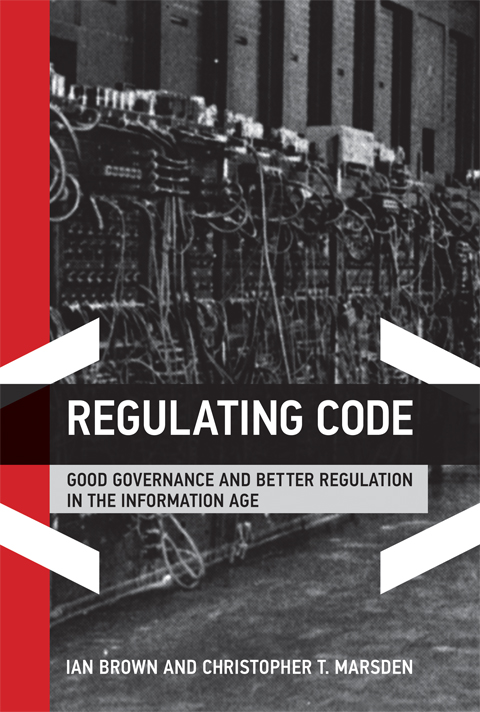 Ian Brown and Christopher T. Marsden’s new book, Regulating Code: Good Governance and Better Regulation in the Information Age, will go down as one of the most important Internet policy books of 2013 for two reasons. First, their book offers an excellent overview of how Internet regulation has unfolded on five different fronts: privacy and data protection; copyright; content censorship; social networks and user-generated content issues; and net neutrality regulation. They craft detailed case studies that incorporate important insights about how countries across the globe are dealing with these issues. Second, the authors endorse a specific normative approach to Net governance that they argue is taking hold across these policy arenas. They call their preferred policy paradigm “prosumer law” and it envisions an active role for governments, which they think should pursue “smarter regulation” of code.

 The Technology Liberation Front is the tech policy blog dedicated to keeping politicians' hands off the 'net and everything else related to technology.