I specifically highlight the danger of new measures from big states like NY and California, but it’s the patchwork of all the state and local regs that will result in a sort of ‘death-by-a-thousand-cuts’ for AI innovation as the red tape grows and hinders innovation and capital formation.
What we need is the same sort of principled, pro-innovation federal framework or AI that we adopted for the Internet a generation ago. Specifically, we need some sort of preemption of most of the state and local constraints on what is inherently national (and even global) commerce and speech.
Alas, Congress appears incapable of getting even basic things done on tech policy these days. Continue reading →
Industrial Policy is a red-hot topic once again with many policymakers and pundits of different ideological leanings lining up to support ambitious new state planning for various sectors — especially 5G, artificial intelligence, and semiconductors. A remarkably bipartisan array of people and organizations are advocating for government to flex its muscle and begin directing more spending and decision-making in various technological areas. They all suggest some sort of big plan is needed, and it is not uncommon for these industrial policy advocates to suggest that hundreds of billions will need to be spent in pursuit of those plans.
Others disagree, however, and I’ll be using this post to catalog some of their concerns on an ongoing basis. Some of the criticisms listed here are portions of longer essays, many of which highlight other types of steps that governments can take to spur innovative activities. Industrial policy is an amorphous term with many definitions of a broad spectrum of possible proposals. Almost everyone believes in
some form of industrial policy if you define the term broadly enough. But, as I argued in a September 2020 essay “On Defining ‘Industrial Policy‘,” I believe it is important to narrow the focus of the term such that we can continue to use the term in a rational way. Toward that end, I believe a proper understanding of industrial policy refers to targeted and directed efforts to plan for specific future industrial outputs and outcomes.
The collection of essays below is merely an attempt to highlight some of the general concerns about the most ambitious calls for expansive industrial policy, many of which harken back to debates I was covering in the late 1980s and early 1990s, when I first started a career in policy analysis. During that time, Japan and South Korea were the primary countries of concern cited by industrial policy advocates. Today, it is China’s growing economic standing that is fueling calls for ambitious state-led targeted investments in “strategic” sectors and technologies. To a lesser extent, grandiose European industrial policy proposals are also prompting new US counter-proposals.
All this activity is what has given rise to many of the critiques listed below. If you have suggestions for other essays I might add to this list, please feel free to pass them along. FYI: There’s no particular order here.
Few things unify people in America more than beer and liquor regulations. On one side you have the forces of repression, who either favor strong liquor taxes and regulations on moralistic grounds, or because they favor curtailing competition and choice for a variety of reasons. On the other side you have those of us looking to end the insanity of quasi-Prohibitionary rules that do nothing to boost public health but do plenty to annoy the living hell out of us (and cost us plenty). And the really interesting thing is that these two groups contain plenty of people of radically different political persecutions. Liquor regulations are the greatest destroyer of political partisanship ever!
The good news is that evasive entrepreneurs and an increasingly technologically-empowered public will keep pushing back and hopefully whittle away at the continuing vestiges of Prohibition Era stupidity. Where there’s a will, there’s a way, and when people want a drink, crafty entrepreneurs will usually find a way to deliver.
I talk a walk back through history and discuss how efforts to evade ridiculous liquor controls have been a longstanding feature of the American experience. People can be remarkably creative when seeking to circumvent silly rules–both before, during, and after Prohibition. Continue reading →
This week, the Trump Administration proposed a new policy framework for artificial intelligence (AI) technologies that attempts to balance the need for continued innovation with a set of principles to address concerns about new AI services and applications. This represents an important moment in the history of emerging technology governance as it creates a policy vision for AI that is generally consistent with earlier innovation governance frameworks established by previous administrations.
Generally speaking, the Trump governance vision for AI encourages regulatory humility and patience in the face of an uncertain technological future. However, the framework also endorses a combination of “hard” and “soft” law mechanisms to address policy concerns that have already been raised about developing or predicted AI innovations.
AI promises to revolutionize almost every sector of the economy and can potentially benefit our lives in numerous ways. But AI applications also raise a number of policy concerns, specifically regarding safety or fairness. On the safety front, for example, some are concerned about the AI systems that control drones, driverless cars, robots, and other autonomous systems. When it comes to fairness considerations, critics worry about “bias” in algorithmic systems that could deny people jobs, loans, or health care, among other things.
These concerns deserve serious consideration and some level of policy guidance or else the public may never come to trust AI systems, especially if the worst of those fears materialize as AI technologies spread. But
how policy is formulated and imposed matters profoundly. A heavy-handed, top-down regulatory regime could undermine AI’s potential to improve lives and strengthen the economy. Accordingly, a flexible governance framework is needed and the administration’s new guidelines for AI regulation do a reasonably good job striking that balance. Continue reading →
Yesterday, the White House Council of Economic Advisers released an important new report entitled, “Occupational Licensing: A Framework for Policymakers.” (PDF, 76 pgs.) The report highlighted the costs that outdated or unneeded licensing regulations can have on diverse portions of the citizenry. Specifically, the report concluded that:
the current licensing regime in the United States also creates substantial costs, and often the requirements for obtaining a license are not in sync with the skills needed for the job. There is evidence that licensing requirements raise the price of goods and services, restrict employment opportunities, and make it more difficult for workers to take their skills across State lines. Too often, policymakers do not carefully weigh these costs and benefits when making decisions about whether or how to regulate a profession through licensing.
The report supported these conclusions with a wealth of evidence. In that regard, I was pleased to see that research from Mercatus Center-affiliated scholars was cited in the White House report (specifically on pg. 34). Mercatus Center scholars have repeatedly documented the costs of occupational licensing and offered suggestions for how to reform or eliminate unnecessary licensing practices. Most recently, my colleagues and I have explored the costs of licensing restrictions for new sharing economy platforms and innovators. The White House report cited, for example, the recently-released Mercatus paper on “How the Internet, the Sharing Economy, and Reputational Feedback Mechanisms Solve the ‘Lemons Problem,’” which I co-authored with Christopher Koopman, Anne Hobson, and Chris Kuiper. And it also cited a new essay by Tyler Cowen and Alex Tabarrok on “The End of Asymmetric Information.” Continue reading →
Along with colleagues at the Mercatus Center at George Mason University, I am releasing two major new reports today dealing with the regulation of the sharing economy. The first report is a 20-page filing to the Federal Trade Commissionthat we are submitting to the agency for its upcoming June 9th workshop on “The “Sharing” Economy: Issues Facing Platforms, Participants, and Regulators.” We have been invited to participate in that event and I will be speaking on the fourth panel of the workshop. The filing I am submitting today for that workshop was co-authored with my Mercatus colleagues Christopher Koopman and Matt Mitchell.
In this new paper, Koopman, Mitchell, and I discuss how the sharing economy has changed the way many Americans commute, shop, vacation, borrow, and so on. Of course, the sharing economy “has also disrupted long-established industries, from taxis to hotels, and has confounded policymakers,” we note. “In particular, regulators are trying to determine how to apply many of the traditional ‘consumer protection’ regulations to these new and innovative firms.” This has led to a major debate over the public policies that should govern the sharing economy.
We argue that, coupled with the Internet and various new informational resources, the rapid growth of the sharing economy alleviates the need for much traditional top-down regulation. These recent innovations are likely doing a much better job of serving consumer needs by offering new innovations, more choices, more service differentiation, better prices, and higher-quality services. In particular, the sharing economy and the various feedback mechanism it relies upon helps solve the tradition economic problem of “asymmetrical information,” which is often cited as a rationale for regulation. We conclude, therefore, that “the key contribution of the sharing economy is that it has overcome market imperfections without recourse to traditional forms of regulation. Continued application of these outmoded regulatory regimes is likely to harm consumers.” Continue reading →
I want to bring to everyone’s attention an important new white paper by Dr. Robert Graboyes, a colleague of mine at the Mercatus Center at George Mason University who specializes in the economics of health care. His new 67-page study, Fortress and Frontier in American Health Care, seeks to move away from the tired old dichotomies that drive health care policy discussions: Left versus Right, Democrat versus Republican, federal versus state, and public versus private, and so on. Instead, Graboyes seeks to reframe the debate over the future of health care innovation in terms of “Fortress versus Frontier” and to highlight what lessons we can learn from the Internet and the Information Revolution when considering health care policy.
What does Graboyes mean by “Fortress and Frontier”? Here’s how he explains this conflict of visions:
The Fortress is an institutional environment that aims to obviate risk and protect established producers (insiders) against competition from newcomers (outsiders). The Frontier, in contrast, tolerates risk and allows outsiders to compete against established insiders. . . . The Fortress-Frontier divide does not correspond neatly with the more familiar partisan or ideological divides. Framing health care policy issues in this way opens the door for a more productive national health care discussion and for unconventional policy alliances. (p. 4)
Ajit Pai, a Republican commissioner at the Federal Communications Commission (FCC), had an outstanding op-ed in the L.A. Times yesterday about state and local efforts to regulate private taxi or ride-sharing services such as Uber, Lyft, and Sidecar. “Ever since Uber came to California,” Pai notes, “regulators have seemed determined to send Uber and companies like it on a one-way ride out of the Golden State.” Regulators have thrown numerous impediments in their way in California as well as in other states and localities (including here in Washington, D.C.). Pai continues on to discuss how, sadly, “tech start-ups in other industries face similar burdens”:
For example, Square has created a credit card reader for mobile devices. Small businesses love Square because it reduces costs and is convenient for customers. But some states want a piece of the action. Illinois, for example, has ordered Square to stop doing business in the Land of Lincoln until it gets a money transmitter license, even though the money flows through existing payment networks when Square processes credit cards. If Square had to get licenses in the 47 states with such laws, it could cost nearly half a million dollars, an extraordinary expense for a fledgling company.
He also notes that “Obstacles to entrepreneurship aren’t limited to the tech world”:
Across the country, restaurant associations have tried to kick food trucks off the streets. Auto dealers have used franchise laws to prevent car company Tesla from cutting out the middleman and selling directly to customers. Professional boards, too, often fiercely defend the status quo, impeding telemedicine by requiring state-by-state licensing or in-person consultations and even restricting who can sell tooth-whitening services.
What’s going on here? It’s an old and lamentable tale of incumbent protectionism and outright cronyism, Pai notes: Continue reading →
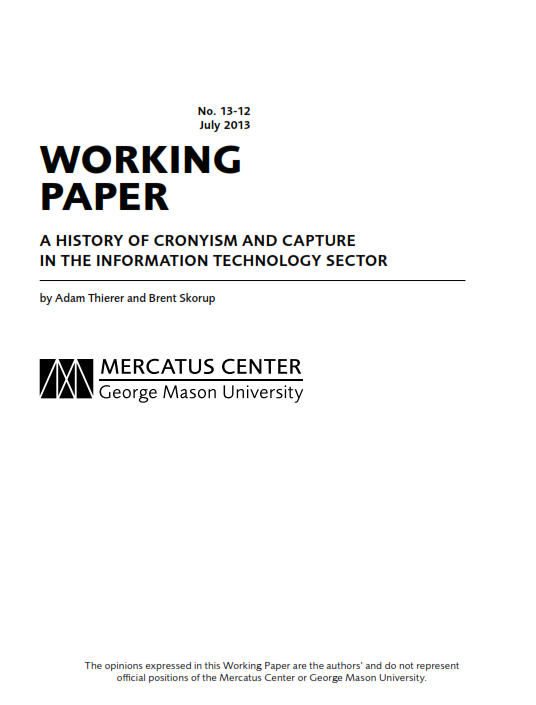
The Mercatus Center at George Mason University has just released a new paper by Brent Skorup and me entitled, “A History of Cronyism and Capture in the Information Technology Sector.” In this 73-page working paper, which we hope to place in a law review or political science journal shortly, we document the evolution of government-granted privileges, or “cronyism,” in the information and communications technology marketplace and in the media-producing sectors. Specifically, we offer detailed histories of rent-seeking and regulatory capture in: the early history of the telephony and spectrum licensing in the United States; local cable TV franchising; the universal service system; the digital TV transition in the 1990s; and modern video marketplace regulation (i.e., must-carry and retransmission consent rules, among others.
Our paper also shows how cronyism is slowly creeping into new high-technology sectors.We document how Internet companies and other high-tech giants are among the fastest-growing lobbying shops in Washington these days. According to the Center for Responsive Politics, lobbying spending by information technology sectors has almost doubled since the turn of the century, from roughly $200 million in 2000 to $390 million in 2012. The computing and Internet sector has been responsible for most of that growth in recent years. Worse yet, we document how many of these high-tech firms are increasingly seeking and receiving government favors, mostly in the form of targeted tax breaks or incentives. Continue reading →
The Technology Liberation Front is the tech policy blog dedicated to keeping politicians' hands off the 'net and everything else related to technology. Learn more about TLF →



 Few things unify people in America more than beer and liquor regulations. On one side you have the forces of repression, who either favor strong liquor taxes and regulations on moralistic grounds, or because they favor curtailing competition and choice for a variety of reasons. On the other side you have those of us looking to end the insanity of quasi-Prohibitionary rules that do nothing to boost public health but do plenty to annoy the living hell out of us (and cost us plenty). And the really interesting thing is that these two groups contain plenty of people of radically different political persecutions. Liquor regulations are the greatest destroyer of political partisanship ever!


 The Technology Liberation Front is the tech policy blog dedicated to keeping politicians' hands off the 'net and everything else related to technology.