I recently joined Rep. Dan Crenshaw on his Hold These Truths podcast to discuss, “What’s Wrong with Industrial Policy.” We chatted for 25 minutes about a wide range of issues related to the the growing push for grandiose industrial policy schemes in the US, including the massive new 3,000-page, $350 billion “COMPETES Act” legislation that recently passed in the House and which will soon be conferenced with a Senate bill that already passed.
On the same day this podcast was released this week, I also had a new op-ed appear in
The Hill on “The Coming Industrial Policy Hangover.” In both that essay and the podcast with Rep. Crenshaw, I stress that, beyond all the other problems with these new industrial policy measures, no one is talking about the fiscal cost of it all. As I note:
In the rush to pass legislation, we’ve barely heard a peep about the $250-$350 billion price tag. This follows a massive splurge of recent government borrowing, which led to the U.S. national debt hitting another lamentable new record: $30 trillion. China already owns over $1 trillion of that debt, making one wonder if we’re really countering China by adopting a massive, new and unfunded industrial policy that they will end up financing indirectly.
On Tuesday, Nancy Pelosi, Speaker of the U.S. House of Representatives, posted the text of the “America Creating Opportunities for Manufacturing, Pre-Eminence in Technology and Economic Strength Act of 2022,” or “The America COMPETES Act.” As far as industrial policy measures go, the COMPETES Act is one of the most ambitious and expensive central planning efforts in American history. It represents the triumph of top-down, corporatist, techno-mercantilist thinking over a more sensible innovation policy rooted in bottom-up competition, entrepreneurialism, private investment, and free trade.
Unprecedented Planning & Spending
First, the ugly facts: The full text of the COMPETES Act weighs in at a staggering 2,912 pages. A section-by-section “summary” of the measure takes up 109 pages alone. Even the shorter “fact sheet” for the bill is 20 pages long. It is impossible to believe that anyone in Congress has read every provision of this bill. It will be another case of having “to pass the bill so you can find out what’s in it,” as Speaker Pelosi once famously said about another mega-measure.
Of course, a mega bill presents major opportunities for lawmakers to sneak in endless gobs of pork and unrelated policy measures they can’t find any other way to get through Congress. The Senate already passed a similar 2,600-page companion measure last summer, “The U.S. Innovation and Competition Act.” Lawmakers loaded up that measure with so much pork and favors for special interests that Sen. John N. Kennedy (R-La.) labelled the effort an “orgy of spending porn.” Like that effort, the new COMPETES Act includes $52 billion to boost domestic semiconductor production as well as $45 billion in grants and loans to address supply chain issues.
But there are billions allocated for other initiatives, as well as countless provisions addressing other technologies and sectors. The list is seemingly endless and includes: Continue reading →
Wishful thinking is a dangerous drug. Some pundits and policymakers believe that, if your intentions are pure and you have the “right” people in power, all government needs to do is sprinkle a little pixie dust (in the form of billions of taxpayer dollars) and magical things will happen.
Of course, reality has a funny way of throwing a wrench into the best-laid plans. Which brings me to the question I raise in a new 2-part series for
Discourse magazine: Can governments replicate Silicon Valley everywhere?
In the first installment, I explore the track record of federal and state attempts to build tech clusters, science parks & “regional innovation hubs” using state subsidies and industrial policy. This is highly relevant today because of the huge new industrial policy push at the federal level is building on top of growing state and local efforts to create tech hubs, science parks, or various other types of industrial “clusters.
At the federal level, this summer, the Senate passed a 2,300-page industrial policy bill, the “United States Innovation and Competition Act of 2021,” that included almost $10 billion over four years for a Department of Commerce-led effort to fund 20 new regional technology hubs, “in a manner that ensures geographic diversity and representation from communities of differing populations.” A similar proposal that is moving in the House, the “Regional Innovation Act of 2021,” proposes almost $7 billion over five years for 10 regional tech hubs. Meanwhile, the Biden administration also is pitching ideas for new high-tech hubs. In late July, the Commerce Department’s Economic Development Administration announced plans to allocate $1 billion in pandemic recovery funds to create or expand “regional industry clusters” as part of the administration’s new Build Back Better Regional Challenge. Among the possible ideas the agency said might win funding are an “artificial intelligence corridor,” an “agriculture-technology cluster” in rural coal counties, a “blue economy cluster” in coastal regions, and a “climate-friendly electric vehicle cluster.”
In my essay, I note that the economic literature on these efforts has been fairly negative, to put it mildly. Continue reading →
Industrial Policy is a red-hot topic once again with many policymakers and pundits of different ideological leanings lining up to support ambitious new state planning for various sectors — especially 5G, artificial intelligence, and semiconductors. A remarkably bipartisan array of people and organizations are advocating for government to flex its muscle and begin directing more spending and decision-making in various technological areas. They all suggest some sort of big plan is needed, and it is not uncommon for these industrial policy advocates to suggest that hundreds of billions will need to be spent in pursuit of those plans.
Others disagree, however, and I’ll be using this post to catalog some of their concerns on an ongoing basis. Some of the criticisms listed here are portions of longer essays, many of which highlight other types of steps that governments can take to spur innovative activities. Industrial policy is an amorphous term with many definitions of a broad spectrum of possible proposals. Almost everyone believes in
some form of industrial policy if you define the term broadly enough. But, as I argued in a September 2020 essay “On Defining ‘Industrial Policy‘,” I believe it is important to narrow the focus of the term such that we can continue to use the term in a rational way. Toward that end, I believe a proper understanding of industrial policy refers to targeted and directed efforts to plan for specific future industrial outputs and outcomes.
The collection of essays below is merely an attempt to highlight some of the general concerns about the most ambitious calls for expansive industrial policy, many of which harken back to debates I was covering in the late 1980s and early 1990s, when I first started a career in policy analysis. During that time, Japan and South Korea were the primary countries of concern cited by industrial policy advocates. Today, it is China’s growing economic standing that is fueling calls for ambitious state-led targeted investments in “strategic” sectors and technologies. To a lesser extent, grandiose European industrial policy proposals are also prompting new US counter-proposals.
All this activity is what has given rise to many of the critiques listed below. If you have suggestions for other essays I might add to this list, please feel free to pass them along. FYI: There’s no particular order here.
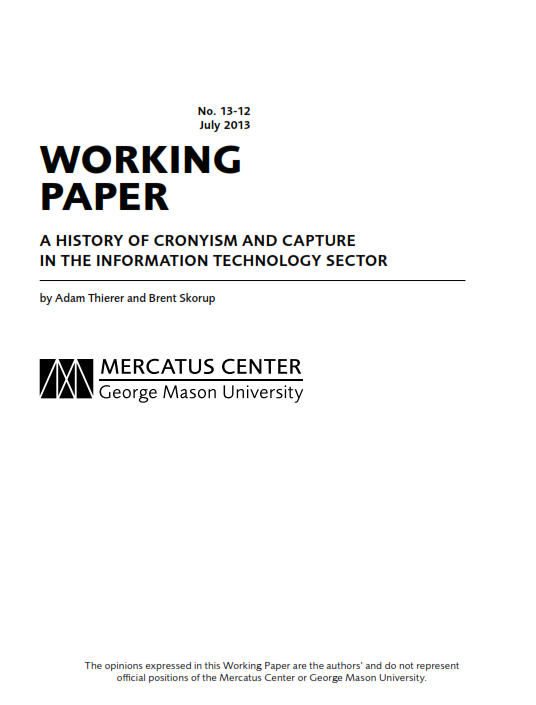
The Mercatus Center at George Mason University has just released a new paper by Brent Skorup and me entitled, “A History of Cronyism and Capture in the Information Technology Sector.” In this 73-page working paper, which we hope to place in a law review or political science journal shortly, we document the evolution of government-granted privileges, or “cronyism,” in the information and communications technology marketplace and in the media-producing sectors. Specifically, we offer detailed histories of rent-seeking and regulatory capture in: the early history of the telephony and spectrum licensing in the United States; local cable TV franchising; the universal service system; the digital TV transition in the 1990s; and modern video marketplace regulation (i.e., must-carry and retransmission consent rules, among others.
Our paper also shows how cronyism is slowly creeping into new high-technology sectors.We document how Internet companies and other high-tech giants are among the fastest-growing lobbying shops in Washington these days. According to the Center for Responsive Politics, lobbying spending by information technology sectors has almost doubled since the turn of the century, from roughly $200 million in 2000 to $390 million in 2012. The computing and Internet sector has been responsible for most of that growth in recent years. Worse yet, we document how many of these high-tech firms are increasingly seeking and receiving government favors, mostly in the form of targeted tax breaks or incentives. Continue reading →
The folks at the Pew Research Center’s Internet & American Life Project came out with another installment of their “Home Broadband” survey yesterday. This one, Home Broadband 2010, finds that “adoption of broadband Internet access slowed dramatically over the last year.” “Most demographic groups experienced flat-to-modest broadband adoption growth over the last year,” it reports, although there was 22% growth in broadband adoption by African-Americans. But the takeaway from the survey that is getting the most attention is the finding that:
By a 53%-41% margin, Americans say they do not believe that the spread of affordable broadband should be a major government priority. Contrary to what some might suspect, non-internet users are less likely than current users to say the government should place a high priority on the spread of high-speed connections.
This has a number of Washington tech policy pundits scratching their heads since it seems to cut against the conventional wisdom. Cecilia Kang of
The Washington Post penned a story about this today (“Support for Broadband Loses Speed as Nationwide Growth Slows“) and was kind enough to call me for comment about what might be going on here.
I suggested that there might be a number of reasons that respondents downplayed the importance of government actions to spur broadband diffusion, including that: (1) many folks are quite content with the Internet service they get today; (2) others might get their online fix at work or other places and not feel the need for it at home; and (3) some may not care two bits (excuse the pun) about broadband at all. More generally, I noted that, with all the other issues out there to consider, broadband policy just isn’t that important to most folks in the larger scheme of things. As I told Kang, “Let’s face it, when the average family of four is sitting around the dinner table, to the extent they talk about U.S. politics, broadband is not on the list of topics.” Continue reading →
Information scientists will find the paper amateurish and riddled with imperfections. Policy people will find it obscure and dense. That’s what you get when you translate between two languages and cultures.
The goal:
Each piece of the policy making process—the budgets, bills, votes, etc.—should originate as structured data, feeding directly into the information infrastructure that the transparency community creates. A budget should come out not just in paper and PDF versions, but as a data set containing all the meaning that exists in the physical documents.
Make sense? If not, you’ll want to get yourself to where it does.
That’s why I was so sorry to see the ECA launch a new campaignthat encourages gamers to petition their congressional leaders and encourage them to regulate the high-tech economy more and waste more taxpayer dollars on inefficient universal service programs and subsidies:
Net Neutrality and Universal Broadband are not only great for America; they allow us to play the games we want at high speeds! … ECA believes that Universal Broadband and Net Neutrality are vital for the development of the national infrastructure, and believes that this bill is an important opportunity to let Congress know that you agree.
The Technology Liberation Front is the tech policy blog dedicated to keeping politicians' hands off the 'net and everything else related to technology. Learn more about TLF →



 The Technology Liberation Front is the tech policy blog dedicated to keeping politicians' hands off the 'net and everything else related to technology.