Last week, it was my great pleasure to be invited on NPR’s “On Point with Tom Ashbrook,” to debate Jeffrey Rosen, a leading privacy scholar and the president and chief executive of the National Constitution Center. In an editorial in the previous Sunday’s New York Times (“Madison’s Privacy Blind Spot”), Rosen proposed “constitutional amendment to prohibit unreasonable searches and seizures of our persons and electronic effects, whether by the government or by private corporations like Google and AT&T.” He said his proposed amendment would limit “outrageous and unreasonable” collection practices and would even disallow consumers from sharing their personal information with private actors even if they saw an advantage in doing so.
I responded to Rosen’s proposal in an essay posted on the IAPP
Privacy Perspectives blog, “Do We Need A Constitutional Amendment Restricting Private-Sector Data Collection?” In my essay, I argued that there are several legal, economic, and practical problems with Rosen’s proposal. You can head over to the IAPP blog to read my entire response but the gist of it is that “a constitutional amendment [governing private data collection] would be too sweeping in effect and that better alternatives exist to deal with the privacy concerns he identifies.” There are very good reasons we treat public and private actors differently under the law and there “are all far more practical and less-restrictive steps that can be taken without resorting to the sort of constitutional sledgehammer that Jeff Rosen favors. We can protect privacy without rewriting the Constitution or upending the information economy,” I concluded.
But I wanted to elaborate on one particular thing I found particularly interesting about Rosen’s comments when we were on NPR together. During the show, Rosen kept stressing how we needed to adopt a more European construction of privacy as “dignity rights” and he even said his proposed privacy amendment would even disallow individuals from surrendering their private data or their privacy because he viewed these rights as “unalienable.” In other words, from Rosen’s perspective, privacy pretty much trumps
everything, even if you want to trade it off against other values. Continue reading →
It’s time again to look back at the major cyberlaw and information tech policy books of the year. I’ve decided to drop the top 10 list approach I’ve used in past years (see 2008, 2009, 2010) and just use a more thematic listing of major titles released in 2011. This thematic approach gets me out of hot water since I have found that people take numeric lists very seriously, especially when they are the author of one of the books and their title isn’t #1 on the list! Nonetheless, at the end, I will name what I regard as the most important Net policy book of the year.
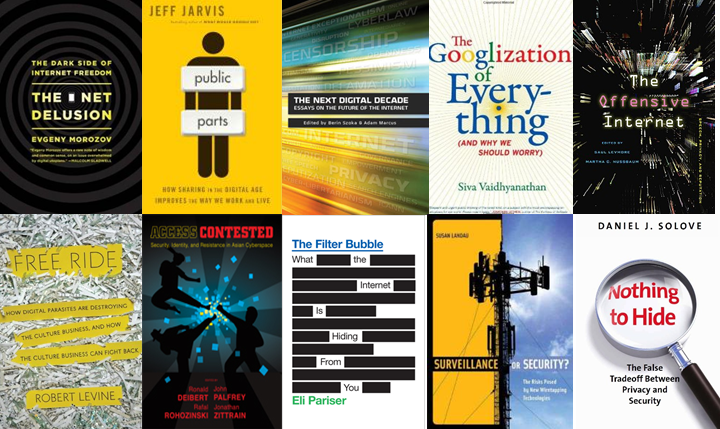
I hope I’ve included all the major titles released during the year, but I ask readers to please let me know what I have missed that belongs on this list. I want this to be a useful resource to future scholars and students in the field. [Reminder: Here’s my compilation of major Internet policy books from the past decade.] Where relevant, I’ve added links to my reviews as well as discussions with the authors that Jerry Brito conducted as part of his “Surprisingly Free” podcast series. Finally, as always, I apologize to international readers for the somewhat U.S.-centric focus of this list.
Continue reading →
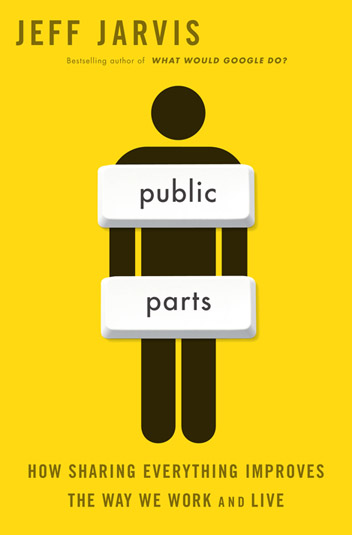 In his latest weekly Wall Street Journal column, Gordon Crovitz has penned a review of the new Jeff Jarvis book, Public Parts: How Sharing in the Digital Age Improves the Way We Work and Live
. Gordon’s review closely tracks my own thoughts on the book, which I laid out last week in my Forbes essay, “Is Privacy Overrated?” Gordon’s essay is entitled “Are We Too Hung Up on Privacy” and he finds, like I do, that Jarvis makes compelling case for understanding the benefits of publicness as the flip-side of privacy. Instead of repeating all the arguments we make in our reviews here, I’ll just ask people go check out both of our essays if they are interested.
In his latest weekly Wall Street Journal column, Gordon Crovitz has penned a review of the new Jeff Jarvis book, Public Parts: How Sharing in the Digital Age Improves the Way We Work and Live
. Gordon’s review closely tracks my own thoughts on the book, which I laid out last week in my Forbes essay, “Is Privacy Overrated?” Gordon’s essay is entitled “Are We Too Hung Up on Privacy” and he finds, like I do, that Jarvis makes compelling case for understanding the benefits of publicness as the flip-side of privacy. Instead of repeating all the arguments we make in our reviews here, I’ll just ask people go check out both of our essays if they are interested.
I did, however, want to elaborate on one thing I didn’t have time to discuss in my review of the Jarvis book. While I like the approach he used in the book, I thought Jarvis could have spent a bit more time exploring some the thorny legal issues in play when advocates of privacy regulation look to enshrine into law quite expansive views of privacy “rights.”
One of the things that both Crovitz and I appreciated about the Jarvis book was the way he tries to get us to think about privacy in the context of ethics instead of law. “Privacy is an ethic governing the choices made by the recipient of someone else’s information,” Jarvis argues, while “publicness is an ethic governing the choices made by the creator of one’s own information,” he says. In my review, I explained why this was so important: Continue reading →
A report in the U.K. Telegraph notes that the European Union is seeking to create a so-called “right to be forgotten” online, and has “drafted potential legislation that would include new, unprecedented privacy rights for citizens sharing personal data.” Details are sparse at this point, but according to this new 20-page European Commission document, “A Comprehensive Approach on Personal Data Protection in the European Union,” the EU will be:
clarifying the so-called ‘right to be forgotten’, i.e. the right of individuals to have their data no longer processed and deleted when they are no longer needed for legitimate purposes. This is the case, for example, when processing is based on the person’s consent and when he or she withdraws consent or when the storage period has expired. (p.8)
Two brief comments on this. First, it should be apparent that any “right to be forgotten” conflicts mightily with free speech rights and press freedom. As I discussed at greater length in this review of Solove’s Understanding Privacy as well as my essay on “Two Paradoxes of Privacy Regulation,” the problem with enshrining expansive privacy “rights” into law is that it means there will need to be stricter limits placed on speech and press freedoms. As Eugene Volokh noted in his 2000 law review article entitled, “Freedom of Speech, Information Privacy, and the Troubling Implications of a Right to Stop People from Speaking About You“: Continue reading →
As a cyber-libertarian, I’ve been lucky enough to work with people of all ideological stripes in pursuit of various public policy objectives. I’ve made selective alliances with people on the Right on economic policy issues (like opposing Net Neutrality regulation, Internet taxes, etc) and also worked closely with folks on the Left on speech and culture issues (content controls, anonymity, online safety concerns, etc).
While engaging with with people on both sides of the political fence, I’m often struck by some of their internal inconsistencies. Conservatives, for example, talk about a big game about personal responsibility on some issues, but quickly abandon that notion when they claim media content or online speech should be regulated by the State (typically “for the children.”) In this essay, I’d like to discuss interesting inconsistencies on the political Left, especially among advocates of strong privacy regulation (most of whom tend to be Left-leaning in their worldview). In particular, here are the two things I find most interesting about modern privacy advocates:
(1)
Most privacy advocates are vociferous First Amendment supporters, yet they abandon their free speech values and corresponding constitutional tests when it comes to privacy regulation. When it comes to proposals to regulate media content or online speech, most folks on the Left have a very principled, clear-cut position: people (or parents) should take responsibility for unwanted information flows in their lives (or the lives of their children). In particular, they rightly argue that the many user empowerment tools on the market (filters, monitoring software, other parental control technologies) constitute a so-called “less-restrictive means” of controlling content when compared to government regulation.
Advocacy groups that I have a great deal of respect for and work with quite closely on these issues–such as EFF, CDT and ACLU—all take this position. Generally speaking, they argue that, when it comes to speech regulation, “household standards” (user-level controls) should trump “community standards” (government regulation). And in Court—where I frequently file joint amicus briefs with them—they repeatedly employ the “less-restrictive means” test to counter government efforts to regulate information flows.
But when it comes to privacy, they throw all this out the window! Continue reading →
 With the publication of Understanding Privacy (Harvard University Press 2008), George Washington University Law School professor Daniel J. Solove has firmly established himself as one of America’s leading intellectuals in the field of information policy and cyberlaw. Solove had already made himself a force to be reckoned with in this field with the publication of important books like The Future of Reputation: Gossip, Rumor, and Privacy on the Internet (Yale University Press 2007), The Digital Person: Technology and Privacy in the Information Age (NYU Press 2004) and his treatise on Information Privacy Law with Paul M. Schwartz of the Berkeley School of Law (Aspen Publishing, 2d ed. 2006). But with Understanding Privacy, Solove has now elevated himself to that rarefied air of “people worth watching” in the cyberlaw field; an intellectual — like Lawrence Lessig or Jonathan Zittrain — whose every publication becomes something of an event in the field to which all eyes turn upon release.
Like those other intellectuals, however, my respect for their stature should not be confused with agreement with their positions. In fact, my disagreements with Lessig and Zittrain are frequently on display here and, we have been critical of Solove here in the past as well. [Here’s Jim Harper’s review of Solove’s last book, with which I am in wholehearted agreement.] In a similar vein, although I greatly appreciate what Prof. Solove attempts to accomplish in Understanding Privacy — and I am sure it will change the way we conceptualize and debate privacy policy in the future — I found his approach and conclusions highly problematic.
Continue reading →
Anyone interested in the long-running debate over how to balance online privacy with anonymity and free speech, whether Section 230‘s broad immunity for Internet intermediaries should be revised, and whether we need new privacy legislation must read the important and enthralling NYT Magazine piece “The Trolls Among Us” by Mattathias Schwartz about the very real problem of Internet “trolls“–a term dating to the 1980s and defined as “someone who intentionally disrupts online communities.”
While all trolls “do it for the lulz” (“for kicks” in Web-speak) they range from the merely puckish to the truly “malwebolent.” For some, trolling is essentially senseless web-harassment or “violence” (e.g., griefers), while for others it is intended to make a narrow point or even as part of a broader movement. These purposeful trolls might be thought of as the Yippies of the Internet, whose generally harmless anti-war counter-cutural antics in the late 1960s were the subject of the star-crossed Vice President Spiro T. Agnew‘s witticism:
And if the hippies and the yippies and the disrupters of the systems that Washington and Lincoln as presidents brought forth in this country will shut up and work within our free system of government, I will lower my voice.
But the more extreme of these “disrupters of systems” might also be compared to the plainly terroristic Weathermen or even the more familiar Al-Qaeda. While Schwartz himself does not explicitly draw such comparisons, the scenario he paints of human cruelty is truly nightmarish: After reading his article before heading to bed last night, I myself had Kafka-esque dreams about complete strangers invading my own privacy for no intelligible reason. So I can certainly appreciate how terrifying Schwartz’s story will be to many readers, especially those less familiar with the Internet or simply less comfortable with the increasing readiness of so many younger Internet users to broadcast their lives online.
But Schwartz leaves unanswered two important questions. The first question he does not ask:
Just how widespread is trolling? However real and tragic for its victims, without having some sense of the scale of the problem, it is difficult to answer the second question Schwartz raises but, wisely, does not presume to answer: What should be done about it? The policy implications of Schwartz’s article might be summed up as follows: Do we need new laws or should we focus on some combination of enforcing existing laws, user education and technological solutions? While Schwartz focuses on trolling, the same questions can be asked about other forms of malwebolence–best exemplified by the high-profile online defamation Autoadmit.com case, which demonstrates the effectiveness of existing legal tools to deal with such problems.
Continue reading →

 The Technology Liberation Front is the tech policy blog dedicated to keeping politicians' hands off the 'net and everything else related to technology.