We hear a lot today about the importance of “disruptive innovation,” “deep technologies,”
“moonshots,” and even “technological miracles.” What do these terms mean and how are they related? Are they just silly clichés used to hype techno-exuberant books, articles, and speeches? Or do these terms have real meaning and importance?
This article explores those questions and argues that, while these terms are confronted with definitional challenges and occasional overuse, they retain real importance to human flourishing, economic growth, and societal progress.
Basic Concepts
Don Boudreaux
defines
moonshots as, “radical but feasible solutions to important problems” and Mike Cushing
has referred to them
as “innovation that achieves the previously unthinkable.” “Deep technology” is another buzzword being used to describe such revolutionary and important innovations. Swati Chaturvedi of investment firm Propel[x]
says
deep technologies are innovations that are “built on tangible scientific discoveries or engineering innovations” and “are trying to solve big issues that really affect the world around them.”
“Disruptive technology” or “game-changing innovations” are other terms that are often used in reference to technologies and inventions with major societal impacts. “Transformative technologies” is another increasingly popular term, albeit one focused mostly on health and wellness-related innovations. Continue reading →
[first published at The Bridge on August 9, 2018]
What happens when technological innovation outpaces the ability of laws and regulations to keep up?
This phenomenon is known as “the pacing problem,” and it has profound ramifications for the governance of emerging technologies. Indeed, the pacing problem is becoming the great equalizer in debates over technological governance because it forces governments to rethink their approach to the regulation of many sectors and technologies.
The Innovation Cornucopia
Had Rip Van Winkle woken up his famous nap today, he’d be shocked by all the changes around him. At-home genetics tests, personal drones, driverless cars, lab-grown meats, and 3D-printed prosthetic limbs are just some of the amazing innovations that would boggle his mind. New devices and services are flying at us so rapidly that we sometimes forget that most did not even exist a short time ago. Continue reading →
Sherwin Siy, Vice President of Legal Affairs at Public Knowledge, discusses emerging issues in digital copyright policy. He addresses the Department of Commerce’s recent green paper on digital copyright, including the need to reform copyright laws in light of new technologies. This podcast also covers the DMCA, online streaming, piracy, cell phone unlocking, fair use recognition, digital ownership, and what we’ve learned about copyright policy from the SOPA debate.
Download
Related Links
Gabriella Coleman, the Wolfe Chair in Scientific and Technological Literacy in the Art History and Communication Studies Department at McGill University, discusses her new book, “Coding Freedom: The Ethics and Aesthetics of Hacking,” which has been released under a Creative Commons license.
Coleman, whose background is in anthropology, shares the results of her cultural survey of free and open source software (F/OSS) developers, the majority of whom, she found, shared similar backgrounds and world views. Among these similarities were an early introduction to technology and a passion for civil liberties, specifically free speech.
Coleman explains the ethics behind hackers’ devotion to F/OSS, the social codes that guide its production, and the political struggles through which hackers question the scope and direction of copyright and patent law. She also discusses the tension between the overtly political free software movement and the “politically agnostic” open source movement, as well as what the future of the hacker movement may look like.
Download
Related Links
Over at Convergences I consider the writings of Polk Wagner, beginning thus:
Polk Wagner has written some worthwhile papers on law and technology. I heartily recommend those that support points on which we agree, such as T
he Perfect Storm: Intellectual Property and Public Values, 73 Fordham L. Rev. 1107. 2005. This paper notes how the de facto balance between copyright and fair use has shifted over the years, and that in key respects copyright has lost, not gained, ground, and also noting that fair use is far from being the only key conceptual or practical limit on copyright.
But his paper “On Software Regulation,” is a bit muddled. It may not be Professor Wagner’s fault, for the article was written following up on the “code is law” meme, which is at bottom a rather unhelpful observation. If “code is law” then so is everything else—the laws of physics, architecture, road design, engineering, biology, the laws of physics, religion, education, insect swarming patterns, families, and so on. All of these things affect human behavior and shape and regularize society. My complaint with “code is law” is not that is not true, in a sense—but that it is very unhelpful in understanding any real problem. Many institutions and systems affect human behavior, but they do so in different ways. It is understanding the differences that will be the key to resolving any serious human problems.
Consistent with this, Professor Wagner begins by noting that “code is law” tells us nothing about how code and law relate. But he restates the view that software code constitutes regulation. Software “regulates” in the sense that it makes human conduct more regular and affects the public. But is it really much like “regulation” enacted through a legal process by Congress or the FCC, or even like law described by courts? Certainly not. But the paper’s description of the differences is oddly incomplete.
For the remainder, visit Convergences here.
FCC Chairman Julius Genachowski suggested at an FCC field hearing this week that the federal government might create its own “version of iTunes.” Multichannel News reports:
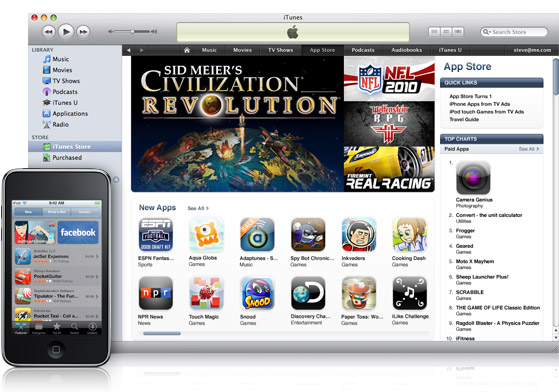
The chairman asked panelists to think about the value of a clearinghouse where best practices could be shared. He suggested that might be a way to spur the spin-off of public-sector apps from private sector initiatives and to prevent reinventing the wheel, rather than tapping into what is already being done. There is not a lot of shared info out there, he said.
If all we’re talking about is a clearinghouse that provides easy access to apps for government-developed apps, Google Code or SourceForge may be a better model than iTunes—though perhaps without the instant name recognition by ordinary consumers. Like SourceForge, Google Code allows hosting and management of open source projects, including Google’s own products. iTunes, by contrast, essentially offers consumers finished apps. Also, iTunes is a stand-alone piece of software, of which the Apps Store is just one part, while I can’t imagine why Genachowski’s “store” need be anything more than a website.
Whatever the analogy, such a “store” could well be a valuable tool for sharing the benefits of software development by government employees, both with the private sector and among federal agencies as well as state, local and even foreign governments. But what, exactly, Genachowski had in mind for the store remains awfully vague: Multichannel News mentions, as examples, “applications that do everything from monitoring heart rates and blood sugar to checking for greenhouse gas levels.” If the idea ever goes anywhere, it should be based on two principles:
- All apps should be open source and available to all users to use as they see fit.
- The store should be limited to apps developed by government employees to meet the needs of government agencies.
Continue reading →
As Berin mentioned last week, we have a new paper out on proposals to expand the Children’s Online Privacy Protection Act (COPPA) of 1998. We generically refer to those COPPA-expansion efforts as “COPPA 2.0.” Hence, the title of our paper: “COPPA 2.0: The New Battle over Privacy, Age Verification, Online Safety & Free Speech.” To recap what Berin already noted, in the name of improving online child safety, some legislators and state attorneys general (AGs) are advocating the expansion of COPPA’s “verifiable parental consent” model of age verification before certain sites or services may collect, or enable the sharing of, personal information for children.
Unlike “COPPA 1.0,” however, which only applied to children under the age of 13, “COPPA 2.0” would apply to all minors up to age 17. Moreover, the range of sites covered by the new law would generally be expanded to include just about any site or service with social networking functionality.
Since Berin has already summarized our general concerns with efforts to expand COPPA’s “verifiable parental consent” online age verification system to cover more online users and sites, I thought I would focus here on what I believe will be the most controversial (and important) part of our paper — our discussion about how COPPA 2.0 affects the speech rights of both adults
and adolescents.
Continue reading →

 The Technology Liberation Front is the tech policy blog dedicated to keeping politicians' hands off the 'net and everything else related to technology.