Here’s the notice I’ve been getting the last few days when, logged into Facebook from a computer, I try to post a comment or update my status.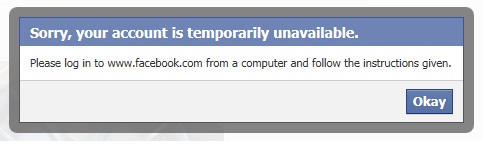
Clever observers will note that the recommendation to log in from a computer is misplaced, as I get it when I’m logged in from a computer. Facebook gives me no instructions when I log in (or when I log out and log in again), though it did once ask me to change my password, which I did.
Most likely, Facebook’s algorithms believe I’ve violated some part of the Terms of Service, such as by repetitive posting or other spammy behavior. My exclusion from the site began contemporaneous with my attempt to post a single comment that failed for reasons I couldn’t discern in several tries.
Undoubtedly, my friends at Facebook will leap to my aid and clear this up for me in short order, feeling slightly stung that I “went public” with the problem rather than going to them. But I wanted to experience this as an ordinary consumer, not as a member of the digerati with insider access to people at important companies. In the past, I’ve used insider access with services like PayPal and (the now defunct) Bitcoin7 to get help that an ordinary user couldn’t have gotten. Bully for me that I can do that, but my experience is atypical and no basis for observing how the world works.
Some observations: Continue reading →
[UPDATE Feb. 2012: This little essay eventually led to an 80-page working paper, “Technopanics, Threat Inflation, and the Danger of an Information Technology Precautionary Principle.”]
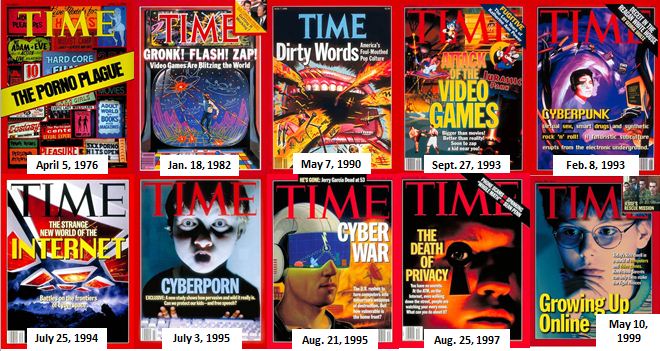
In this essay, I will suggest that (1) while “moral panics” and “techno-panics” are nothing new, their cycles seem to be accelerating as new communications and information networks and platforms proliferate; (2) new panics often “crowd-out” or displace old ones; and (3) the current scare over online privacy and “tracking” is just the latest episode in this ongoing cycle.
What Counts as a “Techno-Panic”?
First, let’s step back and define our terms. Christopher Ferguson, a professor at Texas A&M’s Department of Behavioral, Applied Sciences and Criminal Justice, offers the following definition: “A moral panic occurs when a segment of society believes that the behavior or moral choices of others within that society poses a significant risk to the society as a whole.” By extension, a “techno-panic” is simply a moral panic that centers around societal fears about a specific contemporary technology (or technological activity) instead of merely the content flowing over that technology or medium. In her brilliant 2008 essay on “The MySpace Moral Panic,” Alice Marwick noted: Continue reading →
I’ve had quite enough of service providers of one kind or another making me part of their new social network. (I’m looking at you, Google Buzz.)
So here’s an article about how to control iTunes’ new Ping social network, which comes with iTunes 10.
Apple did a couple things right: They made it very clear in the “Terms and Conditions” click-through for the new version of the software that you’re getting Ping. It also appears to default to “off.” That’s what I found when I followed the directions in the article linked above, anyway.
If you want to be in yet another social network, you can enable Ping using those directions. You also might want to get your head checked. Something might be wrong in your
real life.
Companies often promote consistent and reliable customer experiences. KLM touts itself as “the reliable airline” while Michelin touts its dependability “because so much is riding on your tires.” And now we have Yahoo, who announced that it will be increasing the social networking functionality in Yahoo Mail. Yahoo has the ability to promote consistency in determining user defaults for sharing information.
But social networking is a product much different than most – it is participatory. Passengers can’t fly airplanes and drivers don’t design tire tread, but social networking users control what and with whom they share information.
So what happens when a social networking service changes functionality or adds new features? How does a company be consistent in carrying-over a user’s preference from the prior version to the new one? What assumptions should it make on user privacy preferences for new features?
These considerations matter whenever an online service tries to increase its social networking functionality. Last week, Facebook unveiled new privacy controls, and we blogged that it was a welcome response to clear-up confusion. In the coming weeks Yahoo will change how status updates work in Yahoo Mail. Michael Arrington’s TechCrunch article describes it well:
[C]urrently to see status updates for others in Yahoo Mail, you have to have a mutual follow, meaning both people have agreed to be “friends.” You can then see that user’s Yahoo status updates as well as updates on third party services that they have added to their Yahoo profile as well. In the new version there will no longer be a requirement for a mutual follow. So, like on Twitter, users can follow whomever they choose. This isn’t actually a dramatic change for Yahoo, since users can follow others in this way already on Yahoo Messenger.
Like Google and Facebook before it, Yahoo is adding features to make its service more “social.” And because of the scrutiny over the changes by Google and Facebook, Yahoo seems to be going out of its way to assure users that they can rely and depend on Yahoo. According to the Yahoo Corporate Blog: Continue reading →
I got some feedback from readers about my post last night regarding the irony of the FCC’s newly-created MySpace page containing some rather vulgar user comments. I wondered if the agency would continue to allow such comments when the agency regulates similar words when they are uttered on broadcast TV or radio. A few people asked me why the agency hasn’t bother using the comment management tools that MySpace puts at the public’s disposal. It’s a good question, and actually I’m not sure why they didn’t do that right from the start. Perhaps the agency is concerned about being accused of censoring public comment. [Incidentally, the White House and some federal agencies have MySpace pages, so perhaps I need to look into how those agencies manage comments.]
Regardless, the FCC now
has taken steps to deal with this. John Eggerton of Broadcasting & Cable and Kim Hart of The Hill point out that the agency has removed some vulgar comments on their MySpace page (namely, any comment with the F-bomb in it). And I assume the agency is now taking steps to screen comments going forward. For those who are not aware, MySpace empowers users (including government agencies if they choose to set up profiles) to require approval before new comments appear on their profiles (accessed by clicking “My Account” and then “Spam”). Here are the options:

 Moreover, I should also mention that if people want to see the FCC’s MySpace profile but don’t want to see all the comments, they can always change their default view to MySpace’s “Lite View,” which hides all comments, third party applications, and some other sections of a page. To switch to Lite View, click on “My Account” in the upper-right corner of any MySpace page, then click on “Miscellaneous” to access the Default View setting. It’s another nice way that MySpace empowers users to control their site experience.
 Regardless, this will be a difficult issue for federal agencies to manage going forward. If agencies are going to take the plunge and boldly enter the social networking world, they’ll need to understand that the vibrant exchange of views will sometimes entail some salty language and occasional insults. Yet, when they take steps to deal with some of the most offensive comments posted on their pages, accusations of censorship are bound to fly. It’s a tough position for agencies to be in since they want to encourage maximum public interaction and input, and yet some of that input is bound to get heated, even ugly.
So, here are some questions that both agencies and policy wonks will need to consider going forward. Continue reading →
It seems the whole web is incorporating social networking functionality. Microsoft recently led the way in incorporating functionality to search, allowing users to share search results they like with their social networking contacts directly from the search results page through Twitter and Facebook. I’ve also noted that it’s just a matter of time before the same thing happens with advertising—and that Facebook will likely lead the way.
 Websites have long used social networking buttons to encourage visitors to join their Facebook group, follow them on Twitter, etc. Facebook recently made this even easier by creating a widget for pages that can easily be embedded on any site. So why is Facebook blocking advertisers from including social networking functionality in ads like this one? Facebook’s terms of service using the new Fan Box widget in ads. Facebook’s spokesperson told InsideFacebook.com:
We want Page owners to have an easy way to connect with fans both on and off of Facebook. In order to protect the the Fan Box widget from being used for the wrong reasons, we do not allow it to be used in third party advertising.
InsideFacebook.com speculates:
it’s safe to assume that Facebook wants to protect the “Become a Fan” experience from becoming too intertwined with aggressive online ads that it hasn’t approved. One can imagine the variety of ways advertisers could (potentially misleadingly) push users to become a fan in an ad unit on a web site, then pollute their Facebook stream later. Facebook wants more control over that experience, even if it means partially restricting growth for Facebook Pages.
So why might policymakers be interested in this? Because, as Fred Vogelstein predicted in Wired this June, Facebook will likely someday soon expand beyond selling ads on its own site to selling ads on the wider Internet that incorporate social networking functionality like the “Become a fan” button above. There is a vast untapped market for online advertising, and if Facebook’s going to get a piece of it, they’ll have to offer something no other ad network can. If and when this happens, Facebook will likely get a lot of grief from the anti-advertising zealots, but this would actually be a good thing for consumers for five reasons: Continue reading →
Finally, the courts are starting to take notice of the growing ease with which we all share information online: “Twenty-somethings have a much-reduced sense of personal privacy,” as an NYU law professor put it. Unfortunately, this slow realization of the utterly obvious is happening in the narrow area of legal ethics: Courts are punishing young lawyers who say unkind things about the court on social networking sites or say something inconsistent with what they’ve told the court. It’s a must-read for all young lawyers!
Microsoft is making a major push to integrate social networking tools like Facebook and Twitter into its Bing search engine: users will soon be able to “Ping” search results they like to their friends directly from Bing. Back in January, in “Google, the Innovator’s Dilemma and the Future of Search & Web Ads,” I talked about the implications of this history of search from the WSJ):
Microsoft missed its opportunities to get into paid search not because it was “dumb,” “uninnovative” or a “bad” company, but for the same sorts of reasons that big, highly successful and even particularly innovative companies fail. The reasons companies generally succeed in mastering “adaptive” innovation of the technologies behind their established business models are the very reasons why such great companies struggle to encourage or channel the “disruptive” innovation that renders their core technologies and business models obsolete. This dynamic was described brilliantly in Harvard Business School professor Clayton Christensen’s classic 1997 book The Innovator’s Dilemma: When New Technologies Cause Great Firms to Fail…
Let’s hope that Microsoft—as well as Yahoo!—have carefully studied the vast literature produced by business schools in the wake of Christensen’s book about how big companies can avoid the Innovator’s Dilemma by promoting—and capitalizing on—radical innovation from within. Indeed, this seems to be precisely what has guided Google’s own strategy as it has grown from “disruptive innovator” to become the very sort of behemoth that cannot easily escape the Dilemma, even if corporate managers are fully aware of the problem on a theoretical level. If Google can do it, Microsoft should be able to, too. But let’s also not discount the possibility that, no matter how hard Google’s management might try to retain the innovative culture of a start-up, the giant
can’t do that well enough to prevent its own apparent market dominance from being disrupted by new upstart innovators in search and advertising technologies.
My prediction seems to be coming true: Microsoft, with less to lose and without a huge installed user base to worry about annoying by violating Google’s “Prime Directive” of elegant simplicity, may have an easier time introducing “disruptive” innovations to search than Google. Of course, it’s unlikely that any
one feature will prove the “killer app” that suddenly causes Bing’s market share to explode—and Google’s to plummet—but a steady stream of such nifty features could convince many users to switch to Bing.
At 29, I’m old enough to remember when Microsoft seemed as cool as Google does today. Hell, I remember being thrilled as a sophomore in high school by Bill Gates’ 1995 book
The Road Ahead and the accompanying CD-ROM (which included, as I recall, a tour of Gates’s ultra-futuristic home). If Microsoft can “get its mojo back,” the company could truly become a web services provider to rival Google. We’d all benefit from having more choices in search engines, advertising platforms and related tools. And, driving each other to “build a better mousetrap,” the two companies could lead us down the “Road Ahead” from Search 2.0 to Search 3.0 and beyond. So here’s to hoping that Redmond can solve the “Innovator’s Dilemma” with tools like Google’s “20 percent” time that free engineers to innovate!
What Unites Advocates of Speech Controls & Privacy Regulation? [pdf]
by Adam Thierer & Berin Szoka
The Progress & Freedom Foundation,
Progress on Point No. 16.19
Anyone who has spent time following debates about speech and privacy regulation comes to recognize the striking parallels between these two policy arenas. In this paper we will highlight the common rhetoric, proposals, and tactics that unite these regulatory movements. Moreover, we will argue that, at root, what often animates calls for regulation of both speech and privacy are two remarkably elitist beliefs:
- People are too ignorant (or simply too busy) to be trusted to make wise decisions for themselves (or their children); and/or,
- All or most people share essentially the same values or concerns and, therefore, “community standards” should trump household (or individual) standards.
While our use of the term “elitism” may unduly offend some understandably sensitive to populist demagoguery, our aim here is not to launch a broadside against elitism as
Time magazine culture critic William H. Henry once defined it: “The willingness to assert unyieldingly that one idea, contribution or attainment is better than another.”[1] Rather, our aim here is to critique that elitism which rises to the level of political condescension and legal sanction. We attack not so much the beliefs of some leaders, activists, or intellectuals that they have a better idea of what it in the public’s best interest than the public itself does, but rather the imposition of those beliefs through coercive, top-down mandates.
That sort of elitism—elitism enforced by law—is often the objective of speech and privacy regulatory advocates. Our goal is to identify the common themes that unite these regulatory movements, explain why such political elitism is unwarranted, and make it clear how it threatens individual liberty as well as the future of free and open Internet. As an alternative to this elitist vision, we advocate an empowerment agenda: fostering an environment in which users have the tools and information they need to make decisions for themselves and their families. Continue reading →
 The latest edition (Version 4.0) of my PFF special report on “Parental Controls and Online Child Protection: A Survey of Tools & Methods” is now up. For those not familiar with the report, it explores the market for parental control tools, rating schemes, education and media literacy efforts, and various other tools, methods, and initiatives aimed at promoting online child safety. After evaluating that state of this market, I conclude: “There has never been a time in our nation’s history when parents have had more tools and methods at their disposal to help them decide what constitutes acceptable media content in their homes and in the lives of their children.” Moreover, I believe that the parental controls and content management tools cataloged in the report represent a better, less restrictive alternative to government regulation.
Version 4.0 of the report is now over 250 pages long (up from 200 pages in Version 3.0) and it contains almost 70 exhibits (up from 50), 725 references (up from roughly 500), and numerous updates in all five sections of the book. Major updates have been made to the Internet, social networking, and mobile media sections, reflecting the growing importance of those sectors and issues. Other new sections or appendices have also been added to the report, including:
- a new section examining how many households really need parental control tools;
- a new appendix on the downsides of mandatory parental controls and restrictive default settings;
- a new section on the dangers of “deputizing the online middleman” solution as an approach to solving child safety concerns;
- a new appendix reviewing the findings of 5 past online safety task forces;
- … and much more.
I issue major updates once a year and 1 or 2 minor tweaks during the course of the year to reflect the evolution of the parental control and online child safety marketplace and debate. The report is available free-of-charge on the PFF website, and the previous editions of the report are housed there too in case you want to see how it has evolved over the past couple of years. For those interested in taking a quick look at the report, I have embedded it down below the fold as a Scribd file. Finally, as is always the case, I encourage readers to send me updates and suggestions for how to improve the report and I will incorporate them into future versions.
Continue reading →

 The Technology Liberation Front is the tech policy blog dedicated to keeping politicians' hands off the 'net and everything else related to technology.
Federal Agencies Can Easily Manage Settings on Their MySpace Page, but How Should They?
by Adam Thierer on November 13, 2009 · 9 comments
I got some feedback from readers about my post last night regarding the irony of the FCC’s newly-created MySpace page containing some rather vulgar user comments. I wondered if the agency would continue to allow such comments when the agency regulates similar words when they are uttered on broadcast TV or radio. A few people asked me why the agency hasn’t bother using the comment management tools that MySpace puts at the public’s disposal. It’s a good question, and actually I’m not sure why they didn’t do that right from the start. Perhaps the agency is concerned about being accused of censoring public comment. [Incidentally, the White House and some federal agencies have MySpace pages, so perhaps I need to look into how those agencies manage comments.]
Regardless, the FCC now has taken steps to deal with this. John Eggerton of Broadcasting & Cable and Kim Hart of The Hill point out that the agency has removed some vulgar comments on their MySpace page (namely, any comment with the F-bomb in it). And I assume the agency is now taking steps to screen comments going forward. For those who are not aware, MySpace empowers users (including government agencies if they choose to set up profiles) to require approval before new comments appear on their profiles (accessed by clicking “My Account” and then “Spam”). Here are the options:
So, here are some questions that both agencies and policy wonks will need to consider going forward. Continue reading →