 Ian Brown and Christopher T. Marsden’s new book, Regulating Code: Good Governance and Better Regulation in the Information Age, will go down as one of the most important Internet policy books of 2013 for two reasons. First, their book offers an excellent overview of how Internet regulation has unfolded on five different fronts: privacy and data protection; copyright; content censorship; social networks and user-generated content issues; and net neutrality regulation. They craft detailed case studies that incorporate important insights about how countries across the globe are dealing with these issues. Second, the authors endorse a specific normative approach to Net governance that they argue is taking hold across these policy arenas. They call their preferred policy paradigm “prosumer law” and it envisions an active role for governments, which they think should pursue “smarter regulation” of code.
In terms of organization, Brown and Marsden’s book follows the same format found in Milton Mueller’s important 2010 book Networks and States: The Global Politics of Internet Governance; both books feature meaty case studies in the middle bookended by chapters that endorse a specific approach to Internet policymaking. (Incidentally, both books were published by MIT Press.) And, also like Mueller’s book, Brown and Marsden’s Regulating Code does a somewhat better job using case studies to explore the forces shaping Internet policy across the globe than it does making the normative case for their preferred approach to these issues. Continue reading →
[UPDATE
4/30/13: This article was subsequently published in Volume 65, Issues 2 of the Federal Communications Law Journal in April 2013. The links below now point to the final FCLJ version.]
The Mercatus Center at George Mason University has just released a new paper by Brent Skorup and me entitled, “Uncreative Destruction: The War on Vertical Integration in the Information Economy.” Brent, who is the research director for the Information Economy Project at the George Mason University School of Law, and I have been working on this paper since the Spring and we are looking forward to getting it published in a law review shortly. The paper focuses on Tim Wu’s “separations principle” for the digital economy, something I’ve spent some time critiquing here in the past. Here’s the introduction from the 44-page paper that Brent and I just released:
Are information sectors sufficiently different from other sectors of the economy such that more stringent antitrust standards should be applied to them preemptively? Columbia Law School professor Tim Wu responds in the affirmative in his book The Master Switch: The Rise and Fall of Information Empires. Having successfully pushed net-neutrality regulation into the policy spotlight, Wu has turned his attention to what he regards as excessive market concentration and threats to free speech throughout the entire information economy.To support his call for increased antitrust intervention, Wu explains his view of competition in the information economy—a view that deviates substantially from current mainstream antitrust theory.
Continue reading →
Two data points in the news over the past 24 hours to consider:
- A new report on “Smartphone Adoption & Usage” by the Pew Internet Project finds that “one third of American adults – 35% – own smartphones” and that of that group “some 87% of smartphone owners access the Internet or email on their handheld” and “25% of smartphone owners say that they mostly go online using their phone, rather than with a computer.”
- According to the Wall Street Journal, the “Average iPhone Owner Will Download 83 Apps This Year.” That’s up from an average of 51 apps downloaded in 2010. (At first I was astonished when I read that, but then realized that I’ve probably downloaded an equal number of apps myself, albeit on an Android-based device.)
As I explain in my latest
Forbes column, facts like these help us understand “How iPhones And Androids Ushered In A Smartphone Pricing Revolution.” That is, major wireless carriers are in the process of migrating from flat-rate, “all-you-can-eat” wireless data plans to usage-based plans. The reason is simple economics: data demand is exploding faster than data supply can keep up.
“It’s been four years since the introduction of the iPhone and rival devices that run Google’s Android software,” notes Cecilia Kang of The Washington Post. “In that time, the devices have turned much of America into an always-on, Internet-on-the-go society.” Indeed, but it’s not just the iPhone and Android smartphones. It’s all those tablets that have just come online over the past year, too. We are witnessing a tectonic shift in how humans consume media and information, and we are witnessing this revolution unfold over a very short time frame. Continue reading →
The smartphone is arguably one of the most empowering and revolutionary technologies of the modern era. By putting the processing power of a personal computer and the speed of a broadband connection into a device that fits in a pocket, smartphones have revolutionized how we communicate, travel, learn, game, shop, and more.
Yet smartphones have an oft-overlooked downside: when they end up in the wrong hands, they offer overreaching agents of the state, thieves, hackers, and other wrongdoers an unparalleled avenue for uncovering and abusing the volumes of sensitive personal information we increasingly store on our mobile phones.
Over on Ars Technica, I have a long feature story that examines the constitutional and technical issues surrounding police searches of mobile phones:
Last week, California’s Supreme Court reached a controversial 5-2 decision in People v. Diaz
(PDF)
, holding that police officers may lawfully search mobile phones found on arrested individuals’ persons without first obtaining a search warrant. The court reasoned that mobile phones, like cigarette packs and wallets, fall under the search incident to arrest exception to the Fourth Amendment to the Constitution.California’s opinion in Diaz is the latest of several recent court rulings upholding warrantless searches of mobile phones incident to arrest. While this precedent is troubling for civil liberties, it’s not a death knell for mobile phone privacy. If you follow a few basic guidelines, you can protect your mobile device from unreasonable search and seizure, even in the event of arrest. In this article, we will discuss the rationale for allowing police to conduct warrantless searches of arrestees, your right to remain silent during police interrogation, and the state of mobile phone security.
Continue reading →

Worth It?
OK, time for a quick rant. What is all this confusion and consternation over early termination fees (ETFs) for high-end smartphones? I mean, seriously, how hard is this process to understand? The FCC has worked itself into a lather over this and is bombarding wireless operators and Google with hate mail letters of inquiry harassing asking them about their ETF policies. I just don’t get it. Let’s review some simple realities:
- Smartphones — especially high-end devices like the iPhone, the Droid, and the Nexus One — are basically mobile mini computers.
- Mini mobile computers do not grow on trees; someone has to make them and sell them at a profit or else no one would offer them to begin with.
- But the people who make and sell these devices (and wireless service for these devices) want to ensure rapid, widespread distribution to win over customers and recoup their costs.
- So, they offer a classic business inducement — an upfront subsidy for the product in exchange for monthly payments to amortize the upfront “loan” they have given the customer;
- AND THEN THEY FORM A CONTRACT WITH THE BUYER TO MAKE THE DEAL WORK. And that contract obligates both sides to live up to their end of the deal.
- Hey… did I mention they need to form a contract to make the deal worth it? OK, good, wanted to make sure I got that point across.
- Then they give you a nice shiny new mobile mini-computer that for some reason we Americans still insist on calling a cell phone.
- Then you start paying off the “loan” they’ve given you for that device over the span of the service contract. This is called “prorating.”
- But, if you default on that loan by breaking your contract, you’ll be hit with a penalty — an early termination fee — since it would leave the carrier without a way to recoup the cost of that shiny new mobile mini-computer that they handed you on the cheap when you just absolutely had to have the hot new toy in town.
Is this process really all that complicated? And why is it so controversial? It certainly shouldn’t be. Prorating happens every day in countless ways in a capitalist economy. And yet in the apparent techno-entitlement society we live in these days, some people seem to think there’s something scandalous about this process when it happens with our beloved mobile devices. In reality, the smartphone subsidy and prorated contract system is really one of the great pro-consumer accomplishments of our time. Continue reading →
With weather-related travel trauma so prominent on my Twitterscope, and with news that the federal government is banning flight delays, I stopped short when I read this techology pitch:
One of the biggest hassles of travel has to be keeping track of those pesky hotel key cards and then trying to remember which way to fit the darned things in the wide variety of door locks. But that may soon change.
New technology’s been introduced and will soon be test marketed in Las Vegas hotels that allows guests to use their cell phones — any cell phone model at all — to unlock their hotel room door.
I’m not persuaded at all. The difficulty of managing hotel keys doesn’t even rate on my list of travel hassles.
The solution offered up is:
a simple system in which a computer generates a unique series of tones (that sounds kind of like those digitized cell phone ringtones used early this decade) that is then sent to the mobile device. When the tone is played outside the designated guestroom, a microphone incorporated in the locking system IDs the tone and unlocks the door.
Ohhhhh-kay.
There might be value to this technology or (more probably) others like it. Getting secure credentials onto people’s phones has a lot of promise.
But this iteration? Should it survive testing, and the easily imaginable failure modes and attacks on it, it might provide a scintilla of convenience in hotels.
Interesting piece here from Slate’s Farhad Manjoo on why AT&T should dump unlimited data plans and end what he calls the “iPhone all-you-can-eat buffet.” He notes that: “The typical smartphone customer consumes about 40 to 80 megabytes of wireless capacity a month. The typical iPhone customer uses 400 MB a month. AT&T’s network is getting crushed by that demand.” Because “some iPhone owners are hogging the network” and causing “a slowed-down wireless network,” Manjoo recommends a congestion pricing model as a method of balancing supply and demand:
How would my plan work? I propose charging $10 a month for each 100 MB you upload or download on your phone, with a maximum of $40 per month. In other words, people who use 400 MB or more per month will pay $40 for their plan, or $10 more than they pay now. Everybody else will pay their current rate—or less, as little as $10 a month. To summarize: If you don’t use your iPhone very much, your current monthly rates will go down; if you use it a lot, your rates will increase. (Of course, only your usage of AT&T’s cellular network would count toward your plan; what you do on Wi-Fi wouldn’t matter.)
To understand the advantages of tiered pricing, let’s look at AT&T’s current strategy of spending billions to build more network space. Why won’t this work? For the same reason building more roads doesn’t reduce traffic—more capacity increases the attractiveness of driving, which brings a lot more cars to the road, which leads to more gridlock.
Congestion pricing and metering is something I’ve written quite a bit about here in the context of wireline broadband (1, 2, 3), but Manjoo is equally correct that it could be applied for wireless data plans. It has the added value of taking pressure off lawmakers to impose Net neutrality regulation since pricing of the pipe becomes an effective substitute for most other forms of network management. In other words, price, don’t block bandwidth-hogging customers and applications. The problem, Manjoo explains: Continue reading →
Last summer, my PFF colleague Barbara Esbin and I explained that, while many consumers dislike not being able to get popular smartphones like the iPhone on the wireless network of their choice, such exclusive deals actually benefit consumers. Barbara summarizes her testimony (PDF) as follows:
the dynamic created by the exclusive arrangement between Apple and AT&T that produced the iPhone allowed the two companies to bridge the gap between the technologies of today and the disruptive innovations of tomorrow. Moreover, it is undeniable that the breakthrough success of the iPhone has spurred a wave of competitors. If every wireless carrier had been able to sell the iPhone when it was initially released, I noted, it seems unlikely there would have been as much carrier support for developing competing products like the Google G1, RIM Blackberry Storm, Samsung Instinct or Palm Pre.
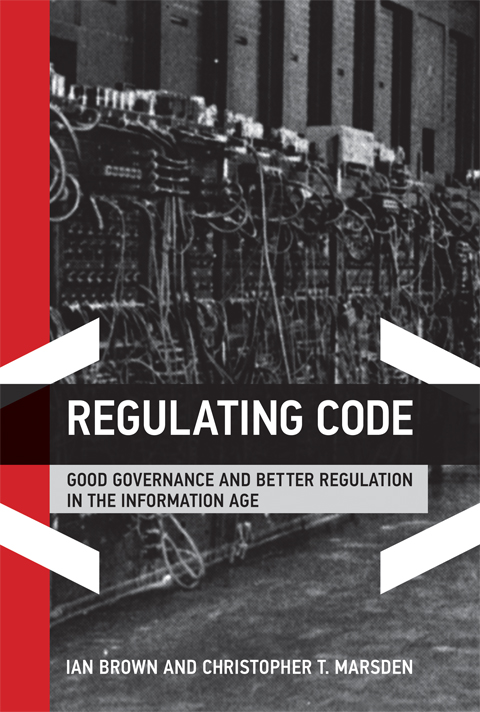 Ian Brown and Christopher T. Marsden’s new book, Regulating Code: Good Governance and Better Regulation in the Information Age, will go down as one of the most important Internet policy books of 2013 for two reasons. First, their book offers an excellent overview of how Internet regulation has unfolded on five different fronts: privacy and data protection; copyright; content censorship; social networks and user-generated content issues; and net neutrality regulation. They craft detailed case studies that incorporate important insights about how countries across the globe are dealing with these issues. Second, the authors endorse a specific normative approach to Net governance that they argue is taking hold across these policy arenas. They call their preferred policy paradigm “prosumer law” and it envisions an active role for governments, which they think should pursue “smarter regulation” of code.
 The Technology Liberation Front is the tech policy blog dedicated to keeping politicians' hands off the 'net and everything else related to technology.