It was my pleasure to recently join Matthew Lesh, Director of Public Policy and Communications for the London-based Institute of Economic Affairs (IEA), for the IEA podcast discussion, “Should We Regulate AI?” In our wide-ranging 30-minute conversation, we discuss how artificial intelligence policy is playing out across nations and I explained why I feel the UK has positioned itself smartly relative to the US & EU on AI policy. I argued that the UK approach encourages a better ‘innovation culture’ than the new US model being formulated by the Biden Administration.
We also went through some of the many concerns driving calls to regulate AI today, including: fears about job dislocations, privacy and security issues, national security and existential risks, and much more.
On July 12, I participated in a Bipartisan Policy Center event on “Civil Society Perspectives on Artificial Intelligence Impact Assessments.” It was an hour-long discussion moderated by Michele Nellenbach, Vice President of Strategic Initiatives at the Bipartisan Policy Center, and which also featured Miriam Vogel, President and CEO of EqualAI. We discussed the ins and outs of algorithmic auditing and impact assessments for artificial intelligence. This is one of the hottest topics in the field of AI governance today, with proposals multiplying rapidly in academic and public policy circles. Several governments are already considering mandating AI auditing and impact assessments.
You can watch the entire discussion here, and down below I have included some of my key talking points from the session. I am currently finishing up my next book, which is on how to craft a flexible governance framework for AI and algorithmic technologies. It includes a lengthy chapter on this issue and I also plan on eventually publishing a stand-alone study on this topic.
[This is a draft of a section of a forthcoming study on “A Flexible Governance Framework for Artificial Intelligence,” which I hope to complete shortly. I welcome feedback. I have also cross-posted this essay at Medium.]
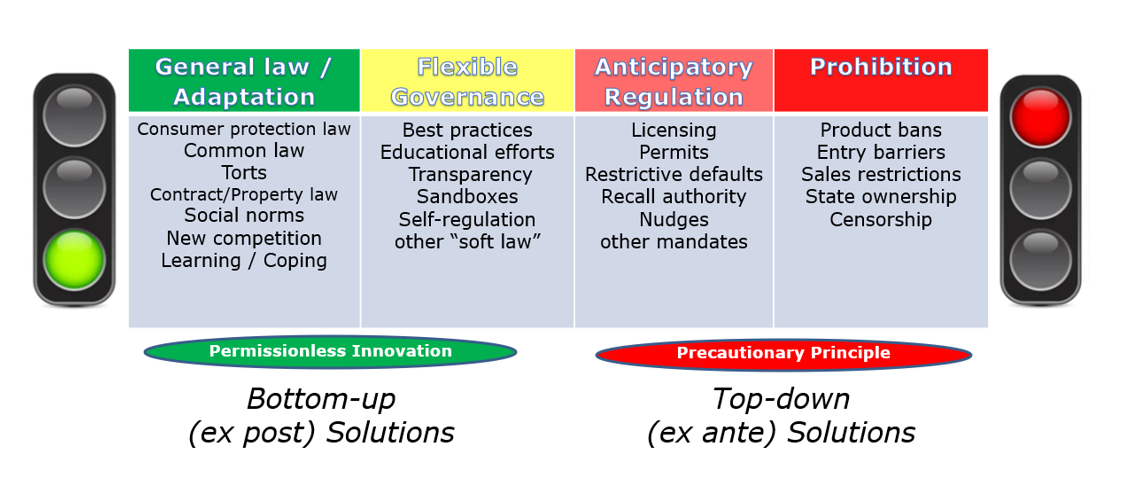
Debates about how to embed ethics and best practices into AI product design is where the question of public policy defaults becomes important. To the extent AI design becomes the subject of legal or regulatory decision-making, a choice must be made between two general approaches: the precautionary principle or the proactionary principle.[1] While there are many hybrid governance approaches in between these two poles, the crucial issue is whether the initial legal default for AI technologies will be set closer to the red light of the precautionary principle (i.e., permissioned innovation) or to the green light of the proactionary principle (i.e., (permissionless innovation). Each governance default will be discussed.
This report was a major undertaking that involved dozens of interviews, extensive historic research, several events and presentations, and then numerous revisions before the final product was released. The final PDF version of the journal article is attached.
This week, the Trump Administration proposed a new policy framework for artificial intelligence (AI) technologies that attempts to balance the need for continued innovation with a set of principles to address concerns about new AI services and applications. This represents an important moment in the history of emerging technology governance as it creates a policy vision for AI that is generally consistent with earlier innovation governance frameworks established by previous administrations.
Generally speaking, the Trump governance vision for AI encourages regulatory humility and patience in the face of an uncertain technological future. However, the framework also endorses a combination of “hard” and “soft” law mechanisms to address policy concerns that have already been raised about developing or predicted AI innovations.
AI promises to revolutionize almost every sector of the economy and can potentially benefit our lives in numerous ways. But AI applications also raise a number of policy concerns, specifically regarding safety or fairness. On the safety front, for example, some are concerned about the AI systems that control drones, driverless cars, robots, and other autonomous systems. When it comes to fairness considerations, critics worry about “bias” in algorithmic systems that could deny people jobs, loans, or health care, among other things.
These concerns deserve serious consideration and some level of policy guidance or else the public may never come to trust AI systems, especially if the worst of those fears materialize as AI technologies spread. But
how policy is formulated and imposed matters profoundly. A heavy-handed, top-down regulatory regime could undermine AI’s potential to improve lives and strengthen the economy. Accordingly, a flexible governance framework is needed and the administration’s new guidelines for AI regulation do a reasonably good job striking that balance. Continue reading →
This essay originally appeared on The Bridge on September 25, 2019.
It is quickly becoming one of the iron laws of technology policy that by attempting to address one problem (like privacy, security, safety, or competition), policymakers often open up a different problem on another front. Trying to regulate to protect online safety, for example, might give rise to privacy concerns, or vice versa. Or taking steps to address online privacy through new regulations might create barriers to new entry, thus hurting online competition.
In a sense, this is simply a restatement of the law of unintended consequences. But it seems to be occurring with greater regularity in the technology policy today, and it serves as another good reminder why humility is essential when considering new regulations for fast-moving sectors.
Consider a few examples.
Privacy vs security & competition
Many US states and the federal government are considering data privacy regulations in the vein of the European Union’s wide-reaching General Data Privacy Regulation (GDPR). But as early experiences with the GDPR and various state efforts can attest, regulations aimed at boosting consumer privacy can often butt against other security and competition concerns. Continue reading →
“He’s making a list and checking it twice. Gonna find out who’s naughty and nice.”
With the Christmas season approaching, apparently it’s not just Santa who is making a list. The Trump Administration has just asked whether a long list of emerging technologies are naughty or nice — as in whether they should be heavily regulated or allowed to be developed and traded freely.
If they land on the naughty list, these technologies could be subjected to complex export control regulations, which would limit research and development efforts in many emerging tech fields and inadvertently undermine U.S. innovation and competitiveness. Worse yet, it isn’t even clear there would be any national security benefit associated with such restrictions.
From Light-Touch to a Long List
Generally speaking, the Trump Administration has adopted a “light-touch” approach to the regulation of emerging technology and relied on more flexible “soft law” approaches to high-tech policy matters. That’s what makes the move to impose restrictions on the trade and usage of these emerging technologies somewhat counter-intuitive. On November 19, the Department of Commerce’s Bureau of Industry and Security launched a “Review of Controls for Certain Emerging Technologies.” The notice seeks public comment on “criteria for identifying emerging technologies that are essential to U.S. national security, for example because they have potential conventional weapons, intelligence collection, weapons of mass destruction, or terrorist applications or could provide the United States with a qualitative military or intelligence advantage.” Continue reading →
The Mercatus Center at George Mason University has just released a new paper on,”Permissionless Innovation and Immersive Technology: Public Policy for Virtual and Augmented Reality,” which I co-authored with Jonathan Camp. This 53-page paper can be downloaded via the Mercatus website, SSRN or Research Gate.
Here is the abstract for the paper:
Immersive technologies such as augmented reality, virtual reality, and mixed reality are finally taking off. As these technologies become more widespread, concerns will likely develop about their disruptive social and economic effects. This paper addresses such policy concerns and contrasts two different visions for governing immersive tech going forward. The paper makes the case for permissionless innovation, or the general freedom to innovate without prior constraint, as the optimal policy default to maximize the benefits associated with immersive technologies.
The alternative vision — the so-called precautionary principle — would be an inappropriate policy default because it would greatly limit the potential for beneficial applications and uses of these new technologies to emerge rapidly. Public policy for immersive technology should not be based on hypothetical worst-case scenarios. Rather, policymakers should wait to see which concerns or harms emerge and then devise ex post solutions as needed.
To better explain why precautionary controls on these emerging technologies would be such a mistake, Camp and I provide an inventory of the many VR, AR, and mixed reality applications that are already on the market–or soon could be–and which could provide society with profound benefits. A few examples include: Continue reading →
Today, the U.S. Department of Transportation released its eagerly-awaited “Federal Automated Vehicles Policy.” There’s a lot to like about the guidance document, beginning with the agency’s genuine embrace of the potential for highly automated vehicles (HAVs) to revolutionize this sector and save thousands of lives annually in the process.
It is important we get HAV policy right, the DOT notes, because, “35,092 people died on U.S. roadways in 2015 alone” and “94 percent of crashes can be tied to a human choice or error.” (p. 5) HAVs could help us reverse that trend and save thousands of lives and billions in economic costs annually. The agency also documents many other benefits associated with HAVs, such as increasing personal mobility, reducing traffic and pollution, and cutting infrastructure costs.
I will not attempt here to comment on every specific recommendation or guideline suggested in the new DOT guidance document. I could nit-pick about some of the specific recommended guidelines, but I think many of the guidelines are quite reasonable, whether they are related to safety, security, privacy, or state regulatory issues. Other issues need to be addressed and CEI’s Marc Scribner does a nice job documenting some of them is his response to the new guidelines.
Instead of discussing those specific issues today, I want to ask a more fundamental and far-reaching question which I have been writing about in recent papers and essays:
Is this guidance or regulation? And what does the use of informal guidance mechanisms like these signal for the future of technological governance more generally? Continue reading →
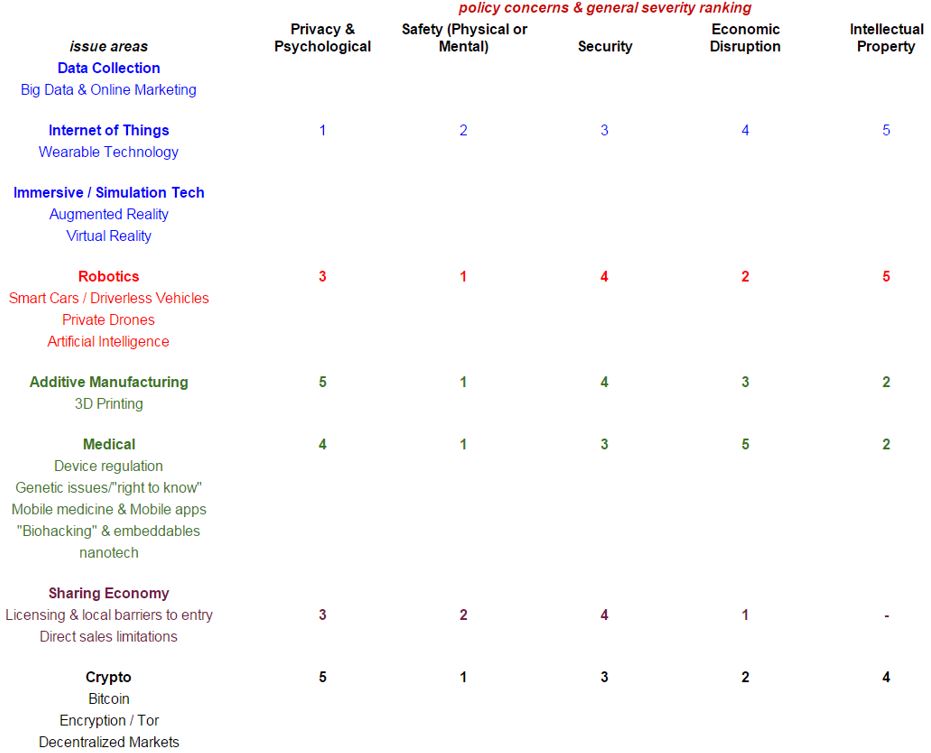
On the whiteboard that hangs in my office, I have a giant matrix of technology policy issues and the various policy “threat vectors” that might end up driving regulation of particular technologies or sectors. Along with my colleagues at the Mercatus Center’s Technology Policy Program, we constantly revise this list of policy priorities and simultaneously make an (obviously quite subjective) attempt to put some weights on the potential policy severity associated with each threat of intervention. The matrix looks like this: [Sorry about the small fonts. You can click on the image to make it easier to see.]
I use 5 general policy concerns when considering the likelihood of regulatory intervention in any given area. Those policy concerns are:
privacy (reputation issues, fear of “profiling” & “discrimination,” amorphous psychological / cognitive harms);
safety (health & physical safety or, alternatively, child safety and speech / cultural concerns);
security (hacking, cybersecurity, law enforcement issues);
The Technology Liberation Front is the tech policy blog dedicated to keeping politicians' hands off the 'net and everything else related to technology. Learn more about TLF →

 The Technology Liberation Front is the tech policy blog dedicated to keeping politicians' hands off the 'net and everything else related to technology.