Over at Discourse magazine this week, my R Street colleague Jonathan Cannon and I have posted a new essay on how it has been “Quite a Fall for Digital Tech.” We mean that both in the sense that the last few months have witnessed serious market turmoil for some of America’s leading tech companies, but also that the political situation for digital tech more generally has become perilous. Plenty of people on the Left and the Right now want a pound of flesh from the info-tech sector, and the starting cut at the body involves Section 230, the 1996 law that shields digital platforms from liability for content posted by third parties.
With the Supreme Court recently announcing it will hear Gonzalez v. Google, a case that could significantly narrow the scope of Section 230, the stakes have grown higher. It was already the case that federal and state lawmakers were looking to chip away at Sec. 230’s protections through an endless variety of regulatory measures. But if the Court guts Sec. 230 in Gonzalez, then it will really be open season on tech companies, as lawsuits will fly at every juncture whenever someone does not like a particular content moderation decision. Cannon and I note in our new essay that, Continue reading →
My colleague Wayne Brough and I recently went on the “Kibbe on Liberty” show to discuss how to discuss the state of free speech on the internet. We explained how censorship is a Big Government problem, not a Big Tech problem. Here’s the complete description of the show and the link to the full episode is below.
”
With Elon Musk’s purchase of Twitter, we are in the middle of a national debate about the tension between censorship and free expression online. On the Right, many people are calling for government to rein in what they perceive as the excesses of Big Tech companies, while the Left wants the government to crack down on speech they deem dangerous. Both approaches make the same mistake of giving politicians authority over what we are allowed to say and hear. And with recent revelations about government agents leaning on social media companies to censor speech, it’s clear that when it comes to the online conversation, there’s no such thing as a purely private company.”
I have been covering telecom and Internet policy for almost 30 years now. During much of that time – which included a nine year stint at the Heritage Foundation — I have interacted with conservatives on various policy issues and often worked very closely with them to advance certain reforms.
If I divided my time in Tech Policy Land into two big chunks of time, I’d say the biggest tech-related policy issue for conservatives during the first 15 years I was in the business (roughly 1990 – 2005) was preventing the resurrection of the so-called Fairness Doctrine. And the biggest issue during the second 15-year period (roughly 2005 – present) was stopping the imposition of “Net neutrality” mandates on the Internet. In both cases, conservatives vociferously blasted the notion that unelected government bureaucrats should sit in judgment of what constituted “fairness” in media or “neutrality” online.
Many conservatives are suddenly changing their tune, however. President Trump and Sen. Ted Cruz, for example, have been increasingly critical of both traditional media and new tech companies in various public statements and suggested an openness to increased regulation. The President has gone after old and new media outlets alike, while Sen. Cruz (along with others like Sen. Lindsay Graham) has suggested during congressional hearings that increased oversight of social media platforms is needed, including potential antitrust action.
Meanwhile, during his short time in office, Sen. Josh Hawley (R-Mo.) has become one of the most vocal Internet critics on the Right. In a shockingly-worded USA Today editorial in late May, Hawley said, “social media wastes our time and resources” and is “a field of little productive value” that have only “given us an addiction economy.” He even referred to these sites as “parasites” and blamed them for a long list of social problems, leading him to suggest that, “we’d be better off if Facebook disappeared” along with various other sites and services.
Hawley’s moral panic over social media has now bubbled over into a regulatory crusade that would unleash federal bureaucrats on the Internet in an attempt to dictate “fair” speech on the Internet. He has introduced an astonishing piece of legislation aimed at undoing the liability protections that Internet providers rely upon to provide open platforms for speech and commerce. If Hawley’s absurdly misnamed new “Ending Support for Internet Censorship Act” is implemented, it would essentially combine the core elements of the Fairness Doctrine and Net Neutrality to create a massive new regulatory regime for the Internet. Continue reading →
This week I will again be attending the Family Online Safety Institute’s excellent annual summit. The 2-day affair brings together some of the world’s leading experts on online safety and privacy issues. It’s a great chance to learn about major developments in the field. As I was preparing for the session I am moderating on Thursday, I thought back to the first FOSI annual conference, which took place back in 2007. What is remarkable about that period compared to now is that there was a flurry of legislative and regulatory activity related to online child safety then that we simply do not see today.
In fact, just 3 1/2 years ago, John Morris of the Center for Democracy and Technology and I compile a legislative index [summary here] that cataloged the more than 30 legislative proposals that had been introduced in the the 110th session of Congress. There was also a great deal of interest in these issues within the regulatory community. Finally, countless state and local measures related to online safety and speech issues had been floated. Today, by contrast, it is hard for me to find any legislative measures focused on online safety regulation at the federal level, and I don’t see much activity at the agency level either. I haven’t surveyed state and local activity, but it seems like it has also died down.
Generally speaking, I think this is a good development since I am opposed to most proposals to regulate online speech, expression, or conduct. But let’s ignore the particular wisdom of such measures and ask a simple question:
What explains the decline in Internet safety legislation and online content regulation? I believe there are three possible explanations: Continue reading →
My latest Forbes column is a celebration of 47 U.S.C. §230, otherwise known as “Section 230.” Sec. 230 turns 15 years old this year and I argue that this important law has “helped foster the abundance of informational riches that lies at our fingertips today” and has served as “the foundation of our Internet freedoms.” Sadly, however, few people have even heard of it. Worse yet, as I note in my essay, this important law is under attack from various academics and organizations who want it modified to address a variety of online problems. But, as I note:
If the threat of punishing liability is increased, the chilling effect on the free exchange of views and information would likely be quite profound. Many site administrators would immediately start removing massive amounts of content to avoid liability. More simply, they might just shut down any interactive features on their sites or limit service in other ways.
Head over to
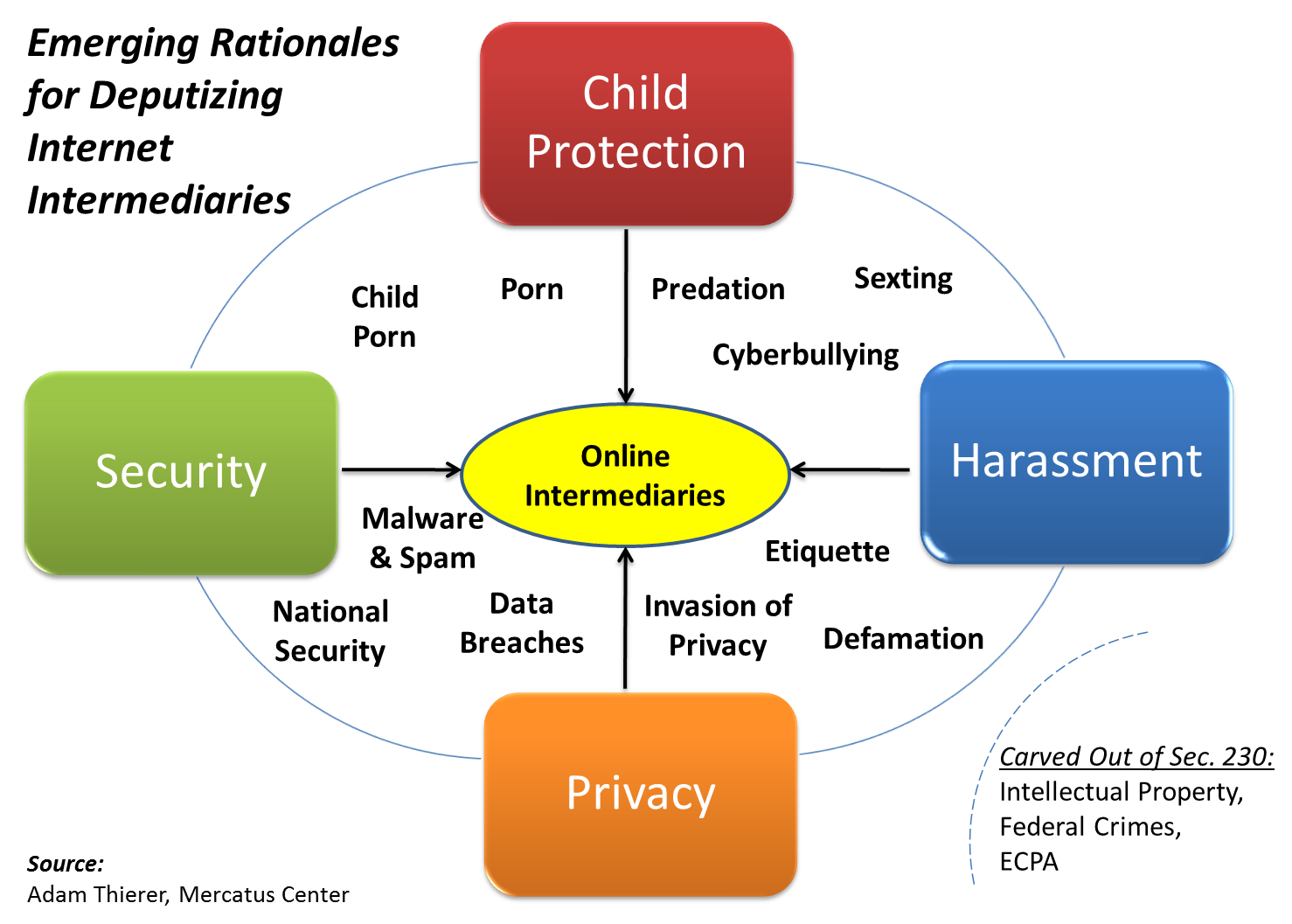
Forbes to read the rest. And here’s a graphic I put together illustrating all the new fault lines in the war against Sec. 230. It will be included in a new paper on the issue that I am wrapping up right now.
Short but very important essay here from Santa Clara University Law School Prof. Eric Goldman about calls to alter Sec. 230 of the Communications Decency Act (CDA) to address concerns about online harassment. Generally speaking, Sec. 230 immunizes online intermediaries from punishing liability for the content that travels over their networks / services. Specifically, Sec. 230 stipulates that “No provider or user of an interactive computer service shall be treated as the publisher or speaker of any information provided by another information content provider.” In other words: Don’t shoot the messenger!
As we’ve noted here before, it is probably not an overstatement to think of Sec. 230 as the very cornerstone of Internet Freedom, since it makes possible an online “utopia for utopias,” to borrow a phrase from our favorite modern political philosopher, the late Robert Nozick. Without Sec. 230, intermediaries would likely be forced to shut down many avenues of communication and would have to become deputized conduct and morality police for every cyber-street corner.
Goldman, America’s leading expert on Sec. 230-related jurisprudence, correctly notes that, “Frequently, § 230’s critics do not attack the immunization generally, but instead advocate a new limited exception for their pet concern.” He’s got that right. Indeed, we are increasingly hearing calls from numerous quarters these days to “tweak 230” for one pet concern after another. We’ve illustrated some of those concerns in this exhibit.
In our exchange, I begin by asking John to more fully develop some statements and proposals he sets forth in
Born Digital. Specifically, he and co-author Urs Gasser argue that: “The scope of the immunity the CDA provides for online service providers is too broad” and that the law “should not preclude parents from bringing a claim of negligence against [a social networking site] for failing to protect the safety of its users.” They also suggest that “There is no reason why a social network should be protected from liability related to the safety of young people simply because its business operates online.” Specifically, the call for “strengthening private causes of action by clarifying that tort claims may be brought against online service providers when safety is at stake,” although they do not define those instances.
Using those proposals as a launching point for our discussion, I challenge John as follows:
I’m troubled by your proposals because I believe Section 230 has been crucial to the success of the Internet and the robust marketplace of online freedom of speech and expression. In many ways — whether intentional or not — Section 230 was the legal cornerstone that gave rise to many of the online freedoms we enjoy today. I fear that the proposal you have set forth could reverse that. It could lead to crushing liability for many online operators-and not just giants like MySpace or Facebook-that might not be able to absorb the litigation costs. Could you elaborate a bit more about your proposal and explain why you think the time has come to alter Section 230 and online liability norms?
And John does and then we go back-and-forth from there. Again, you can read the whole exchange over at Ars.
It was a great pleasure to engage in this exchange with Prof. Palfrey and I look forward to what others have to say in response to our debate. I am working on a longer paper looking broadly at the rising threats to Sec. 230 and the increasing calls for expanded online liability and middleman deputization. I will use whatever feedback I get from this exchange to refine my paper and proposals.
The Technology Liberation Front is the tech policy blog dedicated to keeping politicians' hands off the 'net and everything else related to technology. Learn more about TLF →

 Ars Technica has just posted the transcript of
  The Technology Liberation Front is the tech policy blog dedicated to keeping politicians' hands off the 'net and everything else related to technology.