In the wake of last week’s big SOPA showdown, a lot of people are talking about the expanded presence and power of the Internet, online operators, and digital Netizens in Washington policy debates. I certainly don’t mean to diminish the importance of this particular episode. It certainly is historic, regardless of how you feel about the specifics of SOPA. What does concern me, however, is the way this episode is prompting questions about how much more “engagement” Internet companies need to consider inside the Beltway. For example, today’s Wall Street Journal features an article on “The Web’s Growing Muscle” and notes:
The Internet industry has found a rare sweet spot in Washington. With Google in the lead, the companies have begun building a strong traditional lobbying force in Washington. And, to complement that inside game, websites’ millions of users have become a powerful outside weight on Congress. What’s more, in a rare Washington double play, the concerns of Internet companies have found a sympathetic ear both in the Democratic White House and among Republican presidential candidates who otherwise can’t agree with Barack Obama on anything.
The piece concludes with a quote from an anonymous media executive saying “People are looking at what Google spent on lobbying and wondering, ‘Can we match that?’ It has to be a big spend.”
I cannot possibly think of anything more demoralizing than that. Continue reading →
On the first full day of the new Obama administration, I wrote here, and later followed up, expressing regret that the Obama White House hadn’t ported the “Seat at the Table” program over from the transition. Change.gov published documents submitted to the transition on its Web site for public review and comment. Whitehouse.gov does not.
Now we learn that the White House will not honor an Obama campaign and Whitehouse.gov pledge – not more than nine days old – to post all non-emergency legislation on the White House Web site for five days before the President signs it.
One significant addition to WhiteHouse.gov reflects a campaign promise from the President: we will publish all non-emergency legislation to the website for five days, and allow the public to review and comment before the President signs it.
President Obama signed the “Lilly Ledbetter Fair Pay Act of 2009” into law today, one day after Congress delivered it to him. And there’s the bill law, posted on Whitehouse.gov for public review. But it sure hasn’t been up for five days. And it’s not emergency legislation: Bills like it have been floating around in Congress since at least June 2007.
If I was a little demanding about transparency from day one, it was a bit of counterpoint to folks who were going dewy about Obama’s transparency promises. Those were simply words. Judging by the Whitehouse.gov screen cap below, transparency got thrown over the side for a photo op. Welcome to Washington.
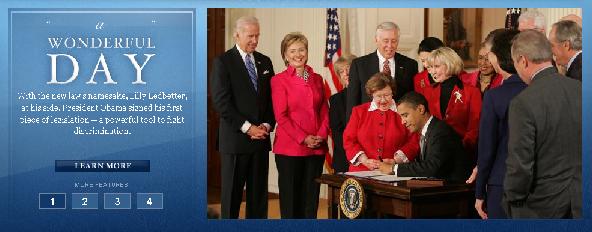
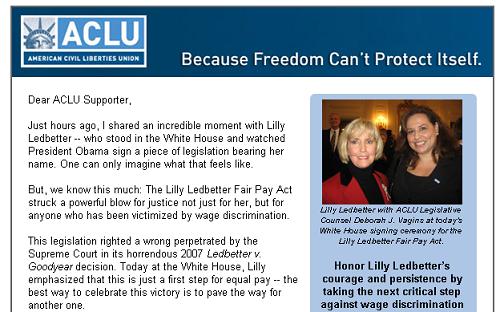
Update: Just got an email that helps illustrate why the sound practices of letting legislation cool and taking public comment would go by the wayside. Getting credit from the ACLU is much more important than pleasing the relatively tiny coterie of transparency fans – and there is almost no expectation among the public that a White House should practice good lawmaking hygiene.
My post yesterday wondering aloud whether the Obama administration was walking away from its transparency commitments was slightly premature. Memoranda were being issued/reported on as I wrote, and this morning’s Washington Post describes some of the technical glitches that befuddled White House staff on day one. The texts of the executive orders President Obama signed yesterday are now online, but his memoranda on transparency aren’t yet. Helpfully, they’ve been posted by the Sunlight Foundation.
But I think my post was sound in the main, because I was looking for actual pro-transparency deeds from the new administration, and they haven’t materialized. I appreciate the sentiments voiced in these documents, but don’t find myself wholly impressed with the actual transparency measures the White House has taken.
What I’m hearing is the transparency dog that didn’t bark: The Obama team set a
great precedent in the transition with the Seat at the Table program, but there’s no sign that such a thing will be implemented in the White House. Why not?
We can expect an “Open Government Directive” within 120 days and new guidelines for the Freedom of Information Act, but I would have appreciated seeing President Obama’s commitment to openness illustrated the best way possible: through the direct and immediate commitment of his own White House operation.
The White House will not be run as openly as the transition was. The agencies, already predisposed against transparency, will see this as a sign of weak commitment and will whittle away even more fiercely at the good sentiments President Obama’s expressed in his transparency memoranda.
(“Thanks for inviting me!” said the skunk at the garden party.)
The new Whitehouse.gov went live shortly after Barack Obama became president yesterday. It has much of the look and feel of his transition Web site, Change.gov.
Among the featured items on the homepage today (they will change regularly, of course) is the site itself and the new administration’s commitment to transparency. However, the actual terms of that commitment come up pretty anemic.
In a post on the White House blog, Director of New Media Macon Phillips says:
President Obama has committed to making his administration the most open and transparent in history, and WhiteHouse.gov will play a major role in delivering on that promise. The President’s executive orders and proclamations will be published for everyone to review, and that’s just the beginning of our efforts to provide a window for all Americans into the business of the government. You can also learn about some of the senior leadership in the new administration and about the President’s policy priorities.
Executive orders and proclamations? Information about senior leadership and the President’s priorities? That’s not breaking any new ground on transparency.
The transition’s “Seat at the Table” program required “any documents from official meetings with outside organizations [to] be posted on our website for people to review and comment on.”
The decision to port this practice over to the White House has either not been made, or has been decided against. Given that meetings are already happening, it will be a tough policy to implement if it is not implemented right away.
There is an “Office of Public Liaison” (and intergovernmental affairs) on the Whitehouse.gov site, but it’s nothing more than an email submission form at this point. “More ways for you to interact” are promised.
Words aren’t deeds, and it’s already too late to demonstrate a day-one commitment to transparency. Let’s hope the first steps of the new administration are not steps away from the important transparency precedents set by the transition.
Update: As I wrote this post, news stories were coming out about new executive orders coming out dealing with ethics and transparency. Though I haven’t been able to find them yet – hint hint, Whitehouse.gov – the change to the interpretation of FOIA sound like a welcome, if modest, step in the right direction.
The memo from John Podesta articulating the transition’s “‘Seat at the Table’ Transparency Policy” is redacted. Redactions are kind of a red flag to transparency fiends, but they’re probably appropriate (a name, an email address).
The overall “Seat at the Table” program is a decent step forward. You can get a look at the documents submitted to the transition, search them (somewhat clumsily – and not more often than once every 15 seconds), and comment on them.
So carry on transparently, Change.gov!

 The Technology Liberation Front is the tech policy blog dedicated to keeping politicians' hands off the 'net and everything else related to technology.