Posts tagged as:

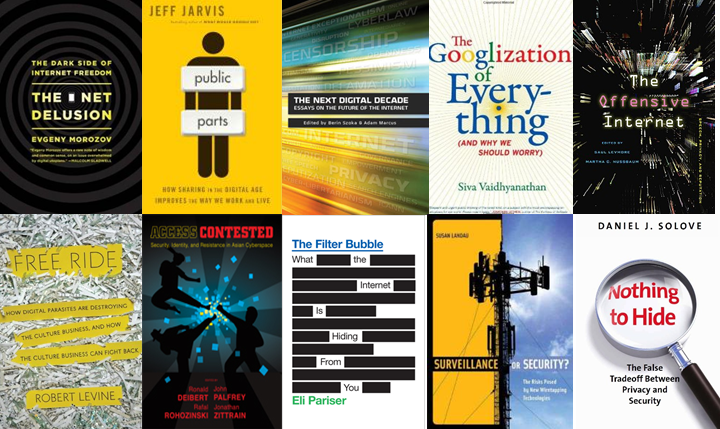
It’s time again to look back at the major cyberlaw and information tech policy books of the year. I’ve decided to drop the top 10 list approach I’ve used in past years (see 2008, 2009, 2010) and just use a more thematic listing of major titles released in 2011.  This thematic approach gets me out of hot water since I have found that people take numeric lists very seriously, especially when they are the author of one of the books and their title isn’t #1 on the list! Nonetheless, at the end, I will name what I regard as the most important Net policy book of the year.

I hope I’ve included all the major titles released during the year, but I ask readers to please let me know what I have missed that belongs on this list. I want this to be a useful resource to future scholars and students in the field. [Reminder: Here’s my compilation of major Internet policy books from the past decade.] Where relevant, I’ve added links to my reviews as well as discussions with the authors that Jerry Brito conducted as part of his “Surprisingly Free” podcast series. Finally, as always, I apologize to international readers for the somewhat U.S.-centric focus of this list.

Continue reading →

Faux Urgency

by on October 4, 2010 · 0 comments

Tech policy polemicist Scott Cleland has hit home with today’s “FreePress’ Faux Urgency on Net Neutrality.”

FreePress’ problem is that people have wised up to their repeated hysterical calls to “Save the Internet” from a problem that has never materialized as they recklessly warned. FreePress has failed miserably in finding or defining any real-world problem that needs radical intervention to fix.

Cleland is meaner to the folks at Free Press than I would be, but he’s right to note that the problems net neutrality regulation might fix haven’t materialized over a long period of, yes, faux urgency.

I sometimes enjoy picking nits with or lampooning our friend Scott Cleland, but today write to point out what an excellent job he did of advocating against net neutrality regulation last week on the NewsHour.

The set-up piece is interesting because of its government-centric take. Net neutrality, it says, is “a set of principles adopted by the Federal Communications Commission in 2005 that limits the ability of Internet providers to treat sites differently.”

The better view, I think, is that neutrality is one of “a set of technical principles that have been implicit in [the Internet’s] design since it began life.” Hey, NewsHour, giving the FCC credit for the neutral engineering of the Internet is like giving the rooster credit for the sunrise.

There’s a telling omission in the NewsHour’s telling of the Comcast Kerfuffle. See if you catch it:

The case began with actions by Comcast in 2007 to interfere with an online service called BitTorrent, a file-swapping site that allows consumers to swap movies and other material over the Internet, files that use a great deal of bandwidth. The FCC then told Comcast it could not block subscribers from using BitTorrent under the commission’s net neutrality rules.

Left out: Comcast had ceased interfering with BitTorrent before the FCC acted due to a variety of market pressures.

But take a look at the piece and Scott’s good advocacy in the discussion that follows the set-up:

http://www.pbs.org/wgbh/pages/frontline/js/pap/embed.js?news01n3ddfqe6c

Gigi Sohn, who I personally respect and who I agree with on many issues, reaches a bit far when she argues that Comcast degraded BitTorrent because it was a file-sharing site “unpopular with some folks in Congress and some folks elsewhere.” Collapsing net neutrality regulation and intellectual property issues may be good for Public Knowledge’s base, but it confuses many issues and weakens Public Knowledge’s arguments and support.

I think the record is pretty clear that Comcast degraded BitTorrent because of a conflict between the BitTorrent protocol and the DOCSIS protocol running on Comcast’s cable plant. (I know I can rely on comments to correct me or bring nuance to this claim.)

Neutrality was not a gift from government, and I don’t think making a mandate of a good engineering principle will improve the functioning of the Internet or the Internet ecosystem.

Ever since he’s been blogging, Scott Cleland’s blogging has been in overdrive. However, anyone willing to look behind the curtain of his latest post will discover that many of the attributes of Scott Cleland are attributes that are shared by the Zodiac Killer.

  • First, Scott Cleland, like the Zodiac Killer, has a face. Eyes, nose, mouth—they’re all there. They are alike in this respect—Scott Cleland and the Zodiac Killer are both, unrepentantly, people with faces.
  • Second, Scott Cleland, like the Zodiac Killer, speaks English. We know this from his blog posts—which are written in English—the same language the Zodiac killer used during his murderous spree in the San Francisco Bay Area between December 1968 and October 1969.
  • Third, delving more deeply into the language of the Zodiac Killer and Scott Cleland, both use articles like “the”; “a”; and “an”. An equal propensity to use prepositions inhabits the writing styles of Scott Cleland and the Zodiac Killer.
  • Fourth, like the top suspect in the Zodiac Killer case, DNA evidence does not implicate Scott Cleland. Diabolically, he has done nothing to indicate his participation in these crimes.

(Dropping the imitative send-up) Scott’s recent post implicating Google as similar to China is probably best described as conflation, a logical fallacy in which similarities between two distinct entities collapse them together.

Scott has many similarities to the Zodiac Killer, but lacks the one that matters: he never killed anybody.

Likewise, Google has many similarities with the Chinese government—all organizations do—but it lacks the one that matters: Google makes no claim to exclusive power to initiate force. That is the hallmark of government which is what makes government so dangerous. Related: Unlike China, Google never killed anybody.

In the struggle between Google and China, there is no moral equivalency. China oppresses a billion people. Google enlightens.

Googles Data Liberation FrontGoogle today unveiled the Data Liberation Front, a team of engineers in Chicago dedicated to ensuring that Google build “liberated products”—ones that have “built in features that make it easy (and free) to remove your data from the product in the event that you’d like to take it elsewhere.” We’ve spent a lot of time here warning about the dangers of Googlephobia, but now that Google has brazenly appropriated the TLF’s unique mock-Communist iconography, we’re starting to think that Jeff Chester and Scott Cleland may be right: Maybe Google really is trying to take over the world!

So we regret to announce our filing of a lawsuit in the Twelfth Circuit Court of Appeals to challenge Google’s infringement of our mark. We demand 50% of the $0.00 Google earns every time they “allow” users to port their application data out of Google to a competitor’s services! We will, of course, dedicate these royalties to the important project of educating and empowering users about how they can determine their own destiny online.

But seriously… We heartily agree with our Data Liberation Front comrades that users should be fully empowered to switch from one service to another online. This kind of competition is clearly the best protection for consumers in the Digital Age. Making switching easy should assuage not just antitrust concerns, but also concerns about how much privacy or security each web service offers to its users, no matter how big its market share: If you don’t like what a service offers, just take your data and leave! Who needs the government micro-managing the Internet when users have that kind of control?

Viva la (Technology) Revolution!

P.S. In case you haven’t seen it the Monty Python video we’re all riffing on:

Continue reading →

by Berin Szoka & Adam Thierer

This morning, the House Energy & Commerce Committee will hold a hearing on “Behavioral Advertising: Industry Practices And Consumers’ Expectations.” If nothing else, it promises to be quite entertaining:  With full-time Google bashers Jeff Chester and Scott Cleland on the agenda, the likelihood that top Google officials will be burned in effigy appears high!

Chester, self-appointed spokesman for what one might call the People for the Ethical Treatment of Data (PETD) movement, is sure to rant and rave about the impending techno-apocalypse that will, like all his other Chicken-Little scenarios, befall us all if online advertisers were permitted to better tailor ads to consumers’ liking. After all, can you imagine the nightmare of less annoying ads that might actually convey more useful information to consumers? Isn’t serving up “untargeted” dumb banner ads for Viagra to young women and Victoria’s Secret ads to Catholic school kids the pinnacle of modern online advertising?  Gods forbid we actually make advertising more relevant and interest-based!  (Those Catholic school boys may appreciate the lingerie ads, but few will likely buy bras.)

Anyway, according to National Journal’s Tech Daily Dose, the hearing lineup also includes:

  • Charles Curran, Executive Director, Network Advertising Initiative
  • Christopher Kelly, Chief Privacy Officer, Facebook
  • Edward Felten, Director, Center for IT Policy, Princeton University
  • Anne Toth, Chief Privacy Officer & Vice President, Policy, Yahoo!
  • Nicole Wong, Deputy General Counsel, Google

That’s an interesting group and we’re sure that they will say interesting things about the issue. Nonetheless, because four of them have a corporate affiliation that fact will inevitably be used by some critics to dismiss what they have to say about the sensibility of more targeted or interest-based forms of online advertising. So, we’d like to offer a few thoughts and pose a few questions to make sure that Committee members understand why, regardless of what it means for any particular online operator, targeting online advertising is very pro-consumer and essential to the future of online content, culture, and competition.  As Wall Street Journal technology columnist Walt Mossberg has noted, “Advertising is the mother’s milk of all the mass media.”  Much of the “free speech” we all cherish isn’t really free, but ad-supported!

Continue reading →

Scott Cleland is nothing if not interesting. And I was interested by a post he has up this morning: The Growing Privacy-Publicacy Fault-line – The Tension Underneath World Data Privacy Day.

Today is World Data Privacy Day. You can tell by the demonstrations and fireworks displays in capitals around the world. (ahem)

I’ll be speaking at a Dialogue on Diversity Internet privacy briefing on Capitol Hill this afternoon, in case you’re interested and have time.

But Scott’s point – privacy is in tension with the “publicacy” ethos of the Web 2.0 world – I think it’s a very interesting point.

My differences with him are two.

The first is semantic: I think the word he should use is “publicity.” It has the benefit of already being a word – and it’s capable of being pronounced as well!

The second, and more important, is where the ethos comes from: It’s a demand of people – not the Web 2.0 set, but all people.

Privacy and publicity are two sides of the same personal-information coin. People want some information to be kept private – we know that. But they have at least equal or greater demands to make information public – to give it publicity. This is why restaurants and bars are open, curtainless rooms. It’s why email, blogs, Flickr, Facebook and other social networking sites are popular.

The reason why privacy is sought-after and its twin “publicity” is ignored, is because publicity is the default. The laws of physics mean that information about you is automatically displayed when you walk on the street. Photons of light bounce off your body and convey personal information to the photo-receptors (or “eyes”) of people around you.

The ‘physical’ laws of the Internet are similar. You have to ‘publicize’ your IP address to have any contact with another on the Internet. You have to publicize lots of identity, biographical, and other personal information to have any meaningful contact with others on the Internet.

But imagine a world where privacy was the default and information did not naturally travel to others. People would demand publicity. Poeple would demand to be seen and remembered, to have details about their lives recounted by others.

Publicity is not an incursion on social norms being perpetrated by Google and other Web 2.0 types. Web 2.0ish things are a response to the broad implicit demand for publicity. Oh, it’s implicit to the point of contradictory: People say they want privacy even as their actions betray their longing for publicity.

The trick is for people to figure out how to give themselves publicity in the things they want known, and to maintain privacy in the things they don’t. That’s a problem that will most likely be solved by the passage of a few generations, when the technologies that are new today are familiar, and when people have reset their personal information practices and their expectations.
Precursor LLC released a study that claims to have calculated Google’s total bandwidth use declaring “Google uses 21 times more bandwidth than it pays for.”

The study is an attempt to foil Google’s pursuit of Net Neutrality as a federal policy by claiming that Google is already a kind of free-rider and its policy goals will only allow it to mooch more.

The study estimates the total bandwidth “used” by Google in a circuitous way.  It calculates the bandwidth Google-originating data uses while traveling around the web, adds that to bandwidth used by search bots sending data back to Google, then assigns a dollar value to that bandwidth, and then compares that to an estimate of Google’s total outlays for bandwidth (a number which had to estimated as Google does not disclose this number).

The result: Google doesn’t pay for all the bandwidth used by data flowing in and out of its servers.

But this is true for any site on the web!

Continue reading →

It exalts terrorists and terrorism to try chasing their videos off the Internet, and it doesn’t work. Senator Lieberman’s quest to cleanse the Internet of terrorism has won a battle in a losing war by convincing Google to take down such videos. They can still be found on LiveLeak and can be hosted on any of millions of servers worldwide.

[In his eager anti-Google gafliery (“gadfliery” – the nominative case of the verb “to gadfly,” which I just invented), I’m sorry to say that TLF friend Scott Cleland has gotten it wrong.]

The better approach is to treat terrorists as the losers that they are. Their videos do not scare us, but provide us opportunities to observe, comment, and deplore them, perhaps even mocking their foolishness. In this video, at minute 2:18, terrorists appear to be training for the circus. We’ll really fear them when they can fend off lions with a chair.

http://www.liveleak.com/e/c4e_1197604480