I caught this tidbit today in a Washington Post article about Julius Genachowski’s tenure as Federal Communications Commission chairman:
He wound up presiding over a crucial period in which the powerful companies of Silicon Valley turned into Washington power players. Lobbying the FCC has become a major economic franchise. Each day, hundreds of dark-suited lawyers crowd the antiseptic, midcentury-modern agency building.
Can anyone think this is a good thing? To be clear, I don’t think Genachowski is solely responsible for Silicon Valley innovators getting more aggressive in Washington or for tech lobbying becoming “a major economic franchise” at the FCC. There’s plenty of blame to go around in that regard. Regardless, every legislative and regulatory action that opens the door to greater regulation of the information economy also opens the door a bit wider to unproductive rent-seeking and cronyist activities. Moreover, every minute and every dollar spent focusing on making legislators and regulators happy is another minute and dollar that could have better been spent making consumers happy in the marketplace. It’s a pure deadweight loss to society.
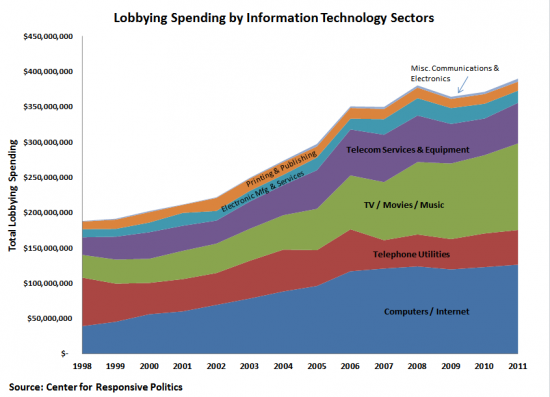
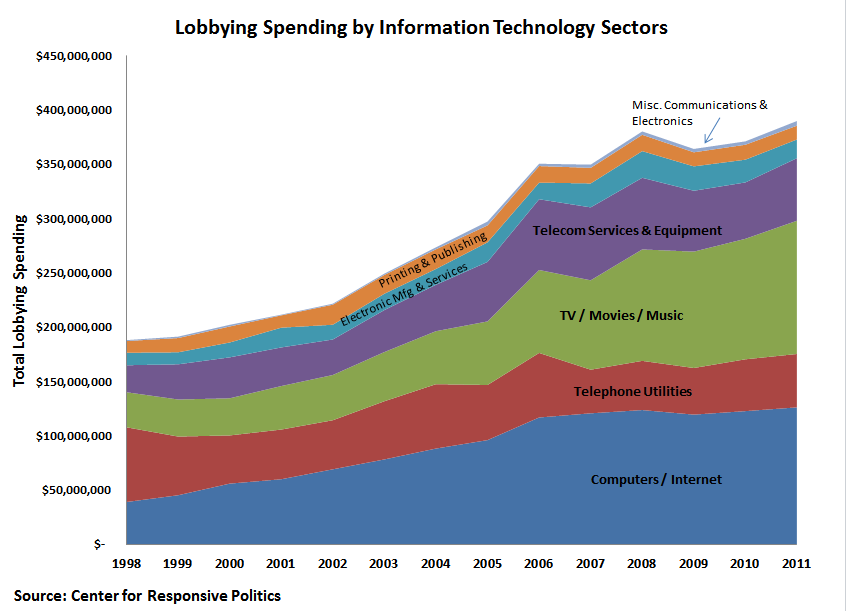
And there has been a remarkable expansion in such tech lobbying activity over the past decade, as the following charts illustrate. The first shows the dramatic growth of lobbying by computer and Internet companies relative to other sectors and the second shows lobbying spending by specific computer and Internet companies. [Click to enlarge.]
Continue reading →
 The Wall Street Journal reports today that student loan borrowing for college “in the 2008-09 academic year grew about 25% over the previous year, to $75.1 billion,” with the average student borrowing $13,172 to pay for college. So it should come as an enormous relief that one Internet start-up, StraighterLine, has essentially made the university fully virtual, offering classes for just $99/month. While this may seem like a boon for students, especially the millions of Americans for whom even community college tuition seems an insurmountable obstacle to climbing up the economic ladder, such “e-Learning” offerings are already, predictably, coming under attack by entrenched interests in “Big Ed” (the professoriat!) as the “media-software–publishing–E-learning-complex.”
In Washington Monthly, Kevin Carey explains why “The next generation of online education could be great for students—and catastrophic for universities.” In a nutshell, the story is the same basic theme of Chris Anderson’s book Free!: digital distribution of information will ultimately drive costs down to zero. Carey shows how universities are essentially facing the same sorts of pressure from disruptive innovation as newspapers—except with more capital costs:
Colleges are caught in the same kind of debt-fueled price spiral that just blew up the real estate market. They’re also in the information business in a time when technology is driving down the cost of selling information to record, destabilizing lows.
In combination, these two trends threaten to shake the foundation of the modern university, in much the same way that other seemingly impregnable institutions have been torn apart. In some ways, the upheaval will be a welcome one. Students will benefit enormously from radically lower prices—particularly people like Solvig who lack disposable income and need higher learning to compete in an ever-more treacherous economy. But these huge changes will also seriously threaten the ability of universities to provide all the things beyond teaching on which society depends: science, culture, the transmission of our civilization from one generation to the next.
Whether this transformation is a good or a bad thing is something of a moot point—it’s coming, and sooner than you think.
Continue reading →
A few gems from George Gilder’s 1990 masterpiece Microcosm: the Quantum Revolution in Economics & Technology as I work my way through the book:
Predatory Pricing. Gilder details how early microchip manufacturers created wholly new markets put Say’s law into action: supply creating its own demand. Not only did these companies introduce new technologies, but they created demand by slashing the prices of those technologies by multiple orders of magnitude (10-10,000x) even before they figured out how to lower production costs enough to make even a small profit. While such practices would later give rise to charges of “predatory pricing” and “dumping,” Gilder explains:
Selling below cost is the crux of all enterprise. It regularly transforms expensive and cumbersome luxuries into elegant mass products. It has been the genius of American industry since the era when Rockefeller and Carnegie radically reduced the prices of oil and steel. (122)
The Learning Curve: Gilder explains the dynamic by which prices drop so consistently in innovative new industries:
Early in the life of a product, uncertainty afflicts every part of the process. An unstable process means energy use per unit will be at its height. Both fuels and materials are wasted. High informational entropy in the process also produces high physical entropy.
The benefits of the learning curve largely reflect the replacement of uncertainty with knowledge. The result can be a production process using less materials, less fuel, less reworks, narrower tolerances, and less supervision, overcoming entropy of all forms with information. This curve, in all its implications, is the
fundamental law of economic growth and progress. (125)
The Curve of the Mind: Gilder explains the broader implications of the Learning Curve to the competitiveness of the market economy, and how easily yesterday’s giants can become tomorrow’s easy prey: Continue reading →

 The Technology Liberation Front is the tech policy blog dedicated to keeping politicians' hands off the 'net and everything else related to technology.