This morning, the Federal Communications Commission (FCC) released its eagerly-awaited “Future of Media” report. The 475-page final report is entitled, “The Information Needs of Communities: The Changing Media Landscape in a Broadband Age.” [Here’s a 2-page summary and the official press release.] The report is a bit overdue; the effort was supposed to be wrapped up late last year. Comments in the proceeding were filed over a year ago. Here are some of the major ones. Also, here is the 80-page monster filing that I submitted with my former PFF colleagues Berin Szoka and Ken Ferree.
Quick refresher… Federal policymakers have been taking a greater interest in the health of media and journalism in recent years. In 2009, the Senate held hearings about “the future of journalism,” and Senator Benjamin L. Cardin (D-MD) introduced the “Newspaper Revitalization Act,” which would allow newspapers to become tax-exempt non-profits in an effort to help them stay afloat. In 2010, the Federal Trade Commission hosted two workshops asking “How Will Journalism Survive the Internet Age?” and also released a staff report on “Potential Policy Recommendations to Support the Reinvention of Journalism.” (As I noted here and here, the FTC was blasted for that report and quickly backed off the issue. The agency has since gone radio silent on the issue.) The FCC also launched its “Examination of the Future of Media and Information in a Digital Age” in 2010, and today’s report wraps up their work on this front.
My first reaction after scanning the FCC’s final report is one of relief. For those of us who care about the First Amendment, media freedom, and free-market experimentation with new media business models, it feels like we’ve dodged a major bullet. The report does not recommend sweeping regulatory actions that might have seen Washington inserting itself into the affairs of the press or bailing out dying business models.
Continue reading →
Two articles of interest in today’s Wall Street Journal with indirect impact on the debate over the future of Internet policy. First, there’s a front-page story (“Facing Budget Gaps, Cities Sell Parking, Airports, Zoo“) documenting how many cities are privatizing various services — including some considered “public utilities” — in order to help balance budgets. The article worries about “fire-sale” prices and the loss of long-term revenue because of the privatizations. But the author correctly notes that the more important rationale for privatization is that, “In many cases, the private takeover of government-controlled industry or services can result in more efficient and profitable operations.” Moreover, any concern about “fire-sale” prices and long-term revenue losses have to be stacked again the massive inefficiencies / costs associated with ongoing government management of resources /networks.
Of course, what’s so ironic about this latest privatization wave is that it comes at a time when some regulatory activists are clamoring for more regulation of the Internet and calling for broadband to be converted into a plain-vanilla public utility. For example, Free Press founder Robert McChesney has argued that “What we want to have in the U.S. and in every society is an Internet that is not private property, but a public utility.” That certainly doesn’t seem wise in light of the track record of past experiments with government-owned or regulated utilities. And the fact that we are talking about something as complex and fast-moving as the Internet and digital networks makes the task even more daunting.
Government mismanagement of complex technology projects was on display in a second article in today’s
Journal (“U.S. Reviews Tech Spending.”) Amy Schatz notes that “Obama administration officials are considering overhauling 26 troubled federal technology projects valued at as much as $30 billion as part of a broader effort by White House budget officials to cut spending. Projects on the list are either over budget, haven’t worked as expected or both, say Office of Management and Budget officials.” I’m pleased to hear that the Administration is taking steps to rectify such waste and mismanagement, but let’s not lose sight of the fact that this is the same government that the Free Press folks want to run the Internet. Not smart.

[cross-posted from BigGovernment.com]
In the battle over media and communications freedom, no group poses a more serious threat to a free and independent press than the insultingly misnamed regulatory activist group Free Press. Along with their founders, the prolific neo-Marxist media theorist Robert W. McChesney and Nation correspondent John Nichols, Free Press has engaged in relentless agitation for a truly radical media and communications policy agenda, and their influence is now spreading throughout the Obama Administration.
The Free Press-McChesney blueprint for media “reform” reads more like a script for State servitude. On the regulatory side, they call for media ownership restrictions, “localism” mandates, “Net neutrality” regulations, price controls on broadband, advertising and copyright restrictions, and layers of additional regulatory edicts. Once all that red tape smothers the life out the independent press and private communications providers, they plan to have the State step in become the primary benefactor of the Fourth Estate and high-tech infrastructure. For starters, McChesney and Nichols advocate a $35 billion annual “public works” program for the press modeled after the Works Progress Administration of the New Deal era. Their media WPA would include a “News AmeriCorps” for out-of-work journalists, a “Citizenship News Voucher” to funnel taxpayer support to struggling media entities, a significant expansion of postal subsidies, a massive new subsidy for journalism schools, corporate welfare for newspapers sufficient to pay 50 percent of the salaries of all “journalistic employees,” municipal government ownership of press and infrastructure, and many more bureaucratic programs. Continue reading →
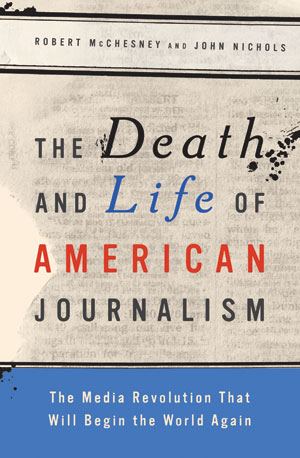
 I’ve been so busy trying to cover breaking developments related to Washington’s new efforts to “save journalism” (FTC) and steer the “future of media” (FCC) — see all my recent essays & papers here — that I forgot to do a formal book review of the book that is partially responsible for whipping policymakers into a lather about this issue: The Death and Life of American Journalism, the media-takeover manifesto by the neo-Marxist media scholar Robert W. McChesney and Nation editor John Nichols. Their book is horrifying in its imperial ambitions since it invites the government become the High Lord and Protector of the Fourth Estate. [For an in-depth look at all of McChesney’s disturbing views on these issues, see: “Free Press, Robert McChesney & the “Struggle” for Media.”] Anyway, I put together a formal review of the book for City Journal. It’s online here and I’ve also pasted it down below.
A Media Welfare State?
by Adam Thierer
Imagine a world of “post-corporate” newsrooms, where the state serves as the primary benefactor of the Fourth Estate. Billions flow from bureaucracies to media entities and individual journalists in the name of sustaining a “free press.” And this new media welfare state is funded by steep taxes on our mobile phones, broadband connections, and digital gadgets.
Sound Orwellian? Well, it’s the blueprint for a press takeover drawn up by Robert W. McChesney and John Nichols in their new book,
The Death and Life of American Journalism. McChesney, the prolific neo-Marxist media scholar who teaches at the University of Illinois at Urbana-Champaign, and Nichols, a journalist with The Nation, aren’t shy about their intentions. Along with Free Press, the absurdly misnamed regulatory activist group they co-founded, McChesney and Nichols outline a self-described “radical” agenda for what they hope will become a media “revolution.” And, shockingly, some folks in the Obama administration are listening. Continue reading →
Faithful readers know of my geeky love of tech policy books [here are my “best of” lists for 2008 & 2009], and the intriguing battle taking place today between Internet optimists and pessimists in particular. One of the things that I noticed when I was putting together my compendium, “The Digital Decade’s Definitive Reading List: Internet & Info-Tech Policy Books of the 2000s,” is that there are up years and down years. For example, there weren’t a lot of big tech policy titles in 2000 or 2005. By contrast, 2001, 2006 and 2008 were monster years. I suppose that’s the case with any genre, of course.
Anyway, I was beginning to think that 2010 was shaping up to be one of those slow years, with Jaron Lanier’s
You Are Not a Gadget being the only major release so far this year. [See my review of it here.] But there are some very important titles on the way that are worth picking up. I’ve already pre-ordered most of these and am looking forward to reviewing them all soon:
Please let me know others that I may be missing. [Note: Most of the books I’ve been reading this year have more to do with the future of media, the press, journalism, etc. It’s been a big year for books like that. For example, McChesney & Nichols’ The Death and Life of American Journalism; Lee Bollinger’s Uninhibited, Robust, and Wide-Open: A Free Press for a New Century; and Bob Garfield’s The Chaos Scenario. But it’s not clear any of these books belong in the “info-tech policy” genre, although they all have something to say about the impact of the Internet and digital technology on the media and journalism. So, who knows, maybe I will add them to my end of year list.]
Can we steer people toward hard news — and get them to financially support it — through the use of “news vouchers” or “public interest vouchers”? That’s the subject of this latest installment in my ongoing series on proposals to have the government play a greater role in the media sector in the name of sustaining struggling enterprises or “saving journalism.”
As I mentioned here previously, last week I testified at the FCC’s first “Future of Media” workshop on “Serving the Public Interest in the Digital Era.” (@3:29 mark of video). It was a great pleasure to testify alongside the all-star cast there that day, which included the always-provocative Jeff Jarvis of the CUNY Graduate School of Journalism. He delivered some very entertaining remarks and vociferously pushed back against many of the ideas that others were suggesting about “saving journalism.” Jeff is a very optimistic guy–far more optimistic than me, in fact–about the prospect that new media and citizen journalism will help fill whatever void is left by the death of many traditional media operators and institutions. He had a lively exchange with Srinandan Kasi, Vice President, General Counsel and Secretary of the Associated Press, that is worth watching (somewhere after the 5-hour mark on the video).
Nonetheless, Jarvis is a enough of a realist to know that it has
always been difficult to find resources to fund hard news, which he creatively refers to as “broccoli journalism.” This is what is keeping the FCC, the FTC (workshop today), and many media worrywarts up at night; the fear that as traditional financing mechanisms falter (advertising, classifieds, subscription revenues, etc) many traditional news-gathering efforts and institutions will disappear. Of course, while it is certainly true we are in the midst of a gut-wrenching media revolution with a great deal of creative destruction taking place, it is equally true that exciting new media business models and opportunities are developing. We shouldn’t over look that, as I argued here and here.
Anyway, a lot of different proposals are being put forth by scholars and policymakers to find new ways to finance news-gathering or “save journalism.” One of the ideas that has been gaining some steam as of late is the idea of crafting a “public interest voucher” or what Robert W. McChesney & John Nichols, authors of the new book The Death and Life of American Journalism, call a “Citizenship News Voucher.” And McChesney discussed this idea in more detail when he spoke at today’s FTC event on saving journalism. Continue reading →
by Adam Thierer & Berin Szoka, Progress Snaphot 6.1
Stephanie Clifford of the
New York Times posted a very interesting article this week summarizing a recent “on-the-record chat” the Times staff had with Federal Trade Commission (FTC) chairman Jon Leibowitz and FTC Bureau of Consumer Protection chief David Vladeck. The interview [discussed by Braden here] is profoundly important in that it reveals an alarming disconnect regarding the relationship between “privacy” regulation and the future of media, which were the subjects of their discussion with Times staff. Namely, Leibowitz and Vladeck apparently fail to appreciate how the delicate balance between commercial advertising and journalism is at risk precisely because of the sort of regulations they apparently are ready to adopt. Because the value of online advertising depends on data about its effectiveness and consumers’ likely interests, and because advertising is indispensable to funding media, what’s ultimately at stake here is nothing short of the future of press freedom.
The “Day of Reckoning” Is Upon Us
Leibowitz and Vladeck spend the first half of
The Times interview wringing their hands about “privacy policies,” the declarations made by websites and advertising networks about their data collection and use practices (for which the FTC can and must hold them accountable). But the two feel that privacy policies don’t adequately inform consumers. Chairman Leibowitz claims that online companies “haven’t given consumers effective notice, so they can make effective choices.” And Mr. Vladeck states that advise-and-consent models “depended on the fiction that people were meaningfully giving consent.” But he and the FTC seem ready to abandon the notice and choice model because the “literature is clear” that few people read privacy policies, Vladeck told the Times. He and Leibowitz continue:
“Philosophically, we wonder if we’re moving to a post-disclosure era and what that would look like,” Mr. Vladeck said. “What’s the substitute for it?” He said the commission was still looking into the issue, but it hoped to have an answer by June or July, when it plans to publish a report on the subject. Mr. Leibowitz gave a hint as to what might be included: “I have a sense, and it’s still amorphous, that we might head toward opt-in,” Mr. Leibowitz said.
This clearly foreshadows the regulatory endgame we have long suspected was coming. When the FTC released its “Self-Regulatory Principles for Online Behavioral Advertising” eleven months ago, we asked: “What’s the Harm & Where Are We Heading?” Their answers to both questions have become clearer with each new calculated comment—all apparently intended to slowly “turn up the heat” on the advertising industry so that the proverbial frog will stay in the pot until the water finally boils. Leibowitz’s FTC has simply dodged the “harm” question with a four-part strategy: Continue reading →
Free Press, the radical regulatory activist group founded by Marxist media scholar Robert W. McChesney, has never seen a media or technology regulation they don’t like, but their latest effort to have the feds halt innovation is shocking even by their standards. According to The Washington Post:
Free Press and other public advocacy groups are sending letters Monday to the Justice Department and the Federal Trade Commission calling for a probe of the “TV Everywhere” plan by cable, satellite and phone companies that brings television shows and movies to computers and devices, but only for those that subscribe to both television and high-speed Internet services.
Think about this. “TV Everywhere” is still in its cradle, having only just been launched recently. It will give multichannel video distributors a chance to find their footing as millions of consumers continue to “cut the video cord.” And it would provide consumers with ubiquitous access to content over the Internet while also ensuring that content creators are compensated for their programming.
OK, so what’s wrong with all this again? Why would we want federal antitrust officials throw a wrecking ball into this innovative new business model? Continue reading →
I’ve just released a new PFF white paper looking at the hysteria that has often accompanied major media mergers and then taking a look at the marketplace reality years after the fact. Here‘s the PDF, but I have also pasted the entire thing down below.
_____________________________
A Brief History of Media Merger Hysteria:
From AOL-Time Warner to Comcast-NBC
by Adam Thierer
Although the pending union of Comcast and NBC Universal has not yet made it to the altar, Chicken Little-esque wails about the marriage have already begun in earnest. For example, the pro-regulatory media organization Free Press has already set up a website to complain about the deal.[1] And Jeff Chester, executive director of the Center for Digital Democracy, has called it “an unholy marriage.”[2] The fever only promises to spread once the deal is formally announced, and a lengthy fight over the deal is expected at the Federal Communications Commission (FCC) and whichever antitrust agency reviews the deal.[3]
But reality tends to play out somewhat less dramatically than the script penned by the media worrywarts. It’s worth looking back at some of the more prominent examples of media merger hysteria in recent years to understand why such panic is unwarranted, and why a deal between Comcast and NBC Universal is unlikely to lead to the sort of problems that the pessimists suggest.[4] Continue reading →
Free Press, the radical pro-regulatory media activist group, recently filed comments with the Federal Trade Commission (FTC) for the agency’s upcoming workshop on “How Will Journalism Survive the Internet Age?” The Free Press comments provide an enlightening glimpse into the mind of how many on the Left now think about media policy in America. Their approach can be summarized as follows:
- Nothing the private sector can do will save journalism (unless it is entirely non-profit / non-commercial in nature);
- Even if there was something that private players could do to save journalism, Free Press would likely have federal authorities forbid it anyway (especially if it involved new business ownership patterns or combinations); and,
- The only thing that can really save journalism is a “public option” for the press in the form of massive state subsidization of media in this country.
To elaborate on the last point, here’s how Free Press summarizes what they are looking for:
For U.S. public media to become a truly world-class system will require a substantial increase in funding. This could be accomplished by an increase in direct congressional appropriations to the Corporation for Public Broadcasting. With increased funding — to as little as $5 per person, increasing annual appropriations to some $1.5 billion — the American public media system could dramatically increase its capacity, reach, diversity and relevance.
But they stress that a simple expansion of the PBS/NPR/CPB non-commercial model will not be enough since that system is “vulnerable to repeated threats of funding cuts” and too “reliant on corporate backing, via the underwriting process.” They want to go well beyond
non-commercial media, therefore, and have the state start building a massive public media infrastructure. Here’s where their pitch for a public option for the press comes in: Continue reading →

 The Technology Liberation Front is the tech policy blog dedicated to keeping politicians' hands off the 'net and everything else related to technology.