In my last post, I discussed an outstanding new paper from Ronald Cass on “Antitrust for High-Tech and Low: Regulation, Innovation, and Risk
.” As I noted, it’s one of the best things I’ve ever read about the relationship between antitrust regulation and the modern information economy. That got me thinking about what other papers on this topic that I might recommend to others. So, for what it’s worth, here are the 12 papers that have most influenced my own thinking on the issue. (If you have other suggestions for what belongs on the list, let me know. No reason to keep it limited to just 12.)
- J. Gregory Sidak & David J. Teece, “Dynamic Competition in Antitrust Law,” 5 Journal of Competition Law & Economics (2009).
- Geoffrey A. Manne & Joshua D. Wright, “Innovation and the Limits of Antitrust,” 6 Journal of Competition Law & Economics, (2010): 153
- Joshua D. Wright, “Antitrust, Multi-Dimensional Competition, and Innovation: Do We Have an Antitrust-Relevant Theory of Competition Now?” (August 2009).
- Daniel F. Spulber, “Unlocking Technology: Antitrust and Innovation,” 4(4) Journal of Competition Law & Economics, (2008): 915.
- Ronald Cass, “Antitrust for High-Tech and Low: Regulation, Innovation, and Risk
,” 9(2) Journal of Law, Economics and Policy, Forthcoming (Spring 2012)
- Richard Posner, “Antitrust in the New Economy,” 68 Antitrust Law Journal, (2001).
- Stan J. Liebowitz & Stephen E. Margolis,”Path Dependence, Lock-in, and History,” 11(1) Journal of Law, Economics and Organization, (April 1995): 205-26.
- Robert Crandall and Charles Jackson, “Antitrust in High-Tech Industries,” Technology Policy Institute (December 2010).
- Bruce Owen, “Antitrust and Vertical Integration in ‘New Economy’ Industries,” Technology Policy Institute (November 2010).
- Douglas H. Ginsburg & Joshua D. Wright, “Dynamic Analysis and the Limits of Antitrust Institutions,” 78 (1) Antitrust Law Journal (2012): 1-21.
- Thomas Hazlett, David Teece, Leonard Waverman, “Walled Garden Rivalry: The Creation of Mobile Network Ecosystems,” George Mason University Law and Economics Research Paper Series, (November 21, 2011), No. 11-50.
- David S. Evans, “The Antitrust Economics of Two Sided Markets.”
The Technology Policy Institute has released an interesting new study from Robert Crandall and Charles Jackson on “Antitrust in High-Tech Industries,” which takes a close look at the impact of antitrust law in the three most high-profile technology cases of the last half century: IBM, AT&T and Microsoft. Crandall and Jackson conclude:
In each of our three cases, the ultimate source of major changes in the competitive landscape appears to have been innovation and new technology — technology that was apparently not unleashed by the antitrust litigation. In each case, the government did not and probably could not see how technology would develop over time. Therefore, it was difficult for the government to design remedies that would accelerate competition when this competition developed from new technologies.
I enjoyed the paper and encourage others to read the entire thing. It’s very much in line with what we’ve written here in the past on the antitrust and high-tech markets. See, for example, my review of Gary Reback’s recent book on antitrust and high-tech markets. As I noted there, the crucial, ‘conflict of visions‘ issue comes down to an appreciation for dynamic competition and technological evolution over the sort of static competition, fixed-pie mindset that so many antitrust defenders espouse. Those of us who believe in dynamic competition see markets in a constant state of flux and expect that sub-optimal market developments or configurations are exactly the spark that incentivizes new form of market entry, innovation, technological disruption, price competition, and so on. But the static competition crowd looks at the same situation and imagines that the only hope is to wheel in the wrecking ball of antitrust regulation since they have little faith that things might change for the better. Moreover, they ignore the profound costs associated with such regulation and litigation. Crandall and Jackson’s paper explains why patience is the better policy.
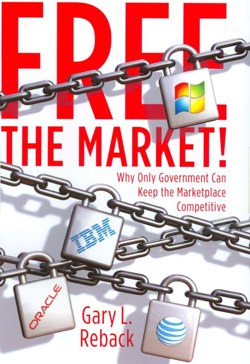 I recently finished reading Free the Market: Why Only Government Can Keep the Marketplace Competitive, a new book by noted antitrust agitator Gary L. Reback. Unsurprisingly, Reback, who led the antitrust jihad against Microsoft during the 1990s, has written a book that reads like an extended love letter to antitrust law. This man loves antitrust the way teenage girls love the Jonas Brothers — gushing, teary-eyed, ‘I-would-just-die-for-you’ sort of love. In Reback’s world, antitrust seemingly has no costs, no downsides, no trade-offs. It is our salvation and he serves as its high prophet. Everything good that happened in the world of high-tech over the past few decades? Oh, you can thank Almighty Antitrust for that. Anything bad that happened? Well, then, clearly there just wasn’t enough antitrust enforcement! That’s this book in a nutshell.
Think I’m kidding? How about this gem of quote from pg. 247: “Antitrust enforcement spawned Silicon Valley’s software industry as well.” Wow, who knew! Of course, that’s utter poppycock and should be somewhat insulting to the many entrepreneurial men and women in the high-tech world who risked everything in an attempt to build a better mousetrap. In Reback’s view of things, however, none of those mousetraps would have ever gotten built without antitrust there to supposedly shelter them from wicked “monopolists” (read: any large company) already operating in the marketplace. I’m sure many in Silicon Valley will also be surprised to hear Reback’s assertion that, “On closer examination, the Valley looks like one big public welfare project.” (p. 54) Ah yes, the old myth that government gave us the Net we know and love today. Please. Like many others, Reback spins a revisionist history of how early ARPANET involvement and seed money somehow made the Internet great when, in reality, the Net was stuck in the digital dark ages until it was finally allowed to be commercialized in 1992.
What irks me most about this book, however, is Reback’s perpetuation of the myth that antitrust is somehow not a form of economic regulation. I hear this tired old argument trotted out time and time again, even by many conservatives. Reback says, for example, that “Antitrust sets the rules of the road, so to speak, but doesn’t tell people where to drive.” By contrast, he argues, “Advocates of regulation want[] continuing government oversight and rule making to produce what would be the beneficial results of a free market… Neither approach works all the time, and decided between them remains difficult.” (p. 19) Again, this “choice” is largely a fiction since, for many industries, we end up getting both! Continue reading →
One of the reasons that so many of us here take issue with proposals to expand regulation of communications, broadband, and media markets is because we have studied the horrendous inefficiencies of economic regulation in practice. We oppose regulatory proposals not because of a “blind faith” in free markets, but because we understand that even when markets stumble they correct themselves quicker and more efficiently than regulatory systems do. One can profess the supposed theoretical benefits of enlightened “public interest” regulation all they want, but the facts are the facts. And the facts do not support the proposition that government regulation generally enhances consumer welfare.
In that regard, Tim Lee’s new Net neutrality report for Cato does a nice job of surveying some of the past unintended consequences of regulation. Also, even though it is now 10 years old, I highly recommend “Economic Deregulation and Customer Choice” by Jerry Ellig and Robert Crandall. It’s an outstanding overview of why economic regulation of various industries failed consumers so miserably in the past.
But if you want even more shocking proof of how horrendously inefficient communications regulation can be in practice, then you must read my PFF colleague Barbara Esbin’s two essays this week on the Universal Service Fund (USF): “The High Cost of USF Support,” and “More FCC Support Fund Follies.” In these two essays, Esbin walks the reader through various grim reports and statistics that have been released recently documenting the failures of the USF.
Continue reading →

 The Technology Liberation Front is the tech policy blog dedicated to keeping politicians' hands off the 'net and everything else related to technology.