Imagine a competition to design the most onerous and destructive economic regulation ever conceived. A mandate that would make all other mandates blush with embarrassment for not being burdensome or costly enough. What would that Worst Regulation Ever look like?
Unfortunately, Bill de Blasio has just floated a few proposals that could take first and second place prize in that hypothetical contest. In a new Wired essay, the New York City mayor and 2020 Democratic presidential candidate explains, “Why American Workers Need to Be Protected From Automation,” and aims to accomplish that through a new agency with vast enforcement powers, and a new tax.
Taken together, these ideas represent one of the most radical regulatory plans any America politician has yet concocted.
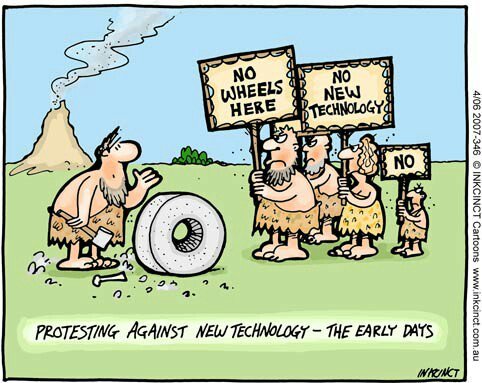
Politicians, academics, and many others have been panicking over automation at least since the days when the Luddites were smashing machines in protest over growing factory mechanization. With the growth of more sophisticated forms of robotics, artificial intelligence, and workplace automation today, there has been a resurgence of these fears and a renewed push for sweeping regulations to throw a wrench in the gears of progress. Mayor de Blasio is looking to outflank his fellow Democratic candidates for president with an anti-automation plan that may be the most extreme proposal of its kind. Continue reading →
In my previous essay, I discussed a new white paper by my colleague Robert Graboyes, Fortress and Frontier in American Health Care, which examines the future of medical innovation. Graboyes uses the “fortress vs frontier” dichotomy to help explain different “visions” about how public policies debates about technological innovation in the health care arena often play out. It’s a terrific study that I highly recommend for all the reasons I stated in my previous post.
As I was reading Bob’s new report, I realized that his approach shared much in common with a couple of other recent innovation policy paradigms I have discussed here before from Virginia Postrel (“Stasis” vs. “Dynamism”), Robert D. Atkinson (“Preservationists” vs. “Modernizers”), and myself (“Precautionary Principle” vs. “Permissionless Innovation”). In this essay, I will briefly relate Bob’s’ approach to those other three innovation policy paradigms and then note a deficiency with our common approaches. I’ll conclude by briefly discussing another interesting framework from science writer Joel Garreau. Continue reading →
I somehow missed this excellent ITIF paper by Robert D. Atkinson and George Ou when it came out at this point last year, but George has just dusted it off, made a couple of updates, and re-posted it over at the Digital Society blog. Worth reading. It touches on a lot of the same case studies I have been documenting in my ongoing series, “Problems in Public Utility Paradise.” In particular, it focuses on the UTOPIA and iProvo fiascos out in Utah. Here’s a key takeaway from those case studies:
The lessons learned in Utah is that projected uptake models and deployment plans don’t always come to fruition, and when that happens the consequence is failure. For UTOPIA, the project was projected to reach 35% uptake rates by February 2008 but the reality was less than 17% uptake. UTOPIA had also hoped for 17% uptake from lucrative business customers but the reality was only 2 to 3 percent. Provo County’s iProvo was hoping for 10,000 subscribers by July 2006 with the assumption that 75% of those customers would subscribe to lucrative triple play services, but the reality was 10,000 customers in late 2007 with only 17% of those customers subscribing to triple play. Many consumers were quite happy to subscribe to existing broadband cable or telecom providers. The consistent theme in Utah was an overestimation of the uptake rates and the underestimation of competition from incumbent cable operator Comcast and telecom operator Qwest which led to consistent underperformance.
Ouch. For more details, see this old essay of mine about UTOPIA from 2008, and this piece from last Sept about iProvo. Not a pretty picture. As I say every time I pen a piece about the latest muni failure du jour, these case studies should serve as a cautionary tale about the dangers of grandiose, centrally planned broadband schemes. There is no such thing as a free lunch. Network-building is hard, and politicians usually aren’t that good at doing it.
The Federal Trade Commission has announced that it will hold “a series of public hearings beginning on December 5, 2008, in Washington, D.C., to explore the evolving market for intellectual property (IP).”
It’s timely, then, that we will be having a forum Monday on a provocative book whose thesis is the title: Against Intellectual Monopoly. Co-author Michele Boldrin will present the book, and Rob Atkinson of the Information Technology and Innovation Foundation will critique it.
Highlighting one of the issues at Monday’s forum, the Arts+Labs blog points to Atkinson’s testimony about the value of American intellectual property on the export market. Over 50 percent of U.S. exports depend on some form of IP protection, according to Rob Atkinson.
It is commonly believed that intellectual property law in the form of copyright and patent is necessary for innovation and the creation of ideas and inventions such as machines, drugs, computer software, books, music, literature and movies.
But Michele Boldrin and his coauthor David K. Levine argue that intellectual property laws are costly and dangerous government grants of private monopoly over ideas. Their book “Against Intellectual Monopoly” seeks to show through theory and example that these legal regimes are not necessary for innovation and are damaging to growth, prosperity, and liberty.
The argument that intellectual property laws actually retard progress is a fascinating challenge to conventional beliefs about their foundations and utility. At the onset of the Information Age, the role of copyright, patent, and other legal regimes in the progress of science and arts is centrally important.
The Technology Liberation Front is the tech policy blog dedicated to keeping politicians' hands off the 'net and everything else related to technology. Learn more about TLF →

 The Technology Liberation Front is the tech policy blog dedicated to keeping politicians' hands off the 'net and everything else related to technology.