On December 13th, I will be participating in an Atlas Network panel on, “Big Tech, Free Speech, and Censorship: The Classical Liberal Approach.” In anticipation of that event, I have also just published a new op-ed for The Hill entitled, “Left and right take aim at Big Tech — and the First Amendment.” In this essay, I expand upon that op-ed and discuss the growing calls from both the Left and the Right for a variety of new content regulations. I then outline the classical liberal approach to concerns about free speech platforms more generally, which ultimately comes down to the proposition that innovation and competition are always superior to government regulation when it comes to content policy.
In the current debates, I am particularly concerned with calls by many conservatives for more comprehensive governmental controls on speech policies enforced by various private platforms, so I will zero in on those efforts in this essay. First, here’s what both the Left and the Right share in common in these debates: Many on both sides of the aisle desire more government control over the editorial decisions made by private platforms. They both advocate more political meddling with the way private firms make decisions about what types of content and communications are allowed on their platforms. In today’s hyper-partisan world,” I argue in my
Hill column, “tech platforms have become just another plaything to be dominated by politics and regulation. When the ends justify the means, principles that transcend the battles of the day — like property rights, free speech and editorial independence — become disposable. These are things we take for granted until they’ve been chipped away at and lost.”
Despite a shared objective for greater politicization of media markets, the Left and the Right part ways quickly when it comes to the underlying objectives of expanded government control. As I noted in my
Hill op-ed:
there is considerable confusion in the complaints both parties make about “Big Tech.” Democrats want tech companies doing more to limit content they claim is hate speech, misinformation, or that incites violence. Republicans want online operators to do less, because many conservatives believe tech platforms already take down too much of their content.
This makes life very lonely for free speech defenders and classical liberals. Usually in the past, we could count on the Left to be with us in some free speech battles (such as putting an end to “indecency” regulations for broadcast radio and television), while the Right would be with us on others (such as opposition to the “Fairness Doctrine,” or similar mandates). Today, however, it is more common for classical liberals to be fighting with both sides about free speech issues.
My focus is primarily on the Right because, with the rise of Donald Trump and “national conservatism,” there seems to be a lot of soul-searching going on among conservatives about their stance toward private media platforms, and the editorial rights of digital platforms in particular. Continue reading →
Interoperability is a topic that has long been of interest to me. How networks, platforms, and devices work with each other–or sometimes fail to–is an important engineering, business, and policy issue. Back in 2012, I spilled out over 5,000 words on the topic when reviewing John Palfrey and Urs Gasser’s excellent book, Interop: The Promise and Perils of Highly Interconnected Systems.
I’ve always struggled with the interoperability issues, however, and often avoided them became of the sheer complexity of it all. Some interesting recent essays by sci-fi author and digital activist Cory Doctorow remind me that I need to get back on top of the issue. His latest essay is a call-to-arms in favor of what he calls “adversarial interoperability.” “[T]hat’s when you create a new product or service that plugs into the existing ones without the permission of the companies that make them,” he says. “Think of third-party printer ink, alternative app stores, or independent repair shops that use compatible parts from rival manufacturers to fix your car or your phone or your tractor.”
Doctorow is a vociferous defender of expanded digital access rights of many flavors and his latest essays on interoperability expand upon his previous advocacy for open access and a general freedom to tinker. He does much of this work with the Electronic Frontier Foundation (EFF), which shares his commitment to expanded digital access and interoperability rights in various contexts.
I’m in league with Doctorow and EFF on some of these things, but also find myself thinking they go much too far in other ways. At root, their work and advocacy raise a profound question: should there be any general right to exclude on digital platforms? Although he doesn’t always come right out and say it, Doctorow’s work often seems like an outright rejection of any sort of property rights in networks or platforms. Generally speaking, he does not want the law to recognize any right for tech platforms to exclude using digital fences of any sort. Continue reading →
President Trump and his allies have gone to war with social media sites and digital communications platforms like Twitter, Facebook, and Google. Decrying supposed anti-conservative “bias,” Trump has even floated an Executive Order aimed at “Preventing Online Censorship,” that entails many new forms of government meddling with these private speech platforms. Section 230 is their crosshairs and First Amendment restraints are being thrown to the wind.
Various others have already documented the many legal things wrong with Trump’s call for greater government oversight of private speech platforms. I want to focus on something slightly different here: The surprising ideological origins of what Trump and his allies are proposing. Because for those of us who are old-timers and have followed communications and media policy for many decades, this moment feels like deja vu all over again, but with the strange twist that supposed “conservatives” are calling for a form of communications collectivism that used to be the exclusive province of hard-core Leftists.
To begin, the truly crazy thing about President Trump and some conservatives saying that social media should be regulated as public forums is not just that they’re abandoning free speech rights, it’s that they’re betraying
property rights, too. Treating private media like a “public square” entails a taking of private property. Amazingly, Trump and his followers have taken over the old “media access movement” and given it their own spin. Continue reading →
I have been covering telecom and Internet policy for almost 30 years now. During much of that time – which included a nine year stint at the Heritage Foundation — I have interacted with conservatives on various policy issues and often worked very closely with them to advance certain reforms.
If I divided my time in Tech Policy Land into two big chunks of time, I’d say the biggest tech-related policy issue for conservatives during the first 15 years I was in the business (roughly 1990 – 2005) was preventing the resurrection of the so-called Fairness Doctrine. And the biggest issue during the second 15-year period (roughly 2005 – present) was stopping the imposition of “Net neutrality” mandates on the Internet. In both cases, conservatives vociferously blasted the notion that unelected government bureaucrats should sit in judgment of what constituted “fairness” in media or “neutrality” online.
Many conservatives are suddenly changing their tune, however. President Trump and Sen. Ted Cruz, for example, have been increasingly critical of both traditional media and new tech companies in various public statements and suggested an openness to increased regulation. The President has gone after old and new media outlets alike, while Sen. Cruz (along with others like Sen. Lindsay Graham) has suggested during congressional hearings that increased oversight of social media platforms is needed, including potential antitrust action.
Meanwhile, during his short time in office, Sen. Josh Hawley (R-Mo.) has become one of the most vocal Internet critics on the Right. In a shockingly-worded USA Today editorial in late May, Hawley said, “social media wastes our time and resources” and is “a field of little productive value” that have only “given us an addiction economy.” He even referred to these sites as “parasites” and blamed them for a long list of social problems, leading him to suggest that, “we’d be better off if Facebook disappeared” along with various other sites and services.
Hawley’s moral panic over social media has now bubbled over into a regulatory crusade that would unleash federal bureaucrats on the Internet in an attempt to dictate “fair” speech on the Internet. He has introduced an astonishing piece of legislation aimed at undoing the liability protections that Internet providers rely upon to provide open platforms for speech and commerce. If Hawley’s absurdly misnamed new “Ending Support for Internet Censorship Act” is implemented, it would essentially combine the core elements of the Fairness Doctrine and Net Neutrality to create a massive new regulatory regime for the Internet. Continue reading →
Thirteen years ago I penned an essay entitled, “Your Soapbox is My Soapbox!” It was condensed from a 2005 book I had released at the same time called Media Myths. My research and writing during that period and for fifteen years prior to that was focused on the dangers associated with calls by radical Left-leaning media scholars and policy activists for a veritable regulatory revolution in the way information and communication technology (ICT) platforms were operated. They pushed this revolution using noble-sounding rhetoric like “fairness in coverage,” “right of reply,” “integrity of public debate,” “preserving the public square,” and so on. Their advocacy efforts were also accompanied by calls for a host of new regulatory controls including a “Bill of Media Rights” to grant the public a litany of new affirmative rights over media and communications providers and platforms.
But no matter how much the so-called “media access” movement sought to sugarcoat their prescriptions, in the end, what those Left-leaning scholars and advocates were calling for was sweeping state control of media and communications technologies and platforms. In essence, they wanted to socialize private soapboxes and turn them into handmaidens of the state.
Here’s the way I began my old “soapbox” essay:
Imagine you built a platform in your backyard for the purpose of informing or entertaining your friends of neighbors. Now further imagine that you are actually fairly good at what you do and manage to attract and retain a large audience. Then one day, a few hecklers come to hear you speak on your platform. They shout about how it’s unfair that you have attracted so many people to hear you speak on your soapbox and they demand access to your platform for a certain amount of time each day. They rationalize this by arguing that it is THEIR rights as listeners that are really important, not YOUR rights as a speaker or the owner of the soapbox.
That sort of scenario could never happen in America, right? Sadly, it’s been the way media law has operated for several decades in this country. This twisted “media access” philosophy has been employed by federal lawmakers and numerous special interest groups to justify extensive and massively unjust regime of media regulation and speech redistributionism. And it’s still at work today.
That was 2005. What’s amazing today is that this same twisted attitude is still on display, but it is
conservatives who are now the ring-leaders of the push to socialize soapboxes! Continue reading →
On Thursday, it was my great pleasure to participate in a Washington Legal Foundation (WLF) event on “Online Privacy Regulation: The Challenge of Defining Harm.” The entire event video can be found on YouTube here, but down below I pasted the clip of just my remarks. Other speakers at the event included: FTC Commissioner Maureen K. Ohlhausen, Commissioner; John B. Morris, Jr., the Associate Administrator and Director of Internet Policy athe U.S. Department of Commerce’s National Telecommunications and Information Administration; and Katherine Armstrong, Counsel at the law firm of Hogan Lovells. Glenn Lammi of the WLF moderated the session.
My remarks drew upon a few recent law review articles I have published relating digital privacy debates to previous debates over free speech and online child safety issues. (Here are those articles: 1, 2, 3).
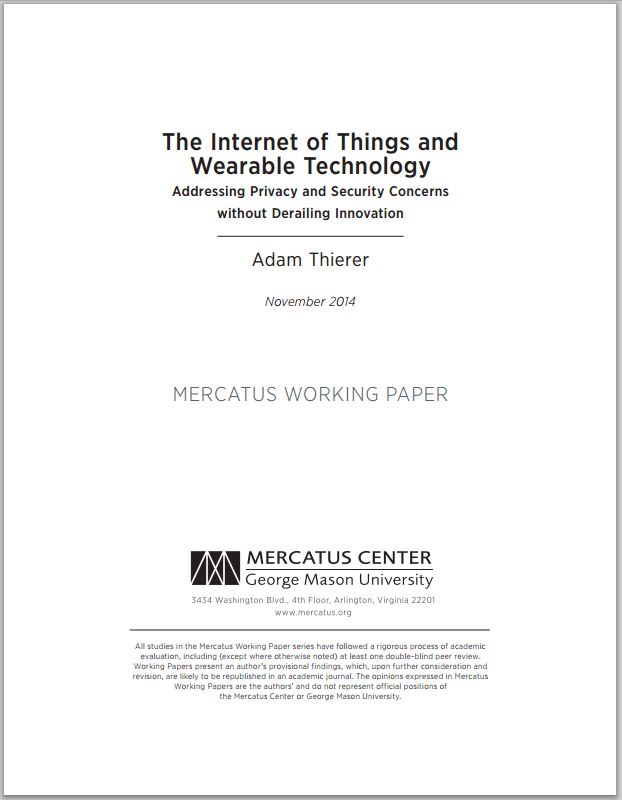
The Mercatus Center at George Mason University has just released my latest working paper, “The Internet of Things and Wearable Technology: Addressing Privacy and Security Concerns without Derailing Innovation.” The “Internet of Things” (IoT) generally refers to “smart” devices that are connected to both the Internet and other devices. Wearable technologies are IoT devices that are worn somewhere on the body and which gather data about us for various purposes. These technologies promise to usher in the next wave of Internet-enabled services and data-driven innovation. Basically, the Internet will be “baked in” to almost everything that consumers own and come into contact with.
Some critics are worried about the privacy and security implications of the Internet of Things and wearable technology, however, and are proposing regulation to address these concerns. In my new 93-page article, I explain why preemptive, top-down regulation would derail the many life-enriching innovations that could come from these new IoT technologies. Building on a recent book of mine, I argue that “permissionless innovation,” which allows new technology to flourish and develop in a relatively unabated fashion, is the superior approach to the Internet of Things.
As I note in the paper and my earlier book, if we spend all our time living in fear of the worst-case scenarios — and basing public policies on them — then best-case scenarios can never come about. As the old saying goes: nothing ventured, nothing gained. Precautionary principle-based regulation paralyzes progress and must be avoided. We instead need to find constructive, “bottom-up” solutions to the privacy and security risks accompanying these new IoT technologies instead of top-down controls that would limit the development of life-enriching IoT innovations. Continue reading →
On Thursday, it was my great pleasure to present a draft of my forthcoming paper, “The Internet of Things & Wearable Technology: Addressing Privacy & Security Concerns without Derailing Innovation,” at a conference that took place at the Federal Communications Commission on “Regulating the Evolving Broadband Ecosystem.” The 3-day event was co-sponsored by the American Enterprise Institute and the University of Nebraska College of Law.
The 65-page working paper I presented is still going through final peer review and copyediting, but I posted a very rough first draft on SSRN for conference participants. I expect the paper to be released as a Mercatus Center working paper in October and then I hope to find a home for it in a law review. I will post the final version once it is released. [UPDATE:The final version of this working paper was released on November 19, 2014.]
In the meantime, however, I thought I would post the 46 slides I presented at the conference, which offer an overview of the nature of the Internet of Things and wearable technology, the potential economic opportunities that exist in this space, and the various privacy and security challenges that could hold this technological revolution back. I also outlined some constructive solutions to those concerns. I plan to be very active on these issues in coming months.
Last week, it was my great pleasure to be invited on NPR’s “On Point with Tom Ashbrook,” to debate Jeffrey Rosen, a leading privacy scholar and the president and chief executive of the National Constitution Center. In an editorial in the previous Sunday’s New York Times (“Madison’s Privacy Blind Spot”), Rosen proposed “constitutional amendment to prohibit unreasonable searches and seizures of our persons and electronic effects, whether by the government or by private corporations like Google and AT&T.” He said his proposed amendment would limit “outrageous and unreasonable” collection practices and would even disallow consumers from sharing their personal information with private actors even if they saw an advantage in doing so.
I responded to Rosen’s proposal in an essay posted on the IAPP
Privacy Perspectives blog, “Do We Need A Constitutional Amendment Restricting Private-Sector Data Collection?” In my essay, I argued that there are several legal, economic, and practical problems with Rosen’s proposal. You can head over to the IAPP blog to read my entire response but the gist of it is that “a constitutional amendment [governing private data collection] would be too sweeping in effect and that better alternatives exist to deal with the privacy concerns he identifies.” There are very good reasons we treat public and private actors differently under the law and there “are all far more practical and less-restrictive steps that can be taken without resorting to the sort of constitutional sledgehammer that Jeff Rosen favors. We can protect privacy without rewriting the Constitution or upending the information economy,” I concluded.
But I wanted to elaborate on one particular thing I found particularly interesting about Rosen’s comments when we were on NPR together. During the show, Rosen kept stressing how we needed to adopt a more European construction of privacy as “dignity rights” and he even said his proposed privacy amendment would even disallow individuals from surrendering their private data or their privacy because he viewed these rights as “unalienable.” In other words, from Rosen’s perspective, privacy pretty much trumps
everything, even if you want to trade it off against other values. Continue reading →
This is the second of two complimentary law review articles I am releasing this year dealing with privacy policy. The first, “The Pursuit of Privacy in a World Where Information Control is Failing,” was published in Vol. 36 of the Harvard Journal of Law & Public Policy this Spring. (FYI: Both articles focus on privacy claims made against private actors — namely, efforts to limit private data collection — and not on privacy rights against governments.)
My new article on benefit-cost analysis in privacy debates makes a seemingly contradictory argument: benefit-cost analysis (“BCA”) is extremely challenging in online child safety and digital privacy debates, yet it remains essential that analysts and policymakers attempt to conduct such reviews. While we will never be able to perfectly determine either the benefits or costs of online safety or privacy controls, the very act of conducting a regulatory impact analysis (“RIA”) will help us to better understand the trade-offs associated with various regulatory proposals. Continue reading →
The Technology Liberation Front is the tech policy blog dedicated to keeping politicians' hands off the 'net and everything else related to technology. Learn more about TLF →


 The Technology Liberation Front is the tech policy blog dedicated to keeping politicians' hands off the 'net and everything else related to technology.