This morning, the Senate Judiciary Committee’s Subcommittee on Privacy, Technology, and the Law had a hearing entitled: “Protecting Mobile Privacy: Your Smartphones, Tablets, Cell Phones and Your Privacy.” It was a remarkably scattered affair, and I blogged three key—and very distinct—elements of it on the Cato@Liberty blog:
- The Department of Justice used this “mobile privacy” hearing to call for increased surveillance of Internet and mobile phone users.
- To escape a prosecutorial dead-end, Senator Blumenthal (D-CT) strongly suggested that he would outlaw the collection of radio signals. Where this government power would lead is quite profound.
- Ignoring mobile privacy, Senator Schumer (D-NY) touted his hobby-horse, mobile app censorship.
Valid concerns with what mobile operating system providers Google and Apple have done with location information were somewhat lost in this disjointed and confused hearing.
(HT The 463) Forget the sex offenders on MySpace, Connecticut Attorney General Richard Blumenthal (and C|Net reporter Elinor Mills) should be investigating reincarnation on Facebook!!

Terrorism too!

Seriously, they appear to have been completely taken in by a joke MySpace page.
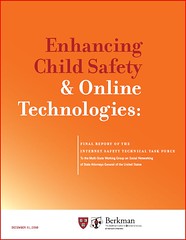 The Internet Safety Technical Task Force (ISTTF), which was formed a year ago to study online safety concerns and technologies, today issued its final report to the U.S. Attorneys General who authorized its creation. It was a great honor for me to serve as a member of the ISTTF and I believe this Task Force and its report represent a major step forward in the discussion about online child safety in this country.
The ISTTF was very ably chaired by John Palfrey, co-director of Harvard University’s Berkman Center for Internet & Society, and I just want to express my profound thanks here to John and his team at Harvard for doing a great job herding cats and overseeing a very challenging process. I encourage everyone to examine the full ISTTF report and all the submissions, presentations, and academic literature that we collected. [It’s all here.] It was a comprehensive undertaking that left no stone unturned.
Importantly, the ISTTF convened (1) a Research Advisory Board (RAB),which brought together some of the best and brightest academic researchers in the field of child safety and child development and (2) a Technical Advisory Board (TAB), which included some of America’s leading technologists, who reviewed child safety technologies submitted to the ISTTF. I strongly recommend you closely examine the RAB literature review and TAB assessment of technologies because those reports provide very detailed assessments of the issues. They both represent amazing achievements in their respective arenas.
There are a couple of key takeaways from the ISTTF’s research and final 278-page report that I want to highlight here. Most importantly, like past blue-ribbon commissions that have studied this issue, the ISTTF has generally concluded
there is no silver-bullet technical solution to online child safety concerns. The better way forward is a “layered approach” to online child protection. Here’s how we put it on page 6 of the final report:
The Task Force remains optimistic about the development of technologies to enhance protections for minors online and to support institutions and individuals involved in protecting minors, but cautions against overreliance on technology in isolation or on a single technological approach. Technology can play a helpful role, but there is no one technological solution or specific combination of technological solutions to the problem of online safety for minors. Instead, a combination of technologies, in concert with parental oversight, education, social services, law enforcement, and sound policies by social network sites and service providers may assist in addressing specific problems that minors face online. All stakeholders must continue to work in a cooperative and collaborative manner, sharing information and ideas to achieve the common goal of making the Internet as safe as possible for minors.
Continue reading →
In a big post two months ago entitled “Age Verification Debate Continues; Schools Now at Center of Discussion,” I noted that there has been an important shift in the age verification debate: Schools and school records are increasingly being viewed as the primary mechanism to facilitate online identity authentication transactions. I pointed out that this raises two very serious questions: Do we want schools to serve as DMVs for our children? And, do we want more school records or information about our kids being accessed or put online?
Brad Stone of the
New York Times has just posted an important article with relevance to this debate. In it, he points out that:
performing so-called age verification for children is fraught with challenges. The kinds of publicly available data that Web companies use to confirm the identities of adults, like their credit card or Social Security numbers, are either not available for minors or are restricted by federal privacy laws. Nevertheless, over the last year, at least two dozen companies have sprung up with systems they claim will solve the problem. Surprisingly, their work is proving controversial and even downright unpopular among the very people who spend their days worrying about the well-being of children on the Web.
Child-safety activists charge that some of the age-verification firms want to help Internet companies tailor ads for children. They say these firms are substituting one exaggerated threat — the menace of online sex predators — with a far more pervasive danger from online marketers like junk food and toy companies that will rush to advertise to children if they are told revealing details about the users.
Continue reading →

 The Technology Liberation Front is the tech policy blog dedicated to keeping politicians' hands off the 'net and everything else related to technology.