My thanks to Dr. Wayne Brough, President at Innovation Defense Foundation, for reviewing my new book, Evasive Entrepreneurs and the Future of Governance, over at the AIER website. Brough says of the book:
Adam Thierer has created a thoughtful and surprisingly timely book examining the interplay between entrepreneurs, innovation, and regulators. Thoughtful because he tackles tough questions of innovation and governance in a dynamic market. Timely because the coronavirus pandemic has forced policymakers to seriously reconsider the cumulative regulatory burden and how it may impede the economic recovery. Whether it’s V-shaped or a slower, longer recovery, decades worth of regulatory underbrush has taken its toll on economic activity while providing few, if any, benefits.
He also does a nice job summarizing the key theme of both this latest book and my previous one on
Permissionless Innovation:
Thierer takes to task the anti-growth mentality and the political movements against innovation and growth, highlighting the long tradition of hostility toward innovation, from the early 19th-century Luddites up through today’s technophobes advocating restrictions on new technologies such as artificial intelligence. Much of this is driven by the precautionary principle, which Thierer views as an inappropriate guide for regulators. The precautionary principle is a highly risk-averse standard that provides regulators an excuse to stifle innovation for the slightest perceived hazard.
But Dr. Brough rightly takes me to task for not addressing intellectual property issues in either book. He’s right. Continue reading →
Reason magazine recently published my review of Franklin Foer’s new book, World Without Mind: The Existential Threat of Big Tech. My review begins as follows:
If you want to sell a book about tech policy these days, there’s an easy formula to follow.
First you need a villain. Google and Facebook should suffice, but if you can throw in Apple, Amazon, or Twitter, that’s even better. Paint their CEOs as either James Bond baddies bent on world domination or naive do-gooders obsessed with the quixotic promise of innovation.
Finally, come up with a juicy Chicken Little title. Maybe something like World Without Mind: The Existential Threat of Big Tech. Wait—that one’s taken. It’s the title of Franklin Foer’s latest book, which follows this familiar techno-panic template almost perfectly.
The book doesn’t break a lot of new ground; it serves up the same old technopanicky tales of gloom-and-doom that many others have said will befall us unless
something is done to save us. But Foer’s unique contribution is to unify many diverse strands of modern tech criticism in one tome, and then amp up the volume of panic about it all. Hence, the “existential” threat in the book’s title. I bet you didn’t know the End Times were so near!
Read the rest of my review over at Reason. And, if you care to read some of my other essays on technopanics through the ages, here’s a compendium of them.
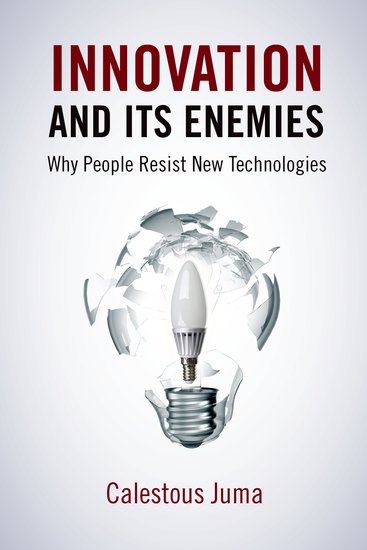
“The quickest way to find out who your enemies are is to try doing something new.” Thus begins Innovation and Its Enemies, an ambitious new book by Calestous Juma that will go down as one of the decade’s most important works on innovation policy.
Juma, who is affiliated with the Harvard Kennedy School’s Belfer Center for Science and International Affairs, has written a book that is rich in history and insights about the social and economic forces and factors that have, again and again, lead various groups and individuals to oppose technological change. Juma’s extensive research documents how “technological controversies often arise from tensions between the need to innovate and the pressure to maintain continuity, social order, and stability” (p. 5) and how this tension is “one of today’s biggest policy challenges.” (p. 8)
What Juma does better than any other technology policy scholar to date is that he identifies how these tensions develop out of deep-seated psychological biases that eventually come to affect attitudes about innovations among individuals, groups, corporations, and governments. “Public perceptions about the benefits and risks of new technologies cannot be fully understood without paying attention to intuitive aspects of human psychology,” he correctly observes. (p. 24) Continue reading →
On May 3rd, I’m excited to be participating in a discussion with Yale University bioethicist Wendell Wallach at the Microsoft Innovation & Policy Center in Washington, DC. (RSVP here.) Wallach and I will be discussing issues we write about in our new books, both of which focus on possible governance models for emerging technologies and the question of how much preemptive control society should exercise over new innovations.
Of all the books of technological criticism or skepticism that I’ve read in recent years—and I have read stacks of them!—
A Dangerous Master is by far the most thoughtful and interesting. I have grown accustomed to major works of technological criticism being caustic, angry affairs. Most of them are just dripping with dystopian dread and a sense of utter exasperation and outright disgust at the pace of modern technological change.
Although he is certainly concerned about a wide variety of modern technologies—drones, robotics, nanotech, and more—Wallach isn’t a purveyor of the politics of panic. There are some moments in the book when he resorts to some hyperbolic rhetoric, such as when he frets about an impending “techstorm” and the potential, as the book’s title suggests, for technology to become a “dangerous master” of humanity. For the most part, however, his approach is deeper and more dispassionate than what is found in the leading tracts of other modern techno-critics.
The Mercatus Center at George Mason University has just released my latest working paper, “The Internet of Things and Wearable Technology: Addressing Privacy and Security Concerns without Derailing Innovation.” The “Internet of Things” (IoT) generally refers to “smart” devices that are connected to both the Internet and other devices. Wearable technologies are IoT devices that are worn somewhere on the body and which gather data about us for various purposes. These technologies promise to usher in the next wave of Internet-enabled services and data-driven innovation. Basically, the Internet will be “baked in” to almost everything that consumers own and come into contact with.
Some critics are worried about the privacy and security implications of the Internet of Things and wearable technology, however, and are proposing regulation to address these concerns. In my new 93-page article, I explain why preemptive, top-down regulation would derail the many life-enriching innovations that could come from these new IoT technologies. Building on a recent book of mine, I argue that “permissionless innovation,” which allows new technology to flourish and develop in a relatively unabated fashion, is the superior approach to the Internet of Things.
As I note in the paper and my earlier book, if we spend all our time living in fear of the worst-case scenarios — and basing public policies on them — then best-case scenarios can never come about. As the old saying goes: nothing ventured, nothing gained. Precautionary principle-based regulation paralyzes progress and must be avoided. We instead need to find constructive, “bottom-up” solutions to the privacy and security risks accompanying these new IoT technologies instead of top-down controls that would limit the development of life-enriching IoT innovations. Continue reading →
On Thursday, it was my great pleasure to present a draft of my forthcoming paper, “The Internet of Things & Wearable Technology: Addressing Privacy & Security Concerns without Derailing Innovation,” at a conference that took place at the Federal Communications Commission on “Regulating the Evolving Broadband Ecosystem.” The 3-day event was co-sponsored by the American Enterprise Institute and the University of Nebraska College of Law.
The 65-page working paper I presented is still going through final peer review and copyediting, but I posted a very rough first draft on SSRN for conference participants. I expect the paper to be released as a Mercatus Center working paper in October and then I hope to find a home for it in a law review. I will post the final version once it is released. [UPDATE:The final version of this working paper was released on November 19, 2014.]
In the meantime, however, I thought I would post the 46 slides I presented at the conference, which offer an overview of the nature of the Internet of Things and wearable technology, the potential economic opportunities that exist in this space, and the various privacy and security challenges that could hold this technological revolution back. I also outlined some constructive solutions to those concerns. I plan to be very active on these issues in coming months.
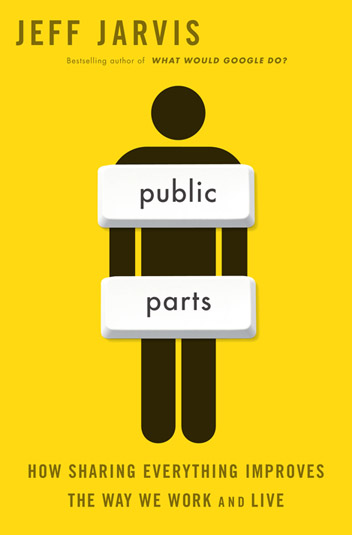
In his latest weekly Wall Street Journal column, Gordon Crovitz has penned a review of the new Jeff Jarvis book, Public Parts: How Sharing in the Digital Age Improves the Way We Work and Live. Gordon’s review closely tracks my own thoughts on the book, which I laid out last week in my Forbes essay, “Is Privacy Overrated?” Gordon’s essay is entitled “Are We Too Hung Up on Privacy” and he finds, like I do, that Jarvis makes compelling case for understanding the benefits of publicness as the flip-side of privacy. Instead of repeating all the arguments we make in our reviews here, I’ll just ask people go check out both of our essays if they are interested.
I did, however, want to elaborate on one thing I didn’t have time to discuss in my review of the Jarvis book. While I like the approach he used in the book, I thought Jarvis could have spent a bit more time exploring some the thorny legal issues in play when advocates of privacy regulation look to enshrine into law quite expansive views of privacy “rights.”
One of the things that both Crovitz and I appreciated about the Jarvis book was the way he tries to get us to think about privacy in the context of ethics instead of law. “Privacy is an ethic governing the choices made by the recipient of someone else’s information,” Jarvis argues, while “publicness is an ethic governing the choices made by the creator of one’s own information,” he says. In my review, I explained why this was so important: Continue reading →
I just finished reading through The Economist’s new 14-page special report on cloud computing, “Let It Rise” in which Ludwig Siegele provides an outstanding overview of cloud computing and why it is so important:
The rise of the cloud is more than just another platform shift that gets geeks excited. It will undoubtedly transform the information technology (IT) industry, but it will also profoundly change the way people work and companies operate. It will allow digital technology to penetrate every nook and cranny of the economy and of society, creating some tricky political problems along the way.
Even if you are very familiar with cloud computing, I recommend you take a look at the article. Anyway, while I was reading it, I was unsurprised to come across some comments from Nicholas Carr, whose new book
The Big Switch: Rewiring the World, from Edison to Google, is essentially an early history of cloud computing and an investigation into its effects on our economy, culture, and society. And that also reminded me that, even though I have mentioned Carr’s book here several times since it was released earlier this year, I have failed to give it a dedicated review. And it certain deserves one because “The Big Switch” is easily one of the most important technology policy books of 2008.
Of the titles I included in a mega-book review about Internet optimists and pessimists that I posted here a few months ago, I mentioned Lee Siegel’s new book, Against the Machine: Being Human in the Age of the Electronic Mob. It is certainly the dourest of the recent books that have adopted a pessimistic view of the impact the Internet is having on our culture, society, and economy.Because Siegel’s book is one of the most important technology policy books of 2008, however, I decided to give it a closer look here.
Siegel’s book essentially picks up where Andrew Keen’s leaves off in
Cult of the Amateur: How Today’s Internet is Killing our Culture (2007). I posted a two-part review of Keen’s book here last year [Part 1, Part 2], but here’s a quick taste of Keen’s take on things. He argues “the moral fabric of our society is being unraveled by Web 2.0” and that “our cultural standards and moral values are not all that are at stake. Gravest of all,” Keen continues, “the very traditional institutions that have helped to foster and create our news, our music, our literature, our television shows, and our movies are under assault as well.”
As I noted in my earlier “Net optimists vs. pessimists” essay, after reading
Cult of the Amateur, I didn’t think anyone else could ever be quite as over-the-top and Chicken Little-ish as Keen. But after working my way through Siegel’s Against the Machine, I realized I was wrong. It made Keen seem downright reasonable and cheery by comparison! Keen and Siegel seem to be in heated competition for the title “High Prophet of Internet Doom,” but Siegel is currently a nose ahead in that race.
Jonathan Zittrain must have been smiling as he read Leander Kahney’s excellent Wired cover story this month, “How Apple Got Everything Right By Doing Everything Wrong.” In a sense, the article vindicates Zittrain’s thesis in The Future of the Internet–And How to Stop It.
Again, in his provocative book, Zittrain argues that, for a variety of reasons, the glorious days of the generative, open Internet and general-purpose PCs are supposedly giving way to closed networks and a world of what he contemptuously calls “sterile, tethered devices.” And Apple products such as the iPhone, the iPod, and iTunes serve as prime examples of the troubling world that await us. And Kahney’s article confirms that Apple is every bit as closed and insular as Zittrain suggests. Kahney nicely contrasts Apple with Google, a company that “embraces openness,” trusts “the wisdom of crowds,” and has its famous “Don’t be evil” philosophy:
It’s ironic, then, that one of the Valley’s most successful companies ignored all of these tenets. Google and Apple may have a friendly relationship — Google CEO Eric Schmidt sits on Apple’s board, after all — but by Google’s definition, Apple is irredeemably evil, behaving more like an old-fashioned industrial titan than a different-thinking business of the future. Apple operates with a level of secrecy that makes Thomas Pynchon look like Paris Hilton. It locks consumers into a proprietary ecosystem. And as for treating employees like gods? Yeah, Apple doesn’t do that either.
The Technology Liberation Front is the tech policy blog dedicated to keeping politicians' hands off the 'net and everything else related to technology. Learn more about TLF →




 The Technology Liberation Front is the tech policy blog dedicated to keeping politicians' hands off the 'net and everything else related to technology.