I’ve been floating around in conservative policy circles for 30 years and I have spent much of that time covering media policy and child safety issues. My time in conservative circles began in 1992 with a 9-year stint at the Heritage Foundation, where I launched the organization’s policy efforts on media regulation, the Internet, and digital technology. Meanwhile, my work on child safety has spanned 4 think tanks, multiple blue ribbon child safety commissions, countless essays, dozens of filings and testimonies, and even a multi-edition book.
During this three-decade run, I’ve tried my hardest to find balanced ways of addressing some of the legitimate concerns that many conservatives have about kids, media content, and online safety issues. Raising kids is the hardest job in the world. My daughter and son are now off at college, but the last twenty years of helping them figure out how to navigate the world and all the challenges it poses was filled with difficulties. This was especially true because my daughter and son faced completely different challenges when it came to media content and online interactions. Simply put, there is no one-size-fits-all playbook when it comes to raising kids or addressing concerns about healthy media interactions. Continue reading →
A growing number of conservatives are calling for Big Government censorship of social media speech platforms. Censorship proposals are to conservatives what price controls are to radical leftists: completely outlandish, unworkable, and usually unconstitutional fantasies of controlling things that are ultimately much harder to control than they realize. And the costs of even trying to impose and enforce such extremist controls are always enormous.
Earlier this year,
The Wall Street Journal ran a response I wrote to a proposal set forth by columnist Peggy Noonan in which she proposed banning everyone under 18 from all social-media sites (“We Can Protect Children and Keep the Internet Free,” Apr. 15). I expanded upon that letter in an essay here entitled, “Should All Kids Under 18 Be Banned from Social Media?” National Review also recently published an article penned by Christine Rosen in which she also proposes to “Ban Kids from Social Media.” And just this week, Zach Whiting of the Texas Public Policy Foundation published an essay on “Why Texas Should Ban Social Media for Minors.”
I’ll offer a few more thoughts here in addition to what I’ve already said elsewhere. First, here is my response to the Rosen essay. National Review gave me 250 words to respond to her proposal:
While admitting that “law is a blunt instrument for solving complicated social problems,” Christine Rosen (“Keep Them Offline,” June 27) nonetheless downplays the radicalness of her proposal to make all teenagers criminals for accessing the primary media platforms of their generation. She wants us to believe that allowing teens to use social media is the equivalent of letting them operate a vehicle, smoke tobacco, or drink alcohol. This is false equivalence. Being on a social-media site is not the same as operating two tons of steel and glass at speed or using mind-altering substances.
Teens certainly face challenges and risks in any new media environment, but to believe that complex social pathologies did not exist before the Internet is folly. Echoing the same “lost generation” claims made by past critics who panicked over comic books and video games, Rosen asks, “Can we afford to lose another generation of children?” and suggests that only sweeping nanny-state controls can save the day. This cycle is apparently endless: Those “lost generations” grow up fine, only to claim it’s the
next generation that is doomed!
Rosen casually dismisses free-speech concerns associated with mass-media criminalization, saying that her plan “would not require censorship.” Nothing could be further from the truth. Rosen’s prohibitionist proposal would deny teens the many routine and mostly beneficial interactions they have with their peers online every day. While she belittles media literacy and other educational and empowerment-based solutions to online problems, those approaches continue to be a better response than the repressive regulatory regime she would have Big Government impose on society.
I have a few more things to say beyond these brief comments. Continue reading →
[UPDATE Feb. 2012: This little essay eventually led to an 80-page working paper, “Technopanics, Threat Inflation, and the Danger of an Information Technology Precautionary Principle.”]
In this essay, I will suggest that (1) while “moral panics” and “techno-panics” are nothing new, their cycles seem to be accelerating as new communications and information networks and platforms proliferate; (2) new panics often “crowd-out” or displace old ones; and (3) the current scare over online privacy and “tracking” is just the latest episode in this ongoing cycle.
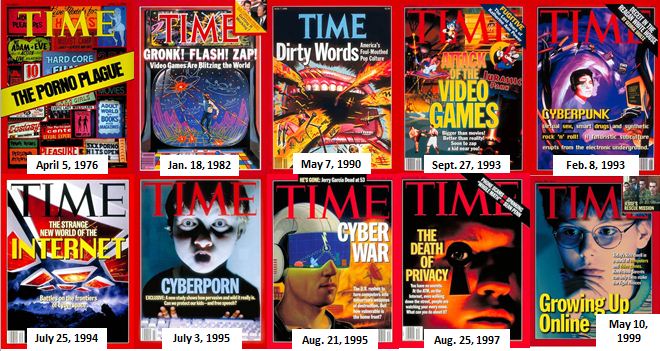
What Counts as a “Techno-Panic”?
First, let’s step back and define our terms. Christopher Ferguson, a professor at Texas A&M’s Department of Behavioral, Applied Sciences and Criminal Justice, offers the following definition: “A moral panic occurs when a segment of society believes that the behavior or moral choices of others within that society poses a significant risk to the society as a whole.” By extension, a “techno-panic” is simply a moral panic that centers around societal fears about a specific contemporary technology (or technological activity) instead of merely the content flowing over that technology or medium. In her brilliant 2008 essay on “The MySpace Moral Panic,” Alice Marwick noted: Continue reading →
What Unites Advocates of Speech Controls & Privacy Regulation? [pdf]
by Adam Thierer & Berin Szoka
The Progress & Freedom Foundation,
Progress on Point No. 16.19
Anyone who has spent time following debates about speech and privacy regulation comes to recognize the striking parallels between these two policy arenas. In this paper we will highlight the common rhetoric, proposals, and tactics that unite these regulatory movements. Moreover, we will argue that, at root, what often animates calls for regulation of both speech and privacy are two remarkably elitist beliefs:
- People are too ignorant (or simply too busy) to be trusted to make wise decisions for themselves (or their children); and/or,
- All or most people share essentially the same values or concerns and, therefore, “community standards” should trump household (or individual) standards.
While our use of the term “elitism” may unduly offend some understandably sensitive to populist demagoguery, our aim here is not to launch a broadside against elitism as
Time magazine culture critic William H. Henry once defined it: “The willingness to assert unyieldingly that one idea, contribution or attainment is better than another.”[1] Rather, our aim here is to critique that elitism which rises to the level of political condescension and legal sanction. We attack not so much the beliefs of some leaders, activists, or intellectuals that they have a better idea of what it in the public’s best interest than the public itself does, but rather the imposition of those beliefs through coercive, top-down mandates.
That sort of elitism—elitism enforced by law—is often the objective of speech and privacy regulatory advocates. Our goal is to identify the common themes that unite these regulatory movements, explain why such political elitism is unwarranted, and make it clear how it threatens individual liberty as well as the future of free and open Internet. As an alternative to this elitist vision, we advocate an empowerment agenda: fostering an environment in which users have the tools and information they need to make decisions for themselves and their families. Continue reading →
I’ve just had a new article published by the American Legislative Exchange Council (ALEC) in which I make the case against “techno-panics,” which refers to public and political crusades against the use of new media or technologies by the young. The article is entitled “Parents, Kids & Policymakers in the Digital Age: Safeguarding Against ‘Techno-Panics‘” and it appears in the July 2009 Inside ALEC newsletter. This is something I have spent a lot of time writing about here in recent years (See 1, 2, 3, 4, 5) and I finally got around to putting it altogether in a concise essay here. I have pasted the full text below. [And I just want to send a shout-out to my friend Anne Collier of Net Family News.org, whose work on this topic has been very influential on my thinking.]
“Parents, Kids & Policymakers in the Digital Age: Safeguarding Against ‘Techno-Panics‘”
by Adam Thierer
A cursory review of the history of media and communications technologies reveals a reoccurring cycle of “techno-panics” — public and political crusades against the use of new media or technologies by the young. From the waltz to rock-and-roll to rap music, from movies to comic books to video games, from radio and television to the Internet and social networking websites, every new media format or technology has spawned a fresh debate about the potential negative effects they might have on kids.
Inevitably, fueled by media sensationalism and various activist groups, these social and cultural debates quickly become political debates. Indeed, each of the media technologies or outlets mentioned above was either regulated or threatened with regulation at some point in its history. And the cycle continues today. During recent sessions of Congress, countless hearings were held and bills introduced on a wide variety of media and content-related issues. These proposals dealt with broadcast television and radio programming, cable and satellite television content, video games, the Internet, social networking sites, and much more. State policymakers, especially state Attorneys General (AGs), have also joined in such crusades on occasion. The recent push by AGs for mandatory age verification for all social networking sites is merely the latest example.
What is perhaps most ironic about these techno-panics is how quickly yesterday’s boogeyman becomes tomorrow’s accepted medium, even as the new villains replace old ones. For example, the children of the 1950s and 60s were told that Elvis’s hip shakes and the rock-and-roll revolution would make them all the tools of the devil. They grew up fine and became parents themselves, but then promptly began demonizing rap music and video games in the ‘80s and ‘90s. And now those aging Pac Man-era parents are worried sick about their kids being abducted by predators lurking on MySpace and Facebook. We shouldn’t be surprised if, a decade or two from now, today’s Internet generation will be decrying the dangers of virtual reality.
Continue reading →
In an earlier post, I mentioned an important new online child safety task force report that has just been released from the “Point Smart. Click Safe.” Blue Ribbon Working Group. It’s a great report and I encourage you to read the whole thing. It was my great pleasure to serve on this task force, and as we started finalizing our conclusions and recommendations, I started thinking about how much of what we were finding and recommending was consistent with what past online safety task forces had also concluded.
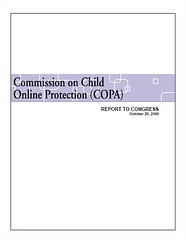
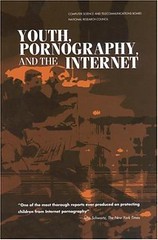
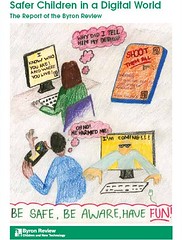
By way of background, over the past decade, five major online safety task forces or blue ribbon commissions have been convened to study online safety issues. Two of these task forces were convened in the United States and issued reports in 2000 (“COPA Commission”) and 2002 (“Thornburgh Commission“). Another was commissioned by the British government in 2007 and issued in a major report in March 2008 (“Byron Review“). Finally, two additional online safety task forces were formed in the U.S. in 2008 and concluded their work, respectively, in January (“Internet Safety Technical Task Force“) and July (“Point Smart. Click Safe.“) of 2009. [And yet another task force — the Online Safety Technology Working Group — was recently formed and has now gotten underway.]
In a new PFF white paper, ”
Five Online Safety Task Forces Agree: Education, Empowerment & Self-Regulation Are the Answer,” I walk through a chronological summary of each of these past task forces [click on covers of each report below to read them in their entirety] and highlight some of the similar themes and recommendations from them.
 Continue reading →
As anyone who has spent time searching for comments on the FCC’s website can tell you, the agency doesn’t exactly have the most user-friendly website. In the interest of making it easier for others to read the comments that came in last week in the agency’s “Child Safe Viewing Act” Notice of Inquiry, I have compiled all the major comments (those over 3 or 4 pages) and provided links to them below the fold.
Again, this proceeding was required under the “Child Safe Viewing Act of 2007,” which Congress passed last year and President Bush signed last December. The goal of the bill and the FCC’s proceeding (MB 09-26) is to study “advanced blocking technologies” that “may be appropriate across a wide variety of distribution platforms, including wired, wireless, and Internet platforms.” I filed 150+ pages worth of comments in this matter last week, and here’s my analysis of why this bill and the FCC’s proceeding are worth monitoring closely.
Continue reading →
Today I filed comments with the Federal Communications Commission (FCC) in its proceeding examining the marketplace for “advanced blocking technologies.” This proceeding was required under the “Child Safe Viewing Act of 2007,” which Congress passed last year and President Bush signed last December. The goal of the bill and the FCC’s proceeding (MB 09-26) is to study “advanced blocking technologies” that “may be appropriate across a wide variety of distribution platforms, including wired, wireless, and Internet platforms.” My colleagues will no doubt laugh about the fact that I have dropped an absurd 150 pages worth of comments on the FCC in this matter, but I had a lot to say on this topic! Parental controls, child safety, and free speech issues have been the focus of much of my research agenda over the past 10 years.
In my filing, I argue that the FCC should tread carefully in this matter since the agency has no authority over most of the media platforms and technologies described in the Commission’s recent Notice of Inquiry. Moreover, any related mandates or regulatory actions in in this area could diminish future innovation in this field and would violate the First Amendment rights of media creators and consumers alike. The other major conclusions of my filing are as follows:
- There exists an unprecedented abundance of parental control tools to help parents decide what constitutes acceptable media content in their homes and in the lives of their children.
- There is a trade-off between complexity and convenience for both tools and ratings, and no parental control tool is completely foolproof.
- Most homes have no need for parental control technologies because parents rely on other methods or there are no children in the home.
- The role of household media rules and methods is underappreciated and those rules have an important bearing on this debate.
- Parental control technologies work best in combination with educational efforts and parental involvement.
- The search for technological silver-bullets and “universal” solutions represent a quixotic, Holy Grail-like quest and it will destroy innovation in this marketplace.
- Enforcement of “household standards” made possible through use of parental controls and other methods negates the need for “community standards”-based content regulation.
My entire filing can be found here and down below in a Scribd reader. All comments in the matter are due tomorrow and then reply comments are due on May 18th.
Continue reading →
Everybody loves to blame the media for the woes of the world. Is your candidate losing? Blame the media. Is the war in Iraq not going the way you want? Blame the media. Is the economy slowing down and heading into recession? Blame the media.
Indeed, one of the entertaining things about being a media policy analyst is that you get to hear various media critics say the most outlandish things about the role of media in our society. And that’s not just the case for news; it’s even truer for culture and entertainment, of course. There’s never been a shortage of self-appointed culture cops in our society who want to tell us that they–or at least some benevolent ruling class acting on their behalf–are in the best position to dictate standards of decency and quality entertainment. And sometimes the antics of such critics are as entertaining as they are outrageous.
Take this recent press released by Concerned Women for America entitled, “Oh, Be Careful Little Eyes What You See: The Influx of Broadcast Indecency.” So desperate are they to expand the scope of government regulation over media that they’ve now resorted to equating broadcasters to murderers and thieves: “If we allow the networks to set the standards of public decency, isn’t that like allowing the criminal to decide what’s illegal?”
Seems a bit over-the-top to me, but let’s try to answer that question by answering another question CWA sets forth in their press release: “Who decides the standards by which we protect our children and ourselves from indecent broadcasts over the public airwaves?”
That is an excellent question, and one that I have devoted much of my life’s work to answering. What CWA is implying in that question is that if the government does not set “standards” to protect society from “indecent broadcasts,” then society will essentially descend into a nihilistic moral abyss. Only by empowering regulators to police “the public airwaves” can we restore and defend moral order.
This assertion is incorrect on multiple counts. I could focus on the constitutional challenges associated with defining “indecent” and “moral” content in a pluralistic society such as ours. Or I could focus on the practical considerations of regulating broadcasters uniquely in our multi-media, multi-platform world. But I would rather focus on that “Who Decides?” question set forth by CWA in their essay, because that’s what is really at the center of all these debates. And here’s the way I counter that logic in my book on “Parental Controls & Online Child Protection”:
Continue reading →

 The Technology Liberation Front is the tech policy blog dedicated to keeping politicians' hands off the 'net and everything else related to technology.