“Damn their lies and trust your eyes. Dig every kind of fox!” I here sing one for the freedom to mix it up as you and your honey alone see fit:
http://www.youtube.com/v/JTcHzGbBoe0&hl=en&fs=1
“Hapa” means “mixed race” in Hawaiian. Skin-tone mash ups have profoundly enriched my life, first with the Honolulu Hapa herself and then with our own little hapas. Honolulu Hapa celebrates coloring across the lines, knocks racism, and gives a shout-out to Loving v. Virginia, 88 U.S. 1 (1967)—the case where the U.S. Supreme Court struck down anti-miscegenation laws as unconstitutional restraints on personal liberty.
As with the prior four songs I’ve posted in this recent series (Take Up the Flame, Sensible Khakis, Nice to Be Wanted, and Hello, Jonah,), Honolulu Hapa comes with a Creative Commons license that allows pretty liberal use by all but commercial licensees, who have to pay a tithe to one of my favorite causes. Honolulu Hapa aims to help Creative Commons, an organization that helps all of us to mix—and remix—it up. Unlike those other songs, however, Honolulu Hapa adds a special ‘unrestricted use” term effective on June 12, Loving Day.
With
Honolulu Hapa, I conclude my recent series of freedom-loving music videos. Like it or not, though, I’ve got more music-making plans. Next, I’ll record some good studio versions of those (and perhaps some other) songs. Eventually, I’d like to release a fundraising CD, one that might help out some good causes. Silly? Yeah, I guess so. But it does add another data point in support of my hypothesis: Freedom has more fun.
[Crossposted at Agoraphilia and Technology Liberation Front.]
It’s been a big year for tech policy books. Several important titles were released in 2008 that offer interesting perspectives about the future of the Internet and the impact digital technologies are having on our lives, culture, and economy. Back in September, I compared some of the most popular technology policy books of the past five years and tried to group them into two camps: “Internet optimists” vs. “Internet pessimists.” That post generated a great deal of discussion and I plan on expanding it into a longer article soon. In this post, however, I will merely list what I regard as the most important technology policy books of the past year.
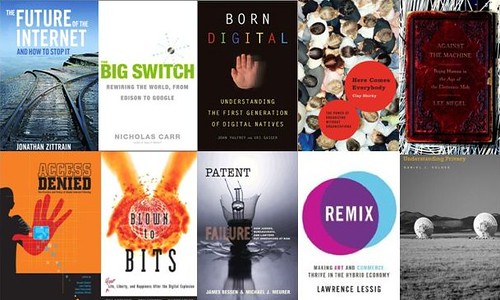
What qualifies as an “important” tech policy book? Basically, it’s a title that many people in this field are currently discussing and that we will likely be talking about for many years to come. I want to make it clear, however, that merely because a book appears on this list it does not necessarily mean I agree with everything said in it. In fact, I found much with which to disagree in my picks for the two most important books of 2008, as well as many of the other books on the list. [Moreover, after reading all these books, I am more convinced than ever that libertarians are badly losing the intellectual battle of ideas over Internet issues and digital technology policy. There’s just very few people defending a “Hands-Off-the-Net” approach anymore. But that’s a subject for another day!]
Another caveat: Narrowly focused titles lose a few points on my list. For example, as was the case in past years, a number of important IP-related books have come out this year. If a book deals exclusively with copyright or patent issues, it does not exactly qualify as the same sort of “tech policy book” as other titles found on this list since it is a narrow exploration of just one set of issues that have a bearing on digital technology policy. The same could be said of a book that deals exclusively with privacy policy, like Solove’s
Understanding Privacy. It’s an important book with implications for the future of tech policy, but I demoted it a bit because of its narrow focus.
With those caveats in mind, here are my Top 10 Most Important Tech Policy Books of 2008 (and please let me know about your picks for book of the year):
Continue reading →
 I’m finishing up Stanford Law School professor Lawrence Lessig’s latest book, Remix: Making Art and Commerce Thrive in the Hybrid Economy and wanted to make a brief comment about his call for a “simple blanket license” to solve online music piracy.
Overall, I thought Prof. Lessig made a good case regarding the benefits of “remix culture” and why copyright law should leave breathing room for the various derivative works of amateur creators. On the other hand, Lessig still too often blurs remix culture with “ripoff culture” (i.e., those who aren’t out to create anything new but instead just take something without paying a penny for it).
To solve that latter problem, Lessig again endorses a proposal that William Fisher, Electronic Frontier Foundation, and others have made for collective licensing of all online music, but he fails to drill down into the devilish details. He says, for example, that “by authorizing a simple blanket licensing procedure, whereby users could, for a low fee, buy the right to freely file-share” we could “decriminalize file sharing.” (p. 271)
I respect the fact that Lessig is at least acknowledging a problem exists and proposing a solution to it, but the collective licensing approach will be anything but “simple” in practice. As I have pointed out here before, collective licensing proposals and efforts almost always become compulsory in practice. They inevitably involve government mandates to determine (1) who pays in, (2) how much they pay in, as well as (3) how much gets paid out and, (4) who gets the money.
Continue reading →

 The Technology Liberation Front is the tech policy blog dedicated to keeping politicians' hands off the 'net and everything else related to technology.