[This article originally appeared at Discourse on January 6, 2021.]
Time magazine recently declared 2020 “The Worst Year Ever.” By historical standards that may be a bit of hyperbole. For America’s digital technology sector, however, that headline rings true. After a remarkable 25-year run that saw an explosion of innovation and the rapid ascent of a group of U.S. companies that became household names across the globe, politicians and pundits in 2020 declared the party over.
“We now are on the cusp of a new era of tech policy, one in which the policy catches up with the technology,” says Darrell M. West of the Brookings Institution in a recent essay, “The End of Permissionless Innovation.” West cites the House Judiciary Antitrust Subcommittee’s October report on competition in digital markets—where it equates large tech firms with the “oil barons and railroad tycoons” of the Gilded Age—as the clearest sign that politicization of the internet and digital technology is accelerating.
It is hardly the only indication that America is set to abandon permissionless innovation and revisit the era of heavy-handed regulation for information and communication technology (ICT) markets. Equally significant is the growing bipartisan crusade against Section 230, the provision of the 1996 Telecommunications Act that shields “interactive computer services” from liability for information posted or published on their systems by users. No single policy has been more important to the flourishing of online speech or commerce than Sec. 230 because, without it, online platforms would be overwhelmed by regulation and lawsuits.
But now, long knives are coming out for the law, with plenty of politicians and academics calling for it to be gutted. Calls to reform or repeal Sec. 230 were once exclusively the province of left-leaning academics or policymakers, but this year it was conservatives in the White House, on Capitol Hill and at the Federal Communications Commission (FCC) who became the leading cheerleaders for scaling back or eliminating the law. President Trump railed against Sec. 230 repeatedly on Twitter, and most recently vetoed the annual National Defense Authorization Act in part because Congress did not include a repeal of the law in the measure.
Meanwhile, conservative lawmakers in Congress such as Sens. Josh Hawley and Ted Cruz have used subpoenas, angry letters and heated hearings to hammer digital tech executives about their content moderation practices. Allegations of anti-conservative bias have motivated many of these efforts. Even Supreme Court Justice Clarence Thomas questioned the law in a recent opinion.
Other proposed regulatory interventions include calls for new national privacy laws, an “Algorithmic Accountability Act” to regulate artificial intelligence technologies, and a growing variety of industrial policy measures that would open the door to widespread meddling with various tech sectors. Some officials in the Trump administration even pushed for a nationalized 5G communications network in the name of competing with China.
This growing “techlash” signals a bipartisan “Back to the Future” moment, with the possibility of the U.S. reviving a regulatory playbook that many believed had been discarded in history’s dustbin. Although plenty of politicians and pundits are taking victory laps and giving each other high-fives over the impending end of the permissionless innovation era, it is worth considering what America will be losing if we once again apply old top-down, permission slip-oriented policies to the technology sector. Continue reading →
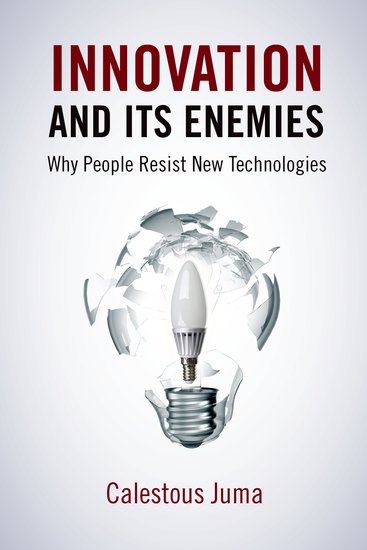
“The quickest way to find out who your enemies are is to try doing something new.” Thus begins Innovation and Its Enemies, an ambitious new book by Calestous Juma that will go down as one of the decade’s most important works on innovation policy.
Juma, who is affiliated with the Harvard Kennedy School’s Belfer Center for Science and International Affairs, has written a book that is rich in history and insights about the social and economic forces and factors that have, again and again, lead various groups and individuals to oppose technological change. Juma’s extensive research documents how “technological controversies often arise from tensions between the need to innovate and the pressure to maintain continuity, social order, and stability” (p. 5) and how this tension is “one of today’s biggest policy challenges.” (p. 8)
What Juma does better than any other technology policy scholar to date is that he identifies how these tensions develop out of deep-seated psychological biases that eventually come to affect attitudes about innovations among individuals, groups, corporations, and governments. “Public perceptions about the benefits and risks of new technologies cannot be fully understood without paying attention to intuitive aspects of human psychology,” he correctly observes. (p. 24) Continue reading →
Along with colleagues at the Mercatus Center at George Mason University, I am releasing two major new reports today dealing with the regulation of the sharing economy. The first report is a 20-page filing to the Federal Trade Commissionthat we are submitting to the agency for its upcoming June 9th workshop on “The “Sharing” Economy: Issues Facing Platforms, Participants, and Regulators.” We have been invited to participate in that event and I will be speaking on the fourth panel of the workshop. The filing I am submitting today for that workshop was co-authored with my Mercatus colleagues Christopher Koopman and Matt Mitchell.
Regular readers know that I can get a little feisty when it comes to the topic of “regulatory capture,” which occurs when special interests co-opt policymakers or political bodies (regulatory agencies, in particular) to further their own ends. As I noted in my big compendium, “Regulatory Capture: What the Experts Have Found“:
While capture theory cannot explain all regulatory policies or developments, it does provide an explanation for the actions of political actors with dismaying regularity. Because regulatory capture theory conflicts mightily with romanticized notions of “independent” regulatory agencies or “scientific” bureaucracy, it often evokes a visceral reaction and a fair bit of denialism.
Indeed, the more I highlight the problem of regulatory capture and offer concrete examples of it in practice, the more push-back I get from true believers in the idea of “independent” agencies. Even if I can get them to admit that history offers countless examples of capture in action, and that a huge number of scholars of all persuasions have documented this problem, they will continue to persist that, WE CAN DO BETTER! and that it is just a matter of having THE RIGHT PEOPLE! who will TRY HARDER!
Well, maybe. But I am a realist and a believer in historical evidence. And the evidence shows, again and again, that when Congress (a) delegates broad, ambiguous authority to regulatory agencies, (b) exercises very limited oversight over that agency, and then, worse yet, (c) allows that agency’s budget to grow without any meaningful constraint, then the situation is ripe for abuse. Specifically, where unchecked power exists, interests will look to exploit it for their own ends.
In any event, all I can do is to continue to document the problem of regulatory capture in action and try to bring it to the attention of pundits and policymakers in the hope that we can start the push for
real agency oversight and reform. Today’s case in point comes from a field I have been covering here a lot over the past year: commercial drone innovation. Continue reading →
In the wake of last week’s big SOPA showdown, a lot of people are talking about the expanded presence and power of the Internet, online operators, and digital Netizens in Washington policy debates. I certainly don’t mean to diminish the importance of this particular episode. It certainly is historic, regardless of how you feel about the specifics of SOPA. What does concern me, however, is the way this episode is prompting questions about how much more “engagement” Internet companies need to consider inside the Beltway. For example, today’s Wall Street Journal features an article on “The Web’s Growing Muscle” and notes:
The Internet industry has found a rare sweet spot in Washington. With Google in the lead, the companies have begun building a strong traditional lobbying force in Washington. And, to complement that inside game, websites’ millions of users have become a powerful outside weight on Congress. What’s more, in a rare Washington double play, the concerns of Internet companies have found a sympathetic ear both in the Democratic White House and among Republican presidential candidates who otherwise can’t agree with Barack Obama on anything.
The piece concludes with a quote from an anonymous media executive saying “People are looking at what Google spent on lobbying and wondering, ‘Can we match that?’ It has to be a big spend.”
I cannot possibly think of anything more demoralizing than that. Continue reading →
This week, my colleague Jerry Brito asked me to guest lecture to his George Mason University law school class on regulatory process. He asked me to talk about one of my favorite topics: the sad, sordid history of regulatory capture. Regular readers will recall the compendium I posted here a few months ago [and that I continue to update] of selected passages from books and papers penned by various economists and political scientists who have studied this issue.
Again, it doesn’t make for pretty reading, but the lesson that history teaches is vital: No matter how noble the “public interest” goals of regulatory advocates or their specific proposals, the only thing that really counts is what regulation means in practice. Regrettably, all too often, regulation is “captured” by various interests and used to their advantage, or at least to the
disadvantage of potential competitors, new entrants, and innovation.
While I was gathering some materials for the case study portion of my lecture — which incorporates the history of telecommunications monopolization, broadcast industry regulatory shenanigans, and transportation / airlines fiascos — I figured I had to post a passage from one of my favorite books on regulation of all-time: Thomas K. McCraw’s brilliant Pulitzer Prize-winning 1984 book, Prophets of Regulation. In his chapter on the late great Alfred Kahn, the father of airline deregulation, McCraw recounts the history of the Civil Aeronautics Board (CAB) from its creation in the 1940s up until the time of Kahn’s ascendency to CAB chairman in the Carter Administration (and then the CAB’s eventual deregulation and abolition). Here’s the key passage from that history: Continue reading →
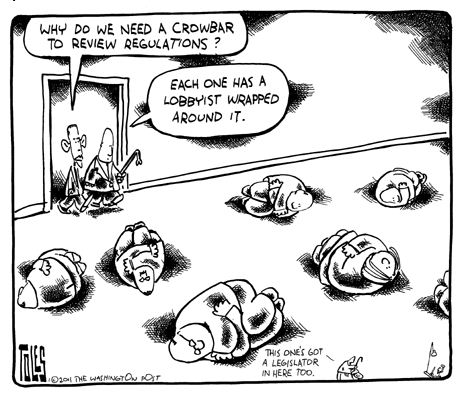
Washington Post cartoonist Tom Toles is certainly no fan of free markets, but his contribution to today’s paper offers us this humorous take on the dangers of regulatory capture, a subject we’ve spent much time documenting here on the TLF.
[Note: This post is updated regularly as I discover relevant old or new material.]
“Regulatory capture” occurs when special interests co-opt policymakers or political bodies — regulatory agencies, in particular — to further their own ends. Capture theory is closely related to the “rent-seeking” and “political failure” theories developed by the public choice school of economics. Another term for regulatory capture is “client politics,” which according to James Q. Wilson, “occurs when most or all of the benefits of a program go to some single, reasonably small interest (and industry, profession, or locality) but most or all of the costs will be borne by a large number of people (for example, all taxpayers).” (James Q. Wilson,
Bureaucracy, 1989, at 76).
While capture theory cannot explain all regulatory policies or developments, it does provide an explanation for the actions of political actors with dismaying regularity. Because regulatory capture theory conflicts mightily with romanticized notions of “independent” regulatory agencies or “scientific” bureaucracy, it often evokes a visceral reaction and a fair bit of denialism. (See, for example, the reaction of New Republic’s Jonathan Chait to Will Wilkinson’s recent Economist column about the prevalence of corporatism in our modern political system.) Yet, countless studies have shown that regulatory capture has been at work in various arenas: transportation and telecommunications; energy and environmental policy; farming and financial services; and many others.
I thought it might be useful to build a compendium of quotes from various economists and political scientists who have studied the regulatory process throughout history and identified regulatory capture or client politics as a major problem. I would greatly appreciate having others suggest additional quotes and studies to add to this list since I plan to update it frequently and eventually work all of this into a future paper or book. [
Note: I have updated this compendium over a dozen times since the original post, so please check back for updates.]
The following list is chronological and begins, surprisingly, with the thoughts of progressive hero Woodrow Wilson…
I’m going to close out my series of essays about Tim Wu’s new book, The Master Switch: The Rise and Fall of Information Empires, by discussing his proposed solutions. In the first five essays in the series, [1, 2, 3, 4, 5] I’ve critiqued Wu’s look at information history as well as his use of terms like “market failure,” “laissez-faire” and “open” vs. “closed.” I argued there’s a great deal of over-simplification, even outright distortion, in his use of those terms throughout the book.
Anyway, let’s run through the basics of the book once more before getting to Wu’s proposed solutions. By my reading of
The Master Switch, Wu’s argumentessentially goes something like this:
Information industries go through cycles. After a period of “openness” and competition, they tend to drift toward “closed,” corporate-controlled, anti-consumer models and outcomes.
The resulting “monopolists” then block much innovation, competition, and free speech.
Consequently, “the purely economic laissez-faire approach… is no longer feasible.”
Moreover, information industries are more important than all others (“information industries… can never be properly understood as ‘normal’ industries”) and even traditional forms of regulation, including antitrust, “are clearly inadequate for the regulation of information industries.” (p. 303).
Thus, special rules should apply to information-related sectors of our economy.
Again, I’ve challenged some of these assertions in my previous essays, specifically, Wu’s incomplete history of cycles and the fact that he greatly underplays the role of governments in “locking-in” sub-optimal market structures or, worse yet, creating those structures through misguided public policies or regulatory capture. Wu discusses some of those factors in his book, but he tends to regard them as secondary to the inquiry, whereas I believe they are crucial to understanding how most “closed” or anti-competitive scenarios develop or endure. Instead, Wu simplistically suggests that “the purely economic laissez-faire approach… is no longer feasible,” even though no such state of affairs has ever existed within communications or media industries. They have been subjected to varying levels of indirect influence or direct control almost since their inception.
Regardless, what does Tim Wu want done about the problems he has (mis-)diagnosed? Continue reading →
The Technology Liberation Front is the tech policy blog dedicated to keeping politicians' hands off the 'net and everything else related to technology. Learn more about TLF →


 The Technology Liberation Front is the tech policy blog dedicated to keeping politicians' hands off the 'net and everything else related to technology.