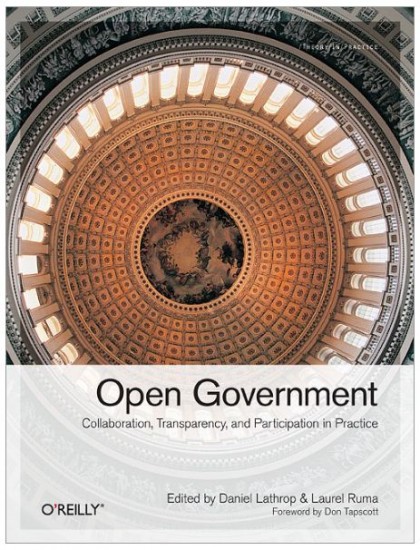
 Those of you interested in transparency and “Government 2.0” issues will absolutely want to pick up Open Government: Collaboration, Transparency, and Participation in Practice, a terrific collection of 34 essays edited by Daniel Lathrop and Laurel Ruma. Much like Access Controlled, the collection of essays on global Internet filtering and censorship that I praised here last month, Open Government is a resource like no other in its field. It offers an amazing diversity of viewpoints covering virtual every aspect of the debate over transparency and open government.
The collection was published by O’Reilly Media and Tim O’Reilly himself has one of the best chapters in the book on “Government as a Platform.” “The magic of open data is that the same openness that enables transparency also enables innovation, as developers build applications that reuse government data in unexpected ways.” (p. 25) This explains why in their chapter on “Enabling Innovation for Civic Engagement,” David G. Robinson, Harlan Yu, and Edward W. Felten, of the Center for Information Technology Policy at Princeton University, speak of “a new baseline assumption about the public response to government data: when government puts data online, someone, somewhere will do something valuable and innovative with it.” (p.84) “By publishing its data in a form that is free, open, and reusable,” they continue, “government will empower citizens to dream up and implement their own innovative ideas of how to best connect with their governments.” (p. 89)
Indeed, just think about some of the many exciting sites and projects (both public and private) that have been developed thanks to government data becoming more accessible in recent years. Here’s a short list of some of the best: Continue reading →
First, Jim Harper would kill me if I didn’t begin this post by mentioning that I’ll be speaking at a Cato Institute lunch panel entitled, “Just Give Us the Data! Prospects for Putting Government Information to Revolutionary New Uses,” on Wednesday, Dec. 10, along with Ed Felten of Princeton and Gary Bass of OMB Watch. RSVP here. That said, I want to talk about CTOs.
A while back I engaged in a debate about whether Barack Obama’s promise to appoint a national chief technology office should be feared. I think the question turns on whether this person will be CTO of the United States or CTO of the U.S. Federal Government. While I personally believe the former should be feared, the latter should be welcomed.
The good news is that in all of Obama’s pronouncement’s on the matter the position has always been described as having a brief to open the government by employing online tools. Here’s how the position is described in Obama’s campaign position paper on technology:
Bring Government into the 21st Century: Barack Obama and Joe Biden will use technology to reform government and improve the exchange of information between the federal government and citizens while ensuring the security of our networks. Obama and Biden believe in the American people and in their intelligence, expertise, and ability and willingness to give and to give back to make government work better. Obama will appoint the nation’s first Chief Technology Officer (CTO) to ensure that our government and all its agencies have the right infrastructure, policies and services for the 21st century. The CTO will ensure the safety of our networks and will lead an interagency effort, working with chief technology and chief information officers of each of the federal agencies, to ensure that they use best-in-class technologies and share best practices.
To me this sounds more like a Chief Transparency Officer, and that’s a good thing. Most federal government websites are terrible relative to the state of the art. Any effort to make them as useful or informative as the barackobama.com website should be welcomed. We can see the beginning of this transformation at the new change.gov site for the Obama transition team.
Continue reading →
 Those of you interested in transparency and “Government 2.0” issues will absolutely want to pick up Open Government: Collaboration, Transparency, and Participation in Practice, a terrific collection of 34 essays edited by Daniel Lathrop and Laurel Ruma. Much like Access Controlled, the collection of essays on global Internet filtering and censorship that I praised here last month, Open Government is a resource like no other in its field. It offers an amazing diversity of viewpoints covering virtual every aspect of the debate over transparency and open government.
 The Technology Liberation Front is the tech policy blog dedicated to keeping politicians' hands off the 'net and everything else related to technology.