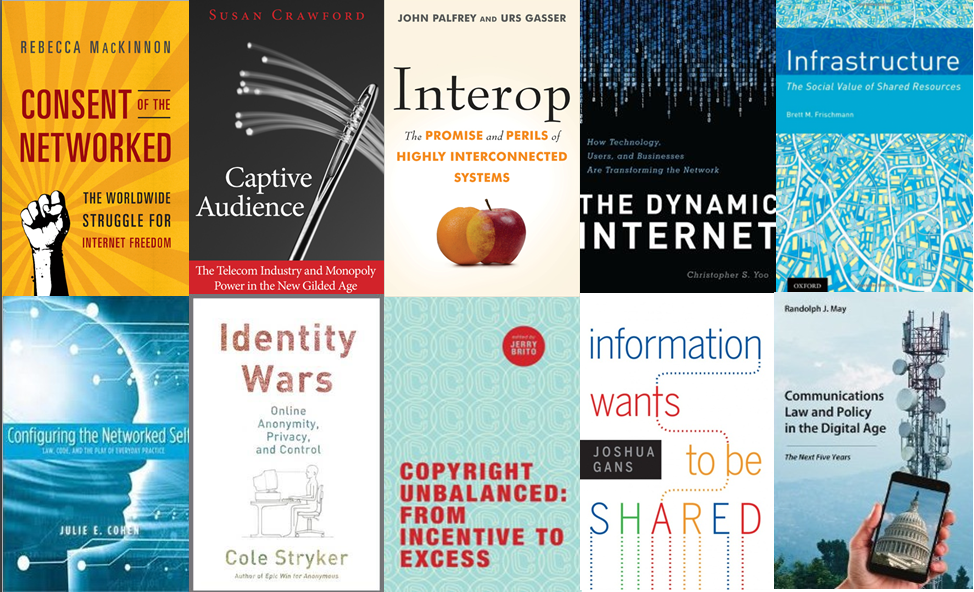
The number of major cyberlaw and information tech policy books being published annually continues to grow at an astonishing pace, so much so that I have lost the ability to read and review all of them. In past years, I put together end-of-year lists of important info-tech policy books (here are the lists for 2008, 2009, 2010, and 2011) and I was fairly confident I had read just about everything of importance that was out there (at least that was available in the U.S.). But last year that became a real struggle for me and this year it became an impossibility. A decade ago, there was merely a trickle of Internet policy books coming out each year. Then the trickle turned into a steady stream. Now it has turned into a flood. Thus, I’ve had to become far more selective about what is on my reading list. (This is also because the volume of journal articles about info-tech policy matters has increased exponentially at the same time.)
So, here’s what I’m going to do. I’m going to discuss what I regard to be the five most important titles of 2012, briefly summarize a half dozen others that I’ve read, and then I’m just going to list the rest of the books out there. I’ve read most of them but I have placed an asterisk next to the ones I haven’t. Please let me know what titles I have missed so that I can add them to the list. (Incidentally, here’s my compendium of all the major tech policy books from the 2000s and here’s the running list of all my book reviews.)
Continue reading →
I’m not one of those libertarians who incessantly rants about the supposed evils of National Public Radio (NPR) and the Public Broadcast Service (PBS). In fact, I find quite a bit to like in the programming I consume on both services, NPR in particular. A few years back I realized that I was listening to about 45 minutes to an hour of programming on my local NPR affiliate (WAMU) each morning and afternoon, and so I decided to donate $10 per month. Doesn’t sound like much, but at $120 bucks per year, that’s more than I spend on any other single news media product with the exception of The Wall Street Journal. So, when there’s value in a media product, I’ll pay for it, and I find great value in NPR’s “long-form” broadcast journalism, despite its occasional political slant on some issues.
In many ways, the Corporation for Public Broadcasting, which supports NPR and PBS, has the perfect business model for the age of information abundance. Philanthropic models — which rely on support for foundational benefactors, corporate underwriters, individual donors, and even government subsidy — can help diversify the funding base at a time when traditional media business models — advertising support, subscriptions, and direct sales — are being strained. This is why many private media operations are struggling today; they’re experiencing the ravages of gut-wrenching marketplace / technological changes and searching for new business models to sustain their operations. By contrast, CPB, NPR, and PBS are better positioned to weather this storm since they do not rely on those same commercial models.
Nonetheless, NPR and PBS and the supporters of increased “pubic media” continue to claim that they are in peril and that increased support — especially public subsidy — is essential to their survival. For example, consider an editorial in today’s
Washington Post making “The Argument for Funding Public Media,” which was penned by Laura R. Walker, the president and chief executive of New York Public Radio, and Jaclyn Sallee, the president and chief executive of Officer Kohanic Broadcast Corp. in Anchorage. They argue: Continue reading →
A group of regulatory advocates that includes Free Press, Media Access Project and the New America Foundation, have fired off a letter to the Federal Communications Commission (FCC) requesting action against the nation’s #5 mobile provider, MetroPCS. These regulatory groups claim that “new service plans being offered by mobile provider MetroPCS block and discriminate against Internet content, applications and websites.” Wired’s Ryan Singel summarizes what the fight is about:
At issue are new, tiered 4G data plans from the nation’s fifth largest mobile carrier, which specializes in pay-as-you-go mobile-phone service. The new plans offer “unlimited web usage” for all three tiers, which cost $40, $50 and $60 a month. But MetroPCS’s terms exclude video sites other than YouTube from “unlimited web usage,” and block the use of internet-telephony services such as Skype and Tango. The terms of service also make it very unclear whether users would be allowed to use online-radio services such as Pandora.
The parties petitioning the FCC for regulatory intervention claim that “MetroPCS appears to be in violation of the Commission’s recently adopted open Internet rules” even though they note that “these rules have not yet taken effect.”
There are four things I find interesting about this hullabaloo: Continue reading →
Holman Jenkins has a stinging editorial in today’s Wall Street Journal entitled, “Neutering the ‘Net,” which borrows a term that my friend Randy May coined long ago to describe what net neutrality regulation will ultimately accomplish. What I like best about the Jenkins essay was the way he exposed Free Press for their hypocrisy over metering as a possible alternative approach to network management, something I documented in this piece and this piece about their new-found love of Internet price controls. Here’s how Jenkins puts it in his essay today:
The mask really slipped earlier this year when Time Warner Cable began experimenting with usage-based pricing to protect the average broadband customers from the 20% of users who create 80% of the traffic. A lobby called Free Press, the most extreme of the pro-net neutrality interests, went ballistic, calling metered pricing a “price-gouging scheme” and backing a bill in Congress to ban it.
Never mind that Free Press had previously argued just the opposite, saying usage-based pricing was a fairer way to deal with congestion than, say, by selectively slowing down file-sharing sites that gobble up disproportionate broadband capacity. Never mind, too, the irony that the net-neut campaign against the selective slowing of non-urgent traffic has left only differential pricing as a way to bring a modicum of efficiency to network usage.
Indeed. Of course, we should expect nothing less from the neo-Marxist media reformistas as the UnFree Press.
In a past life — that is, from roughly 1994-2004 — I spent an enormous amount of time countering the proponents of “open access” regulation for communications and high-tech networks. My work in that field culminated in the publication of a 2003 book with my old Cato colleague Wayne Crews entitled, What’s Yours is Mine: Open Access & the Rise of Infrastructure Socialism. We aimed to counter the efforts of bureaucrats and central planners to command technology companies and industry sectors to share networks, facilities, or specific technologies with rivals in the name of “competition.” Simply stated, sharing is not competing, and
competition in the creation of networks is just as important as competition in the goods, services, and information that move across those networks. Moreover, there are property right considerations that come into play when governments seek to commandeer networks or take over network management decisions.
But let’s just stick to the economic issue here regarding the incentives created by the network-sharing mentality of the “forced access” movement and the fiction associated with the belief that network sharing can create competition. My old PFF colleague Randy May, who currently serves as President of the Free State Foundation, continues to cover developments in this field far closer than I do, and has always done much better work on the subject than me. Recently, Randy addressed some new fictions put forth by the radical Leftist activity group, the (Un-)Free Press who are, once again, spinning a revisionist history of telecom and media policy. Specifically, Free Press has recently suggested that in the late 1990s we lived in a veritable communications nirvana, with thousands of Internet Service Providers and/or “competitive exchange carriers” hotly “competing” for our business. Here’s how Randy May addresses this:
Continue reading →
I’ve been blathering on about this week’s big Supreme Court decision in FCC v. Fox, [See Parts 1, 2, 3, 4, 5], so I thought I would just wrap this series of essays up with a collection of other articles and views on the decision in case readers are looking for alternative perspectives:
Mainstream Media Stories
Conservative, Religious, & “Family” Groups
Free Speech Advocates or Other Views

 The Technology Liberation Front is the tech policy blog dedicated to keeping politicians' hands off the 'net and everything else related to technology.